|

WTI Crude Oil: Geopolitical pressure and wave three momentum

Fueling the bullish fire

Oil markets have surged recently, driven largely by escalating tensions between Israel and Iran. With direct military action and threats to key infrastructure, the risk premium has returned in full force:

  • Strait of Hormuz threat: Iran has hinted at disrupting this vital oil route.
  • Israeli strikes on Iranian energy/nuclear assets raised fears of wider conflict.
  • Global oil flow concerns: A potential squeeze in supply is keeping traders on edge.
  • Market reaction: WTI surged past $72 on fear-driven buying and safe-haven flows.

While physical supply hasn't yet been disrupted in a major way, the possibility alone is enough to keep bulls in control—for now.

Elliott Wave points to a wave ((iv)) pause
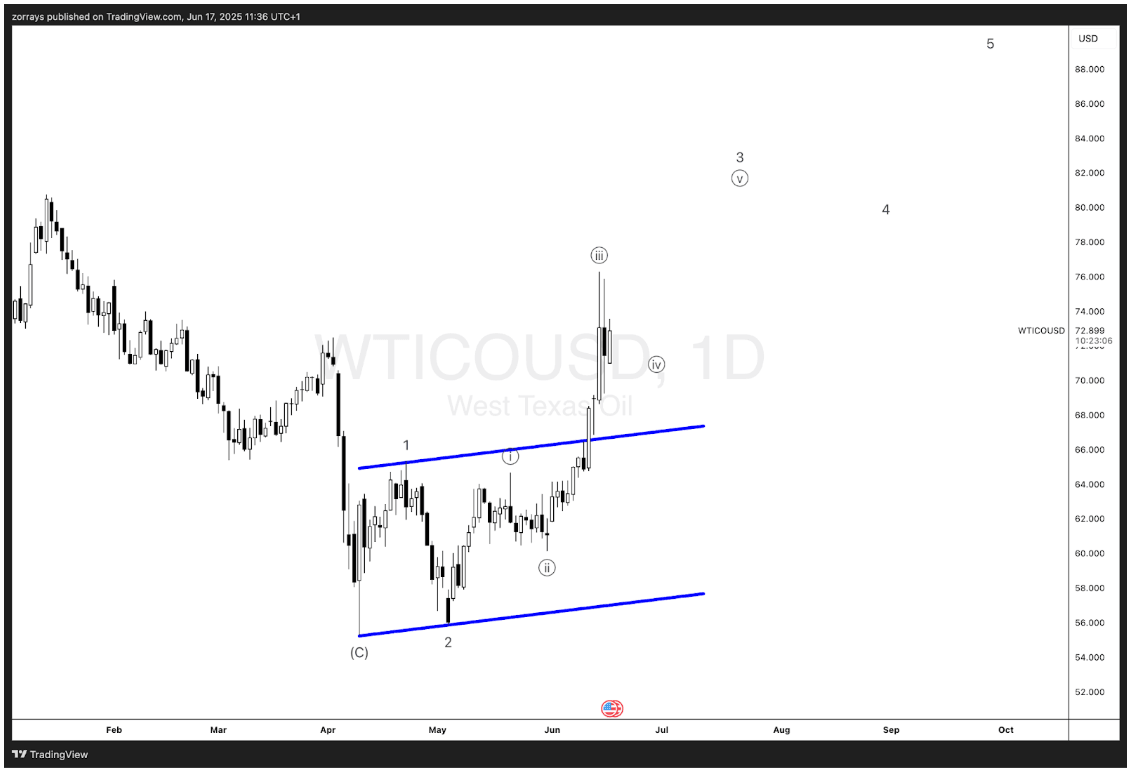
We're tracking a clean impulsive structure in WTIUSD. Price has broken out of its channel and looks to be in the middle of a larger wave 3. However, there are signs we might be stalling inside wave ((iv)) of 3 before one more leg up.

Here’s how it’s shaping up:

  • Price impulsed out of the blue channel, clearly entering wave (iii) of 3.
  • Now we’re seeing a potential pause or consolidation, suggesting we’re in wave ((iv)).
  • The correction could take the form of a triangle or flat, both common in this position.
  • Once complete, we expect wave ((v)) of 3 to push toward new highs—possibly into the $78–$82 area.

This aligns well with the geopolitical risk premium we're seeing in oil markets. When technicals and fundamentals align like this, bulls tend to stay in charge—at least until wave 3 exhausts.

Author

Zorrays Junaid

Zorrays Junaid

Alchemy Markets

Zorrays Junaid has extensive combined experience in the financial markets as a portfolio manager and trading coach. More recently, he is an Analyst with Alchemy Markets, and has contributed to DailyFX and Elliott Wave Forecast in the past.


More from Zorrays Junaid
Share:

Editor's Picks

EUR/USD onsolidates around mid-1.1800s as traders keenly await FOMC Minutes

The EUR/USD pair struggles to capitalize on the previous day's goodish rebound from the 1.1800 neighborhood, or a one-and-a-half-week low, and consolidates in a narrow band during the Asian session on Wednesday. Spot prices currently trade just below mid-1.1800s, nearly unchanged for the day.

GBP/USD bounces off lows, retargets 1.3550

After bottoming out just below the 1.3500 yardstick, GBP/USD now gathers some fresh bids and advances to the 1.3530-1.3540 band in the latter part of Tuesday’s session. Cable’s recovery comes as the Greenback surrenders part of its advance, although it keeps the bullish bias well in place for the day.

Gold bounces back toward $4,900, looks to FOMC Minutes

Gold is attempting a bounce from the $4,850 level, having touched a one-week low on Tuesday. Signs of progress in US–Iran talks dented demand for the traditional safe-haven bullion, weighing on Gold in early trades. However, rising bets for more Fed rate cuts keep the US Dollar bulls on the defensive and act as a tailwind for the non-yielding yellow metal. Traders now seem reluctant ahead of the FOMC Minutes, which would offer cues about the Fed's rate-cut path and provide some meaningful impetus.

DeFi could lift crypto market from current bear phase: Bitwise

Bitwise Chief Investment Officer Matt Hougan hinted that the decentralized finance sector could lead the crypto market out of the current bear phase, citing Aave Labs’ latest community proposal as a potential signal of good things to come.

UK jobs market weakens, bolstering rate cut hopes

In the UK, the latest jobs report made for difficult reading. Nonetheless, this represents yet another reminder for the Bank of England that they need to act swiftly given the collapse in inflation expected over the coming months. 

Ripple slides to $1.45 as downside risks surge

Ripple edges lower at the time of writing on Tuesday, from the daily open of $1.48, as headwinds persist across the crypto market. A short-term support is emerging at $1.45, but a buildup of bearish positions could further weaken the derivatives market and prolong the correction.