Will the RBNZ follow the RBA?


At its July meeting, the Reserve Bank of New Zealand (RBNZ) opted to keep the Official Cash Rate (OCR) unchanged, citing an “elevated level of uncertainty” and the importance of waiting for clearer signals. Policymakers argued that holding steady until August would allow them to better assess whether domestic weakness is entrenched, how inflation and expectations are evolving, and what global developments could mean for the local economy.
But now markets are now laser-focused on the August decision, with consensus expectations tilted toward a 25-basis-point reduction that would bring the OCR to 3%. Such a move would mirror the Reserve Bank of Australia, which delivered its third cut this year on August 12, lowering its cash rate to 3.60% as it sought to support a fragile recovery while keeping inflation in check.
The question for traders and investors is whether the RBNZ will follow suit, and if so, what the implications will be for the New Zealand dollar, bond markets, and broader risk sentiment. Beyond the headline rate call, the key lies in how the central bank frames inflation risks, growth prospects, and global spillovers.
Inflation’s near-term spike vs. long-term ease
Annual CPI rose 2.7% in the June 2025 quarter, following a 2.5% increase in March, keeping inflation inside the central bank’s 1–3% target range for a fourth consecutive quarter. However, the near-term trajectory is tilted higher. Food price pressures and elevated administered costs are expected to push inflation close to the top of the band through Q2 and Q3.
The RBNZ has acknowledged that these drivers are temporary, tied largely to volatile food prices and government-regulated costs. Core inflation continues to trend lower, and with significant spare capacity in the economy, headline inflation is projected to gradually decline. The central bank expects inflation to fall back toward the midpoint of its target band by early 2026, as domestic demand remains subdued and price-setting behaviour normalises.
Against this backdrop, policymakers have reiterated that if medium-term inflation pressures ease as anticipated, further cuts to the Official Cash Rate are on the table. In other words, while the short-term outlook remains challenging, the medium-term path still supports a gradual loosening of monetary policy.
Increased global trade tensions and slow domestic recovery
New Zealand’s economic recovery has shown uneven progress. On one hand, weaker high-frequency indicators point to softening activity, suggesting households and firms may still be acting with caution amid persistent uncertainty. This could dampen aggregate demand and delay recovery momentum. On the other, household consumption and business investment have shown tentative signs of resilience, with investment intentions rising in recent surveys.
The RBNZ remains alert to the risks on both sides: prolonged weakness could entrench a slow-growth trajectory, while sticky administered prices and near-term inflation spikes risk fuelling more persistent wage and price-setting behaviour.
The international environment is also complicating things for the RBNZ. Global growth is expected to weaken in the second half of 2025, weighed down by protectionist policies and trade frictions. However, fiscal expansion in major economies—the euro area, the U.S., and China—could partially offset the drag.
For New Zealand, the inflationary impact of tariffs is uncertain. While U.S. tariffs are likely to stoke price pressures domestically there, inflation forecasts for China and emerging Asia have been revised lower, supported by currency appreciation. These cross-currents mean the net effect for New Zealand could range from mild inflationary pressure to outright disinflation, depending on how trade flows adjust.
Meanwhile, financial markets are contending with higher long-term bond yields, driven by rising term premia in the U.S. and spillovers into other advanced economies. The U.S. dollar has weakened as investor sentiment shifts, further adding to volatility. Geopolitical risks—particularly conflicts in Ukraine and the Middle East—have also heightened uncertainty around global energy prices, with the potential for renewed oil price spikes.
NZD/USD weekly technical outlook
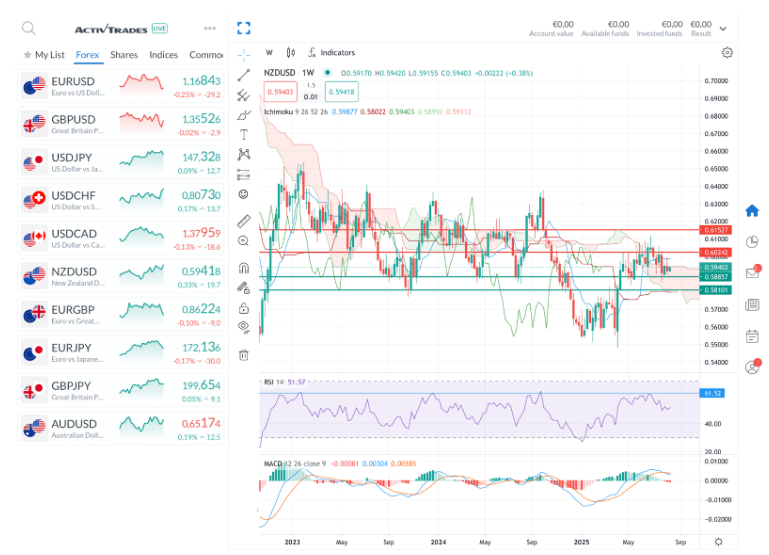
On the weekly chart, NZD/USD has been moving inside the red Ichimoku cloud for about a month, a clear sign of consolidation and market indecision. When price trades within the cloud, it usually reflects a phase of neutral equilibrium, where neither bulls nor bears hold the upper hand. This is precisely the picture now, as the kiwi remains trapped in a tight band, awaiting a breakout catalyst. The Relative Strength Index (RSI 14) is reinforcing this view. It is hovering close to the neutral 50 mark, showing that momentum is evenly balanced and trend conviction is weak.
Key levels to watch
- Support zone: The immediate support is at 0.5885, with deeper support at 0.5810. A break below this range would tilt the balance in favour of the bears, potentially driving the pair down toward the lowest level reached at the beginning of the year around 0.5500-0.5600.
- Resistance zone: On the topside, the first resistance comes at 0.6025, followed by 0.6100 and the stronger cap near 0.6150. A weekly close above these levels would signal a bullish breakout from the cloud and open the path to 0.6100-0.6200.
Stay up to date with what's moving and shaking on the world's markets and never miss another important headline again! Check ActivTrades daily news and analyses here.
Stay up to date with what's moving and shaking on the world's markets and never miss another important headline again! Check ActivTrades daily news and analyses here.
Author
Carolane de Palmas
ActivTrades
Carolane graduated with a Masters in Corporate Finance & Financial Markets and got the AMF Certification (Financial Markets Regulator in France). Afterward, she became an independent trader, investing mostly in European and American stocks/indices.