|

Will another US mortgage crisis hit markets in 2021?

Dave Burt thinks it’s possible

There is a growing risk of defaulted mortgages from the US and the alarm bell is being sounded by one of the traders who shorted the subprime bond market and made millions during the US mortgage bubble of the early 2000’s. At that time US citizens were taking cheap mortgages, but then defaulted on them ultimately causing a crash in the US housing market. The ripple effect was felt all over the world.

At that time Dave Burt was credited with having great information to inform shorting subprime bonds. He knew what was going to happen in terms of mortgage loans zip code by zip code. Dave Burt now thinks that risk is growing once again.

Burt can see two problems ahead

This he sees coming from two sources: Climate change on the one hand and COVID defaults on the other.

Climate change

Dave Burt’s view is that flood, fire and wind risk all end up adding to a home’s cost. Higher insurance, higher taxes and uninsured losses all add up over time. As these incremental costs rise eventually the value of the home goes down and the homes are then at higher risk of default. Previously ‘solid’ mortgages look weaker. Who wants a negative equity situation? It’s is easier to simply default and walk away. Burt now sees about 33% of US homeowners vulnerable to big losses in the value of their homes due to climate change. If true, that is a huge figure.

COVID-19 risk

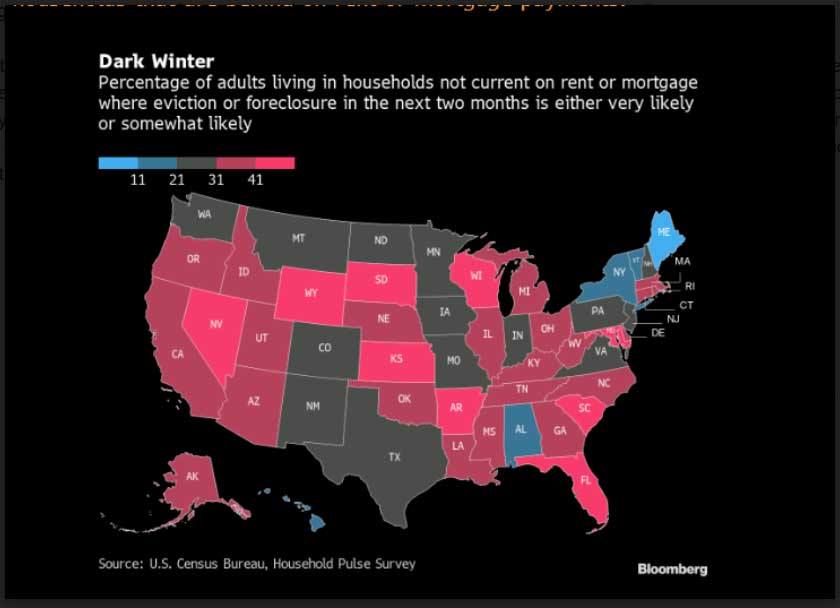
About 3 million mortgages are currently in Gov’t or private sector COVID bailout programmes. There are no guarantees that these borrowers will be able to keep up repayments on their loans. So, if these homes start defaulting then the current high home prices will start to fall. Defaulting mortgages causes other property prices to drop in surrounding homes. According to Bloomberg there are around 5.8 million Americans who are expecting to potentially face eviction by the end of this year. They consider themselves somewhat or very likely to face eviction. Furthermore, around half of households behind on rent or mortgage payments in Arkansas, Florida, and Nevada think there is a strong chance of eviction by early January. The CDC’s temporary suspension on evictions is due to end December 31. There may be trouble ahead in the US housing market and this is a theme to keep on track of.
Chart

Learn more about HYCM

Author

Giles Coghlan LLB, Lth, MA

Giles is the chief market analyst for Financial Source. His goal is to help you find simple, high-conviction fundamental trade opportunities. He has regular media presentations being featured in National and International Press.


More from Giles Coghlan LLB, Lth, MA
Share:

Editor's Picks

AUD/USD breaks below 0.7000 ahead of inflation data

AUD/USD has accelerated its downward trend on Tuesday, breaching below the key 0.7000 yardstick ahead of the opening bell in Asia on Wednesday. Indeed, spot has retreated for the second day in a row despite the hawkish hike by the RBA early on Tuesday and in response to the continuation of the move higher in the Greenback. Looking ahead, all the attention will be on the release of Australia’s inflation data on Wednesday.

USD/JPY consolidates near 157.50 as a bullish USD counters intervention risks

USD/JPY struggles to capitalize on the overnight bounce from a one-week low, consolidating around 157.50 in the Asian session on Tuesday. Trump's concerns about the Japanese Yen's weakness fueled speculation about another US-Japan joint intervention. This, along with the hawkish BoJ, underpins the JPY and caps the currency pair. Meanwhile, rising Fed rate-hike bets and oil-driven inflation fears continue to push US bond yields to multi-year highs, keeping the US Dollar pinned near a two-month high and supporting the pair.

Gold trims gains; back toward $4,150

Gold now surrenders some of its initial advance and retests the $4,150 zone per troy ounce on Tuesday. Meanwhile, the move higher in the yellow metal comes despite the firmer US Dollar and rising US Treasury yields across the board, while escalating geopolitical tensions appear to limit the downside potential.

XRP advances within a robust technical structure
Ripple (XRP) shows signs of stabilizing after reclaiming support at $1.50 on Tuesday. A robust technical structure underpins the token’s short to medium-term bullish outlook. Still, XRP is not out of the woods yet, as profit-taking and buyer exhaustion could weigh on price action and extend the recent correction from September highs around $1.66.
RBA recap: Rate hikes are on the table as demand stays too strong

The Reserve Bank of Australia unanimously tightened monetary policy, warning that inflation remained too high and that several upside risks had begun to materialise. Governor Michele Bullock said the Board would raise rates again if necessary.

Silver is more volatile than Gold ahead of PCE and NFP. This chart shows the positioning gap
The market’s attention is focused on American data this week, but there’s something only those with a trained eye may be looking at: Gold and Silver positioning gap. Financial markets are moving on fears, mostly related to persistently high energy prices driven by the Middle East war. Sure, the US Dollar (USD) is strong, but at what cost?