Will 2022 be a better year for the airline industry?

Delays and cancellations have featured in another pandemic-stricken quarter for the aviation industry, but compared to the catastrophic 2020, 2021 has been more kind to US airlines according to earnings estimates. Although investors are hoping for a bullish 2022, the road ahead could still be rocky, and frustration could stay in place. American airlines’ Q4 earnings will probably provide more guidance on Thursday before markets open.
Airlines see the glass half full
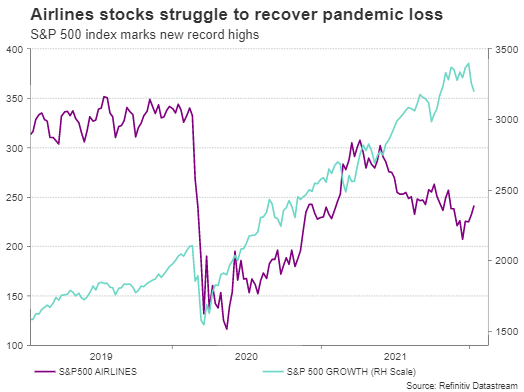
The omicron variant has been the latest punch against the already buttered travel sectors. Popping up just before the most sensitive Christmas holiday season, along with a series of winter storms, border checks, and record-breaking sick calls from employees, airlines faced another huge setback in operations in America at the end of 2021. The hiring process has been even more puzzling. Despite receiving more than $60bln in federal aid, most airlines have induced workers to take early retirement as flights remain subdued and making profits is a struggle.
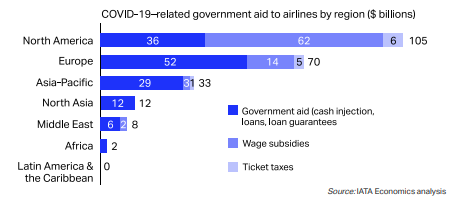
In stock markets, unlike other resilient sectors such as the tech sector, the aviation industry is still performing below its pre-pandemic levels despite the fast rally at the start of 2021, lagging the whole S&P 500 community for the past two years. Optimism, however, is growing that the latest Omicron variant is a point closer to the peak than just another wave in the pandemic cycle, with investors expecting some recovery during the next summer of 2022 for the whole travel sector as passengers' flying commitment could become more sustainable.
Risks to tackle, America could do better
Of course, the brighter prospects are still largely tempered with caution given the unpredictable covid twists. Also, the job will not be easy in practice, and it may take a few more years until businesses fully heal their wounds. Global airlines have absorbed an outstanding amount of leverage from governments, bond markets and shareholders during the past two years, with net debt soaring to $397.9bln in 2021 from $293.7bln in 2019. That is compared to an EBIDTA of - $8.6bln in 2021, which remained in the negative area for the second consecutive year, and $9.1bln in 2019; EBIDTA is an indication of underlying gross profit, calculated by adding taxes, interest, depreciation and amortization to net income.
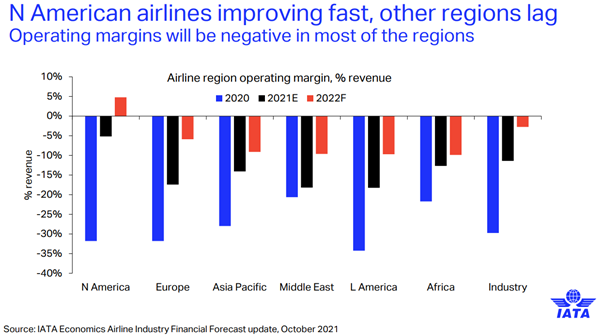
Apparently, businesses will keep using their flexible low-price strategy to motivate people to travel this year, and that may demand more cash to improve balance sheets if energy and other essential costs remain elevated. That said, the aviation industry is uneven, and some regions could perform better than others, with sources from the International Air Transport Association predicting a profitable year for US airlines in 2022 compared to declines in net post-tax profits in Europe and Asia.
Delta earnings beat estimates, American airlines next in focus
Delta airlines reported its earnings for the final quarter of 2021 last week, topping analysts’ estimates on quarterly revenues and per share earnings (EPS). The full year generated profits after a sharp dip in 2020, and although the management expects a depressing start to 2022, it is "positioned to generate a healthy profit in the June, September and December quarters, resulting in a meaningful profit in 2022". Reducing debt will be its major priority, aiming to return its balance sheet to investment grade metrics by 2024.
Although Delta airlines have already set sentiment in stock markets, traders will also be interested to learn how the major US airline, American airlines, fared this Thursday.
Expectations point to a 4.4% quarterly and a 132.6% annual boost in revenues to $9.36bln in the final three months of 2021. On the other hand, EPS are expected to have declined at a faster pace to -$1.47 from -0.99 before, but that could be milder than the reduction of $3.86 in the same period last year.
Investors will also pay close attention to the 2019 comparisons after the company said that total revenues will be down by 17% versus pre-pandemic levels.
From the above stats, American airlines seems to be lagging Delta airlines, while a number of analysts have recently lowered their price targets for the company, with Refinitiv analysts assigning overall a hold rating.
Perhaps its aggressive recruiting steps may have created extra costs. Delays and quality concerns in Boeing deliveries will also be a burden this summer as the Fort Worth Texas company forecasts fewer international flights than initially planned.
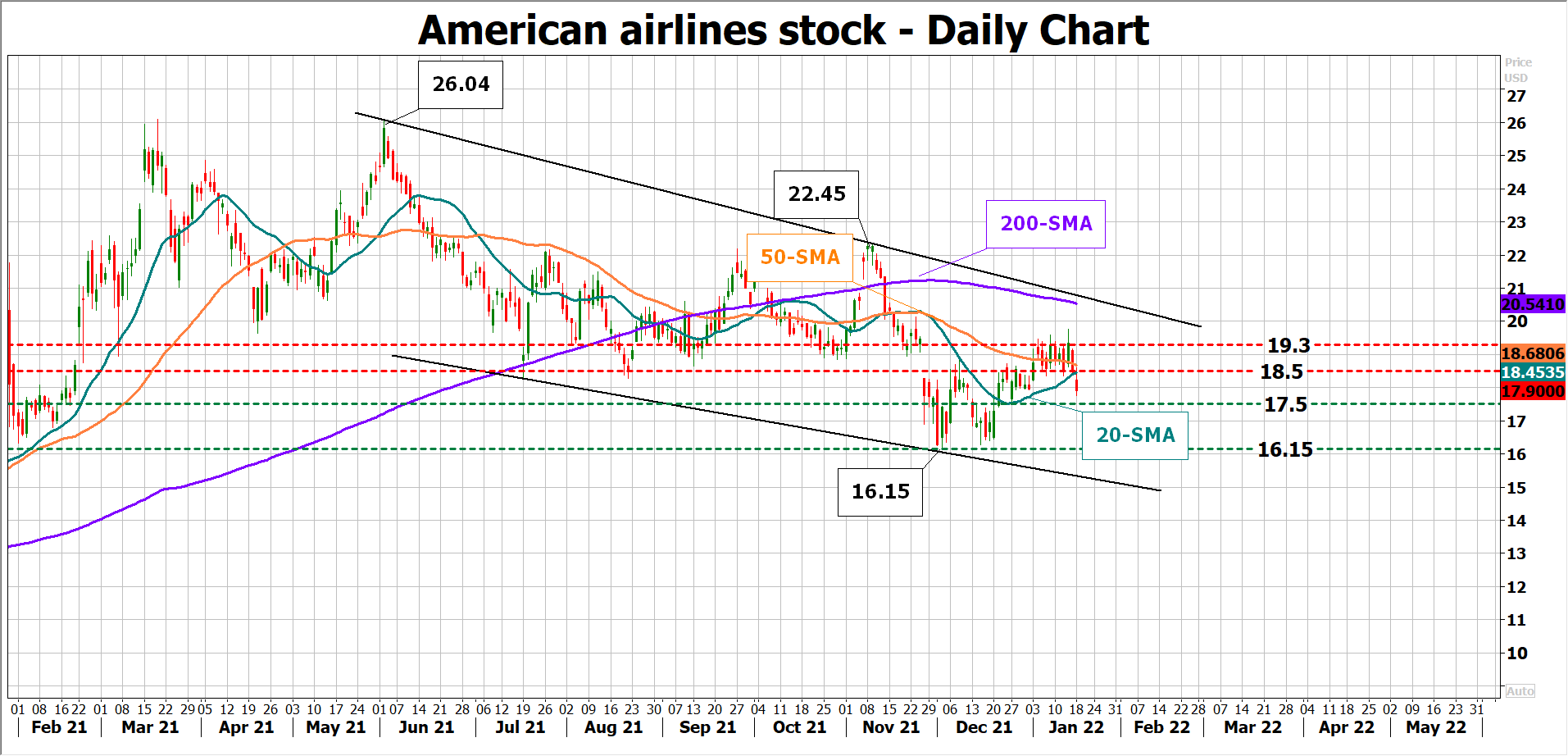
From a technical perspective, its stock is still in a bearish path since the peak in June and negative risks have resumed following the pullback below the supportive 20-day simple moving average (SMA), which is currently intersecting the neckline of a bullish double bottom pattern around 18.50. Should the earnings event disappoint, with the price retreating below 17.50, the spotlight will turn to the one-year low of 16.15.
On the upside, the bulls will need to return above 18.50 and push beyond the 19.30 bar in order to access the top line of the bearish channel and the 200-day SMA at 20.54. Further up, the next target will be November’s high of 22.45.
Author
Christina joined the XM investment research department in May 2017. She holds a master degree in Economics and Business from the Erasmus University Rotterdam with a specialization in International economics.

















