Why tax refund season may not give stocks the boost investors hoped for

Since late last year, US stock market bulls have been arguing that one of the primary events likely to boost share prices in 2026 was the coming tax refund season. But as the first refund data rolls in, the supposed market-fueling cash surge is looking far less impressive than expected, challenging that bullish assumption.
The tax refund season is when the US’ Internal Revenue Service (IRS) sends taxpayers refund checks if individuals have overpaid in the past year what they owe the government.
This year the checks were expected to be much fatter on account of President Trump’s One Big Beautiful Bill Act (OBBBA), which introduced tax cuts halfway through 2025. Since the bill was retroactive and taxpayers continued to pay 2025 taxes at the previous rates, the consensus has been that refunds this year would be outsized. In fact, analysts at Piper Sandler suspected that the average refund this year would be $1,000 higher than the previous year.
But that is not how the evidence is playing out so far.
Tax refunds to increase by less than initially expected
While Congress’ House Ways and Means Committee had estimated that Americans would receive an extra $191 billion in refunds, meaning a ~33% increase YoY, the latest round of data shows that refunds are up just 9% year to date.
The Tax Foundation, a political research institution, says that average refunds are likely to rise $748 rather than $1,000.
The IRS’ latest data suggests that through February 27, 2026, the government has refunded $136.6 billion to taxpayers, up 9.4% compared to the figure a year earlier. This is due to the total number of refunds falling 1% from the prior year, while the average refund of $3,742 is up about 10%.
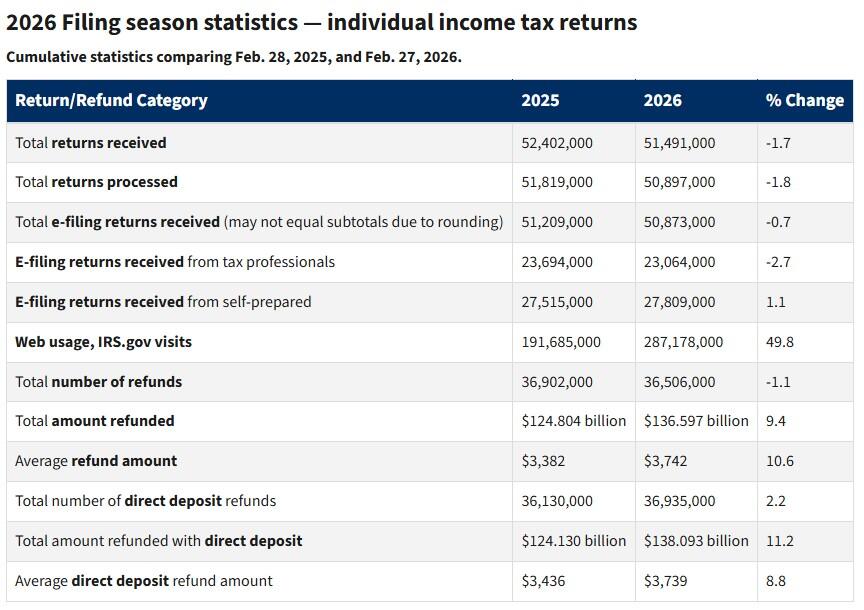
Possibly due to Trump’s deportations and a higher unemployment rate, the IRS now estimates that 164 million individual filings will be processed, down from the 165.8 million in 2025.
Not big enough to boost stock markets
Morgan Stanley estimates that extra individual refunds will be a more sober $55 billion. This is still positive, but the bank says that much of the refunds this year will be spent on paying down debt, something that doesn’t boost GDP or the stock market. The rest is more likely to go toward groceries and essentials.
With the war with Iran raging on, Oil prices are already up over 50% as well, which could soak up quite a bit of the additional fiscal power of the refunds.
By a generous estimate, possibly 5-10% of the additional refunds could make their way into the stock market. That would only supply an extra $5 billion or so, not an amount capable of by itself pushing the S&P 500 to new highs. The stock market will need to wait for another trigger.
Author

Clay Webster
FXStreet
Clay Webster grew up in the US outside Buffalo, New York and Lancaster, Pennsylvania. He began investing after college following the 2008 financial crisis.