Yen attempts to recoup losses, but recovery prospects remain limited

USD/JPY edged lower to 157.94 on Friday following a sharp rise the previous day. The yen is finding support from Tokyo inflation data, with core inflation accelerating to 2.7% in September and exceeding the Bank of Japan’s 2% target for the first time in nine months.
At the same time, the Bank of Japan’s summary of opinions from its September meeting proved less hawkish than expected. The central bank is increasingly focused on the risk of inflation exceeding its target, keeping the prospect of another rate hike before year-end alive, although it gave no clear signal on the timing of the next move.
Nevertheless, the yen remains on track for a third consecutive weekly decline. A strong US dollar and elevated US Treasury yields continue to weigh on the Japanese currency amid expectations that the Federal Reserve may continue raising rates as high energy prices add to inflationary pressures.
As a result, the US-Japan interest rate differential risks remaining wide, with the Fed so far tightening policy faster than the BoJ. Taken together, these factors limit the yen’s potential for sustained strengthening.
Technical analysis
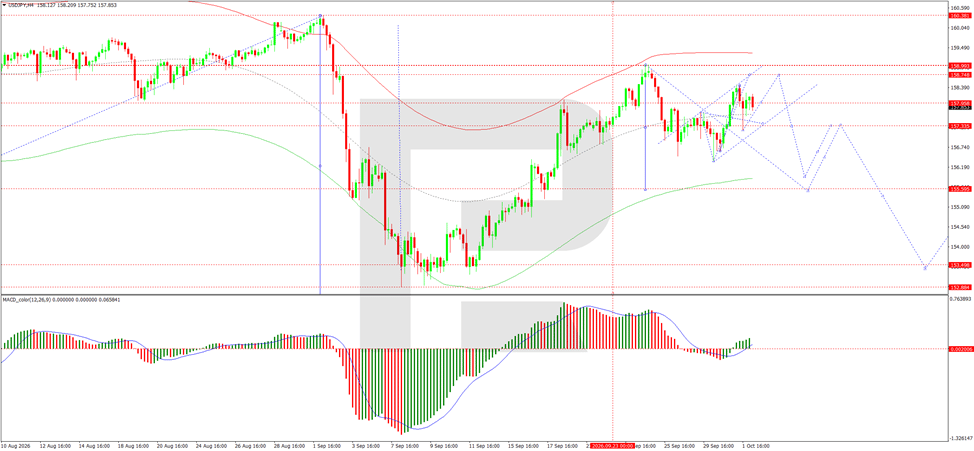
On the H4 USD/JPY chart, the pair recovered from the 156.20 area, gained upward momentum and tested resistance at 158.75–158.99. Buyers failed to establish a foothold above this zone, after which the pair began consolidating around 157.85. The current structure allows for another move higher towards 158.75–158.99, where an important resistance area lies and a second test from below is likely. The MACD indicator remains above zero, but momentum appears limited, suggesting that the rise is primarily corrective. A rejection from 158.75–158.99 could trigger a new downward move, initially towards 157.34 and, if this support is broken, towards 155.60. The 153.50 area remains a further downside target.
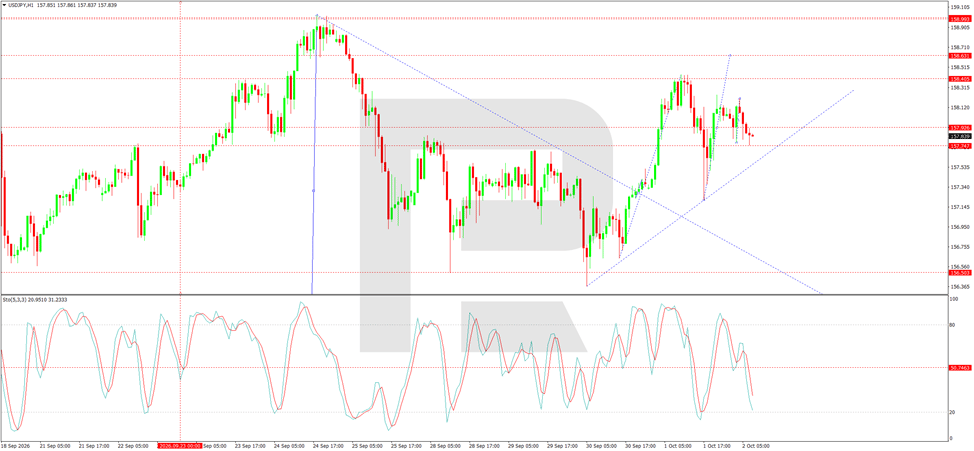
On the H1 USD/JPY chart, following a rise to 158.40, the pair pulled back and returned to resistance at 157.93. The Stochastic oscillator is pointing downwards and approaching the oversold zone, suggesting that a local corrective rise is possible before the decline resumes. Early in the session, the key range is 157.75–157.93. A return above 157.93 could open the way for a recovery towards 158.40 and then 158.63–158.99. However, while resistance at 158.99 remains unbroken, the main scenario envisages the completion of the corrective rise followed by a reversal lower. A break below 157.75 would increase selling pressure and open the way towards 157.34, followed by 155.60. The bearish scenario therefore remains the priority once the current correction is complete.
Conclusion
The yen is attempting to recoup some of its recent losses, supported by stronger-than-expected Tokyo inflation data, with core inflation exceeding the BoJ’s target for the first time in nine months. However, the BoJ’s September meeting summary was less hawkish than expected and offered no clear guidance on when the next rate hike will occur. The yen remains on track for a third consecutive weekly decline, weighed down by a strong US dollar, elevated US Treasury yields and the persistent US-Japan interest rate differential.
From a technical perspective, USD/JPY could see another corrective rise towards the 158.75–158.99 resistance area. However, as long as the pair remains below 158.99, the main scenario envisages a subsequent reversal lower towards 157.34, with the decline potentially extending towards 155.60. The 153.50 area remains a further downside target.
Author

RoboForex Analysis Department
RoboForex
RoboForex Analysis Department provides timely market insights, expert technical analysis, and actionable forecasts across forex, commodities, indices, and equities.