Why NZD/USD Plunged So Aggressively? We Expect a Dive Below 0.7000 in the Next Hours

The New Zealand dollar had a huge decline today and is still falling following the announcement from the leader of the First Party, Winston Peters, that they will support the opposition Labour party in order to form a government. Moreover, he announced Jacinda Ardern as the next Prime Minister and she will hold this position until 2020. She will be the third woman prime minister of the country.
The New Zealand’s First party became kingmaker at the elections took place on September 23rd, which brought it at the third place, while the first two National and Labour parties failed to win enough support to form a government by themselves. The coalition agreement between the First and Labour parties, raised fears for the long-term growth and the policy of the Reserved Bank of New Zealand and pulled vigorously the NZD/USD at a five-month low at 0.7013. The market participants believe that the two parties combined will pursue aggressive reforms of the central bank, that means lower interest rates for even longer.
NZD/USD Sank Sharply, Lost More Than 150 Pips So Far
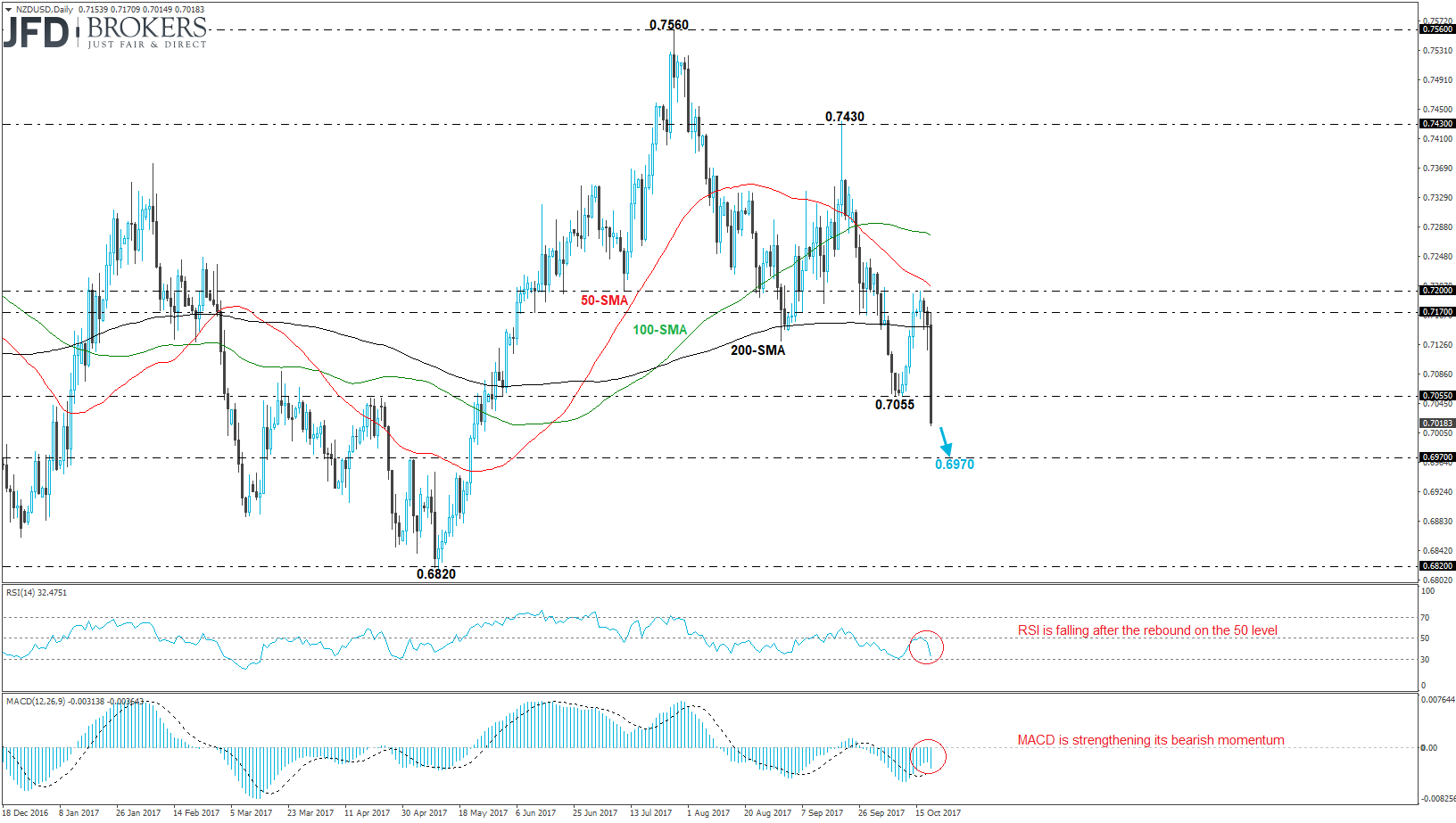
The New Zealand dollar had an aggressive sell-off today, almost 2%, against the U.S. dollar, so far, the biggest single day drop since August 2015. The commodity currency pair is completing the third bearish day in a row and slipped below the 0.7055 strong barrier. Moreover, the NZD/USD pair is posting a red month with more than 2.5% losses until now.
From the technical point of view, on the weekly timeframe, the price is trading slightly beneath the 100-SMA and if the price closes the week below it, will open the way for the 0.6970 support level. Going to the daily chart, the RSI indicator is pointing to the downside and is approaching the 30 level. Also, the MACD oscillator is strengthening its bearish momentum and is ready to create a downward crossover with its trigger line.
Author
JFD Team
JFD