Why Japan is fighting a billion-dollar battle at the 160 level for the Yen

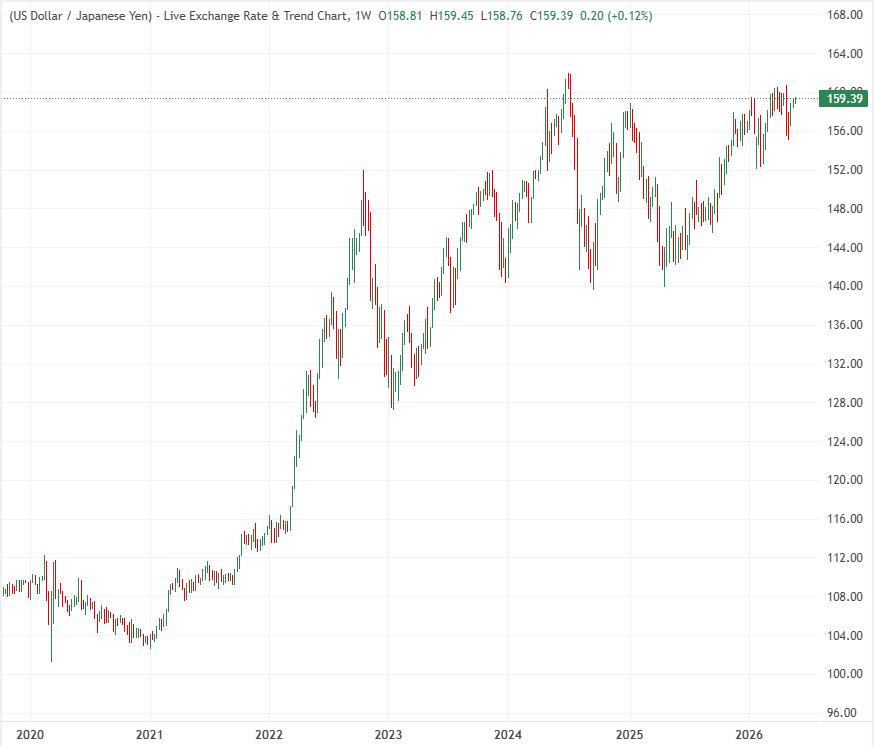
The USD/JPY exchange rate at 160 represents the most dangerous level in the foreign exchange market, serving as a critical political and economic threshold where Japanese authorities have repeatedly stepped in to halt the currency's decline. Driven by a massive interest-rate differential known as the carry trade, where investors borrow cheap Japanese Yen (JPY) to invest in higher-yielding assets such as the US Dollar (USD), the pair has surged 60% since the COVID pandemic.
Despite billions of dollars spent by the Bank of Japan (BoJ) and the Ministry of Finance (MoF) through coordinated interventions, the market continues to challenge this line. Understanding the mechanics behind these interventions, why they have previously faded, and how global shifting policies impact the currency is essential for anyone trading the Yen.
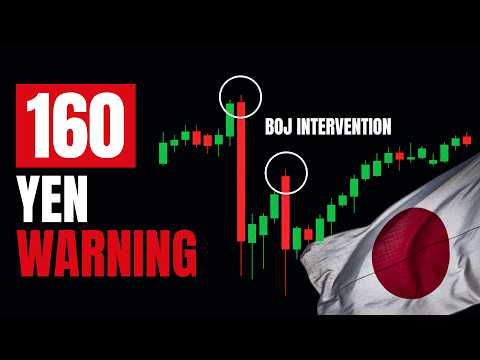
What’s behind the Japanese Yen slide?
The Yen is in a multi-year downtrend, driven mainly by the carry trade. This is what happens when a massive interest rate differential allows investors to borrow a currency cheaply (the Yen) to fund investments in higher-yielding foreign assets, such as US Dollar-denominated assets.
Following that carry trade, USD/JPY has risen from just above 100 after COVID to the dreaded 160 barrier. That’s a 60% surge in less than six years, a move that resembles an emerging-market currency rather than that of the world's fourth-biggest economy.
The Bank of Japan and the Japanese Ministry of Finance have already intervened twice this year, first in late April, then again in early May. Both times, USD/JPY crashed violently. This is a coordinated effort by Japan's top two financial authorities, on both the fiscal and monetary sides, to stop the Yen's slide. But despite billions spent defending the currency, the market ignored it and pushed USD/JPY right back to the same level again.
Why the 160.00 threshold is a critical line for Tokyo
The 160.00 level is not just psychological. For Japanese authorities, it represents a political and economic pain threshold that they have imposed upon themselves. A weaker Yen massively increases import costs, energy prices, and inflation pressures on Japanese households.
Historically, whenever USD/JPY accelerates aggressively higher, Japanese officials start becoming very uncomfortable. This has been happening since the Plaza Accord back in 1985, so we’ve got a 40-year-long track record of interventions. That’s exactly what happened earlier this year as USD/JPY surged past 160.00 for two consecutive trading sessions.
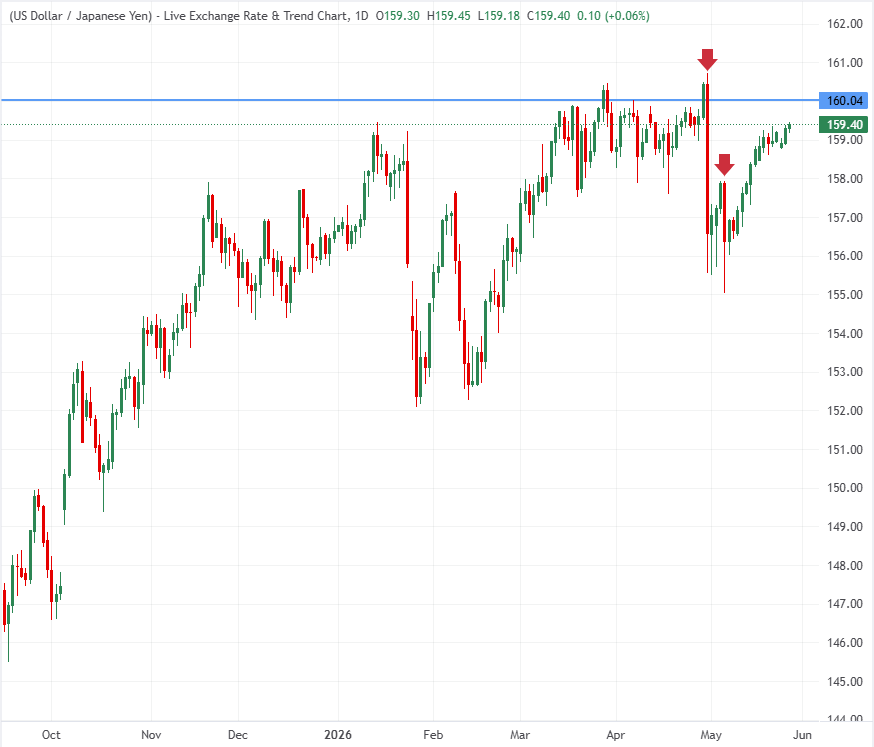
Sometimes, you have to draw the line somewhere. Respecting it gives Japanese authorities credibility around their economic agenda. So, the BoJ and MoF fired their Yen-buying bazooka twice, while dumping US Dollars. The moves triggered massive intraday declines, hundreds of pips within hours. Tokyo has now intervened across five confirmed Yen-buying episodes since 2022. According to the BoJ data, the 2026 campaign added roughly ¥10 trillion across two interventions. But despite those interventions, the Yen continues to weaken.
The reason why temporary interventions fade
Intervention can temporarily provide relief for the Yen, but it cannot permanently offset interest rate differentials. That’s the core problem for Japan. The Fed still offers significantly higher yields on US Treasuries than the BoJ does on the JGBs, keeping the carry trade alive. As long as US Treasury yields remain elevated while Japan continues to offer near-zero rates, traders continue buying USD/JPY dips. That’s why the interventions faded. The market viewed them as temporary liquidity events, not a sustained policy shift. Unless the BoJ becomes materially more hawkish, the market may continue to challenge the Japanese currency near 160.00 repeatedly.
How Washington stance shifts the risk calculation
Shifting international dynamics are adding a new layer to this narrative, particularly in light of comments from US Treasury Secretary Scott Bessent. His remarks suggested that the BoJ should play a role in managing foreign exchange stability. Traders immediately noticed the significance because Japan maintains close coordination with the US regarding interventions to stabilize the Yen. If Washington sounds more tolerant or even supportive of Japanese actions, Tokyo may gain more confidence to step in aggressively again. Suddenly, speculators no longer assume Japan is isolated, which dramatically increases intervention risk as USD/JPY approaches 160.00.
What lies ahead for USD/JPY traders
At this point, another round of Yen buying by the MoF and BoJ absolutely remains possible, especially if USD/JPY decisively breaks above 160.00. However, Japan does not want to, nor can it, defend a specific number forever. Authorities mainly want to guard against excessive and disorderly FX moves.
So if USD/JPY keeps grinding slowly higher rather than exploding vertically, Tokyo may tolerate more weakness. The real shift will depend on whether the Bank of Japan meaningfully tweaks its monetary policy, goes hawkish, and abandons sub-1% interest rates. That could turn things around decisively and offer plenty of JPY bullish trades.
If you are trading USD/JPY or any Yen pairs, the upcoming Bank of Japan interest rate decisions are the critical events to watch. The 160.00 level is no longer just a chart technical level: it’s the line that points to a direct battle between global carry traders and intervention risk. The pace of the rally matters just as much as the level itself, and the market is about to find out Japan’s tolerance for this threshold once again.
(This article was created with the help of an Artificial Intelligence tool and reviewed by an editor.)
Author

Dhwani Mehta
FXStreet
Residing in Mumbai (India), Dhwani is a Senior Analyst and Manager of the Asian session at FXStreet. She has over 10 years of experience in analyzing and covering the global financial markets, with specialization in Forex and commodities markets.