The boom daily: War, yields, Yen and AI collide across the global fault lines
AI daily: Emerging markets discover the dark side of the AI boom
Emerging markets have spent most of this year wearing an AI halo, but the latest price action suggests investors are beginning to see the wiring underneath. According to Bloomberg Emerging Markets Editor Srinivasan Sivabalan, the MSCI Emerging Markets Index has fallen to just 10.8 times projected earnings, its lowest valuation since November 2022 and its widest discount to the S&P 500 since late 2024.
That would normally look like a bargain. Instead, it looks like a warning.
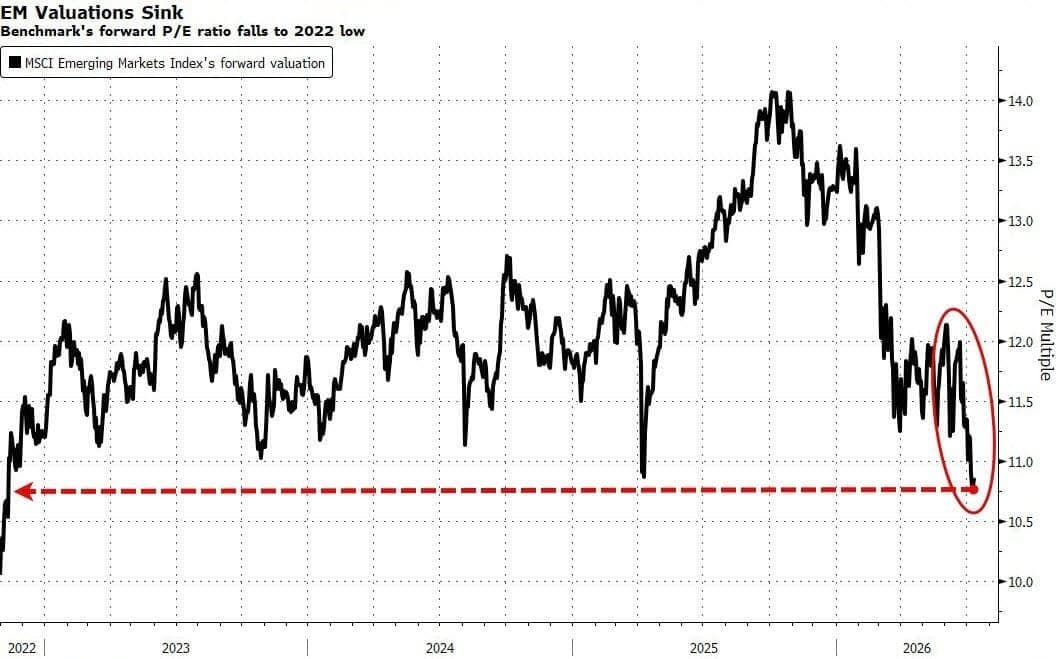
Analysts have lifted their forecasts for 12-month earnings across the index by an extraordinary 48% this year, taking expected profits to a record high. Almost all of that optimism has come from the AI complex, particularly South Korea’s semiconductor giants. Yet share prices have failed to keep pace with those upgrades, and investors are now paying less for the projected earnings than they did before the AI boom took hold.
The market is effectively saying that the profits may be real, but the durability, margins and valuations are still open to argument.
That skepticism matters because emerging markets have become far more concentrated than the label suggests. The AI rally has pushed Asia’s weight in the MSCI EM Index above 83%, leaving emerging Europe, the Middle East, Africa and Latin America sharing less than 17%. What looks like a broad emerging-market benchmark has quietly become an Asia technology trade wearing a global passport.
The earlier rally and the current selloff tell the same story. The index climbed as much as 28% through June 22, largely on the back of AI-linked stocks. It is now approaching correction territory for precisely the same reason. When semiconductors rise, emerging markets look like a growth miracle. When they roll over, the diversification disappears and the benchmark begins to resemble a crowded position with too many passengers trying to find the same narrow exit.
This is the Achilles’ heel of the emerging-market AI story. Earnings forecasts have become more ambitious just as investors have become less willing to pay for them. That gap between analyst optimism and market scepticism is rarely comfortable. Either prices must recover to validate the earnings boom, or the forecasts will eventually be dragged back toward the message already being delivered by valuations.
For South Korea and Taiwan, the problem is not that AI demand has vanished. It is that the market has moved beyond rewarding every company attached to the theme. Investors now want proof that capital spending can translate into sustainable free cash flow, that pricing power can survive the next wave of supply and that the AI cycle is not simply pulling tomorrow’s earnings into today’s forecasts.
For broader emerging-market investors, the index itself has become part of the risk. Concentration has turned semiconductor strength into apparent regional prosperity, but it has also made AI weakness contagious.
The AI boom may still have plenty of runway. But in emerging markets, it is no longer just the engine. It has become the single point of failure.
Author

Stephen Innes
SPI Asset Management
With more than 25 years of experience, Stephen has a deep-seated knowledge of G10 and Asian currency markets as well as precious metal and oil markets.