Why is the ECB set to cut interest rates again and what does that mean

The European Central Bank (ECB) is widely expected to cut interest rates on Thursday for the third time this year. This is a significant achievement as it suggests that the ECB, which sets monetary policy in the Eurozone, is accelerating its path towards lower interest rates after an unprecedented increase.
Lower interest rates directly affect families and businesses in the Eurozone, a group of 20 countries in Europe that share the Euro (EUR) as a currency and one of the strongest economic areas in the world.
The interest is the price to pay when borrowing money: bank loans, mortgages,...the amount of interest in all these ultimately depends on the level of the benchmark interest rates set by the ECB.
The ECB decides the level of interest rates independently, meaning that its decisions aren’t subject to approval by the European Commission or Parliament. Setting interest rates is one of the ECB’s most powerful tools: high rates can make borrowing money more expensive, while lower rates can make it cheaper and easier to get a loan approved.
What does a ECB rate cut mean and why is it important?
The interest rate is essentially what the bank charges for lending you money. While the ECB doesn’t directly set the interest rates charged by the bank, the level of its benchmark rates does influence them.
So, cutting interest rates lowers the cost of borrowing and thus encourages households and businesses to take on more debt. It also reduces the incentives to save money as banks are also likely to give less interest on the savings accounts they offer.
As previously said, the ECB is expected to deliver an interest rate cut for the third time this year after keeping rates at high levels for nine months.
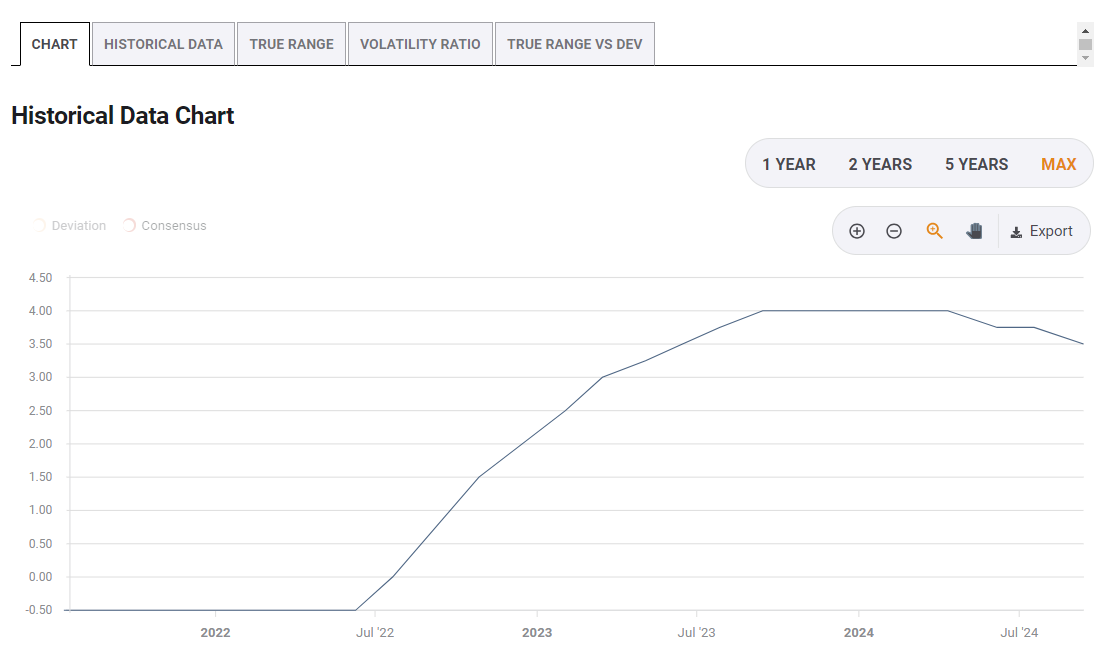
Evolution of the ECB deposit facility rate since 2022. Source: FXStreet.
Will the ECB cut interest rates on Thursday, and why?
Yes, or at least that is what the majority of economists think. The ECB already cut rates in June and in September. Back then, analysts thought that the central bank would refrain from cutting again in October, but some things seem to have changed in a matter of weeks.
“The European Central Bank meets Thursday and is expected to cut rates 25 basis points (...) because the Eurozone economy is stagnating and inflation is undershooting the ECB’s 2% target,” said Win Thin, Global Head of Currency Strategy at private investment bank Brown Brothers Harriman (BBH).
As Thin mentions, inflation – or by how much prices are rising – is a key driver for the ECB’s actions. The central bank’s only mandate is to keep inflation under control close to its 2% target.
The sharp increase in interest rates from mid-2022 to mid-2023 was the response to fight the quick rise in prices that happened during the reopening of the Covid-19 pandemic and the surge in energy costs after Russia invaded Ukraine.
Having peaked at 10.6% in October 2022, inflation in the Eurozone was at 1.8% in September, the lowest rate since mid-2021 and below the ECB’s 2% target.
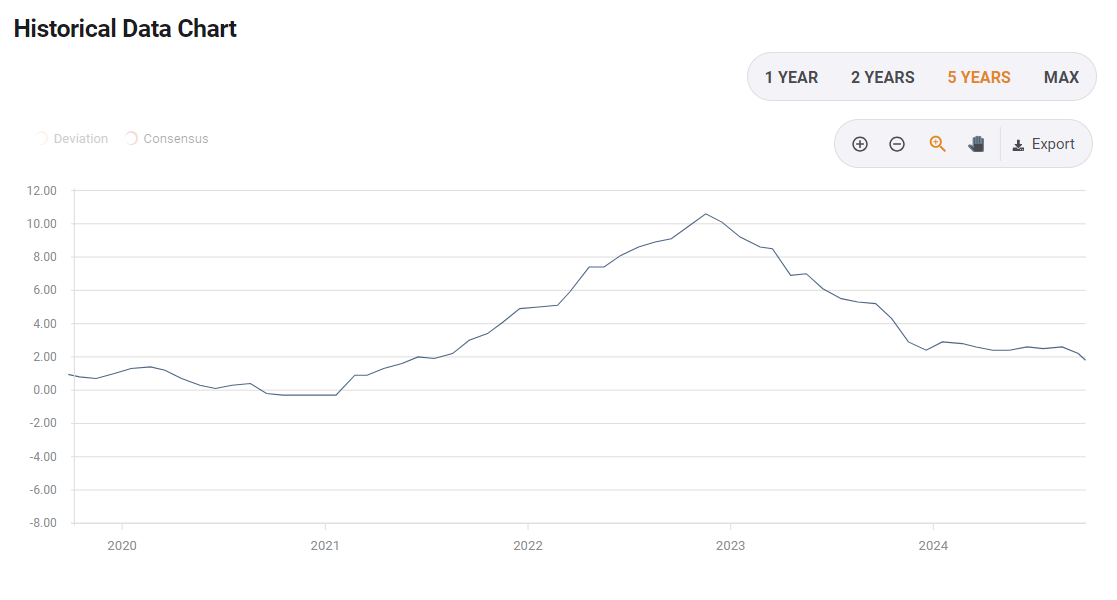
Evolution of inflation rate in the Eurozone since 2020. Source: FXStreet.
"Latest developments strengthen our confidence that inflation will return to the target level in a timely manner," ECB President Christine Lagarde said at a European Union parliamentary hearing on September 30.
"We will take that into account in our next monetary policy meeting in October," she added, in a clear message that further interest rate cuts were on the way.
Another factor tilting the ECB towards another interest rate cut is increasing evidence that the economy in the Eurozone is getting more and more vulnerable to a downturn.
Lower rates can encourage thousands of people to take a mortgage or a loan to buy big-ticket items and pay less interest for it (and thus be able to spend this money somewhere else). The same applies to businesses, which can get cheaper funds to invest in expansion. This is why lower rates tend to help the economy grow.
By how much the ECB is expected to cut rates?
By 25 basis points, or a quarter-percentage point.
The ECB has three key rates, and it tends to change them by the same magnitude.
The deposit facility rate, which is the key measure, is currently at 3.5% and it is expected to be lowered to 3.25%.
The main refinancing operations rate is at 3.65% and it is expected to be cut to 3.4%. Finally, the marginal lending facility rate is at 3.9% and it is set to be cut to 3.65%.
Will the ECB continue to cut rates further ahead?
Yes, or that’s what the majority of economists think.
ECB officials haven’t pre-committed to continue to lower interest rates, but the fact that inflation in the Eurozone seems under control and the recent deterioration of the economy make analysts believe that lower rates are coming.
“We believe that more meaningful disinflation progress coupled with concerns around economic growth will see the ECB adopt a more consistent pace of rate cuts moving forward,” said economists at US bank Wells Fargo.
According to their projections, the ECB is expected to keep lowering interest rates at each of its meetings until the end of the first quarter of 2025. From then on, the ECB would shift to cut rates only once per quarter, reaching a deposit rate of 2% by late 2025.
(This story was corrected on October 16 at 11:19 GMT to say that the sharp increase in ECB's interest rates occurred from mid-2022 to mid-2023, not late 2024.)
Economic Indicator
ECB Rate On Deposit Facility
One of the European Central Bank's three key interest rates, the rate on the deposit facility, is the rate at which banks earn interest when they deposit funds with the ECB. It is announced by the European Central Bank at each of its eight scheduled annual meetings.
Read more.Next release: Thu Oct 17, 2024 12:15
Frequency: Irregular
Consensus: 3.25%
Previous: 3.5%
Source: European Central Bank
Author

FXStreet Team
FXStreet
Composed of a group of economic journalists and FX experts, the FXStreet content team produces and oversees all content published on FXStreet. It provides a purely journalistic approach to the Forex market.