Gold and Silver bounce after Trump rules out pre-election strikes

Today’s pre-market trading looks like yesterday in a mirror. On Thursday morning, oil jumped, stocks fell, and silver fell with them. This morning, oil is lower, stock futures and copper are higher, and silver is up more than gold. Gold trades near $4,210, about $54 above Thursday's settlement of $4,157.00, and silver is back above $60.
The trigger was a single post. At 12:45 p.m. Eastern on Thursday, President Trump wrote on Truth Social that "we will not be attacking Iran at any time prior to the Midterm Elections to be held in the United States on November 3rd," and cited "productive conversations" with Iran. The bounce has clear drivers, and none of them is the one that would signal a bottom in gold.
In my view, Trump said that to help stocks hold above the previous highs as he’s determined to prevent a sell-off before the midterms. It will be interesting to see what happens when / if, the Iranian side says that there are no talks being held or they will intensify the attacks.
The mirror image
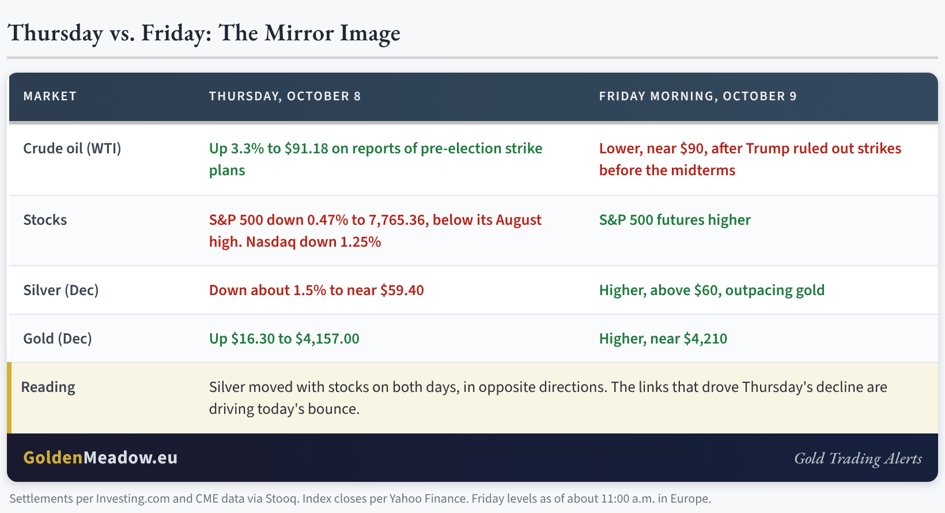
Yesterday, I wrote: "Silver follows stocks more closely than gold does, and the reason is industry."
On Thursday, the link worked to the downside: the Nasdaq fell 1.25 percent, and silver fell while gold rose. Today, it works to the upside: stock futures and copper are higher, and silver is rising faster than gold. I also wrote that silver "amplifies gold's moves in both directions," and today it's repeating Thursday's move in the other direction.
In my view, silver's outperformance today says more about stocks and copper than about the precious metals. It's the industrial half of silver reacting to a better morning for risk assets.
Gold: A bounce with clear drivers
On Thursday, oil rose 3.3 percent, but the 10-year Treasury yield eased to about 5.23 percent after a well-received 30-year bond auction, and gold rose $16.30. That's a modest gain for a day with lower yields and a war headline in the morning.
This morning, three things are working for gold: oil is lower after Trump's post, the dollar's rally has paused, and yields remain below Wednesday's highs. Gold is up on all three, and that's what it should do. The sign I'm watching for is different: gold holding up on the dollar's up days. The dollar is little changed today, so today doesn't test it.
On Wednesday, I wrote: "The verification of the breakdown continues, and the next stage of the October sequence is the move toward the first target near $3,920."
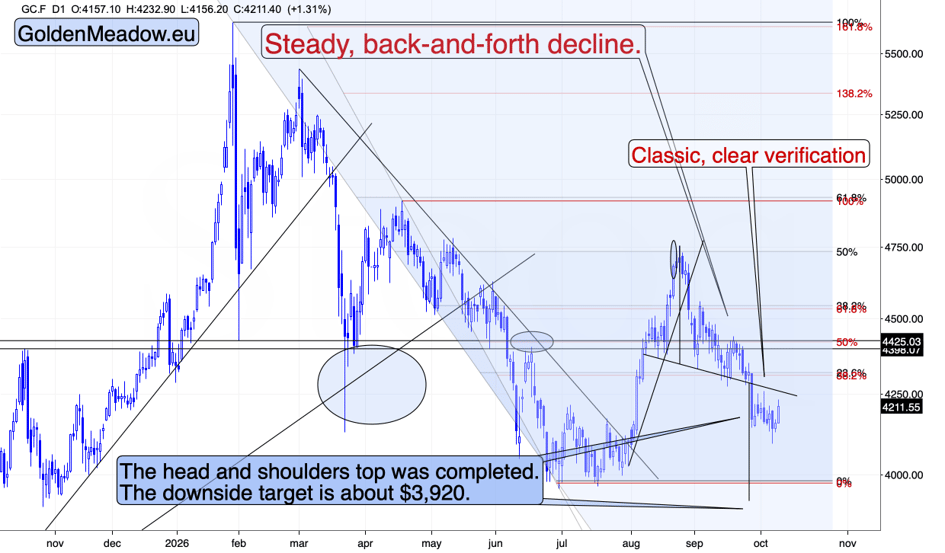
Gold's high this morning is $4,232.90, still below the highs of the verification rebound: $4,251 on September 30 and about $4,239 on October 2. The bounce keeps gold inside the range of the past two weeks.
The key thing is that this does NOT invalidate the breakdown below the previous head-and-shoulders pattern. The move below $4,000 remains the most likely outcome from here.
Stocks
Yesterday, I wrote: "If that holds, Tuesday's breakout to new records will have been invalidated."
It held. The S&P 500 fell 0.47 percent on Thursday to 7,765.36, below its August 13 high of 7,816.70 and Tuesday's record close of 7,818.93. The Nasdaq fell 1.25 percent to 27,193.34 as rising yields and oil weighed on technology stocks, while the Dow and the Russell 2000 closed slightly higher.
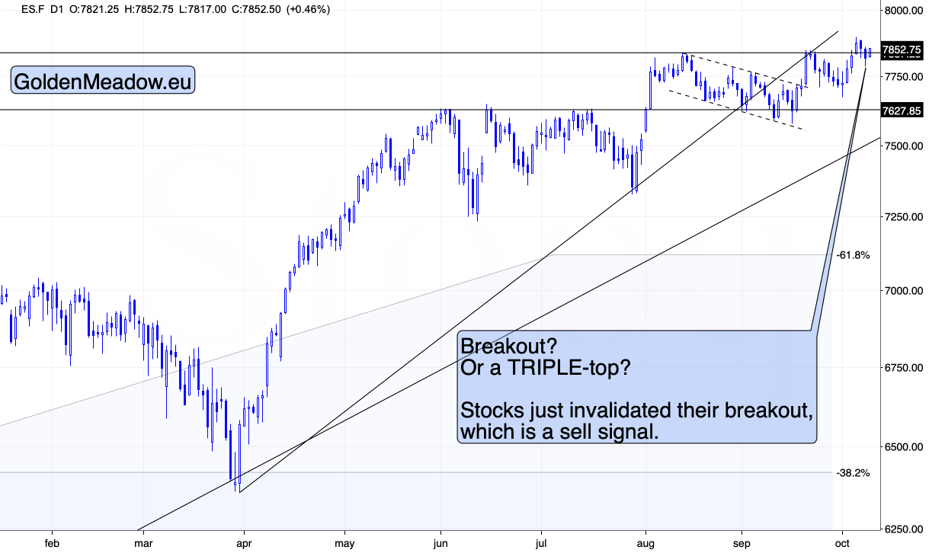
S&P 500 futures are rebounding this morning. In my view, yesterday’s invalidation of the breakout was a sell signal for stocks, and through the industrial link, and it was bad news for silver and the miners.
Today, stocks are making another attempt to break to new highs. Will they be successful? I doubt that – if the news from Iran supports conflict and exposes that no talks are being held or that they are not going well, we can see another invalidation.
Remember – history doesn’t support the “no selloff before midterms” scenario. Trump might be determined to have such an outcome, but others in his position were just as motivated, and overall historically stocks did not hold up that well right before midterms.
Oil and Iran
Yesterday, I wrote that the rally in crude oil confirmed the bottom it formed on its triangle-vertex day. Just as I had forecasted it.
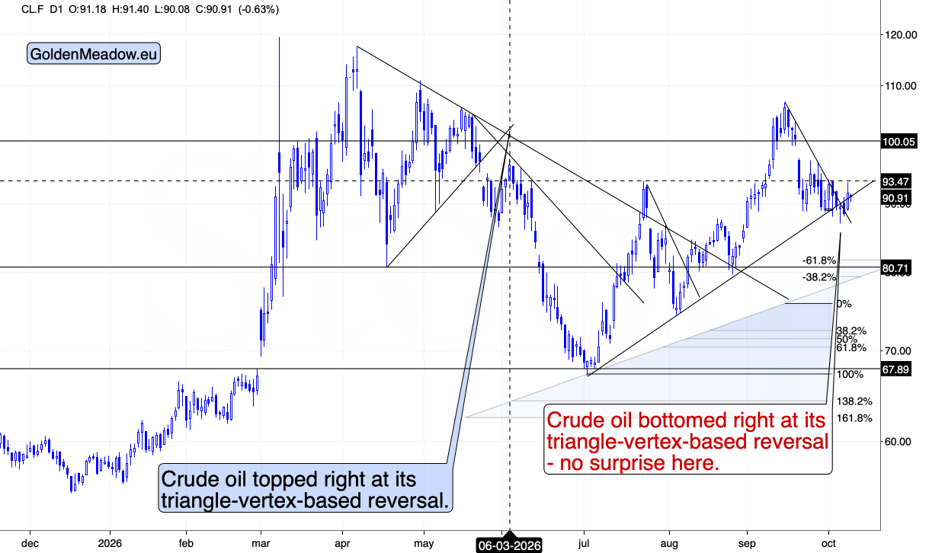
Trump's post pared the gains, with Brent falling from about $105 to about $103 during the session, but crude still settled higher: WTI rose 3.3 percent to $91.18, and Brent rose 3.9 percent to $104.11. This morning, WTI trades near $90 and Brent near $103, nearly $3 above Tuesday's low in WTI.
Iran's foreign minister said Tehran is reviewing Washington's response to its seven-day plan and that "I think we will respond within a few days." Putin told Iran's president that Russia is ready to "do everything that is in our power" to help settle the conflict. The Houthis kept up their attacks on Saudi airports and warned workers at oil facilities to leave, UK Maritime Trade Operations reported that a tanker was struck by an unknown projectile on Tuesday, and the United States sanctioned 17 vessels it called "the remnants of Iran's shadow fleet." Isaias is expected to reach the northern Gulf Coast as a hurricane around early Saturday.
The pledge moves the risk rather than removing it. According to The Atlantic, the Pentagon has also presented options for after the election, up to large-scale strikes on Iran's energy industry. The oil market didn't take the pledge at face value either: crude still closed more than 3 percent higher on the day it was made.
The Dollar and the Fed
Two days ago, I wrote: "In my view, the USD Index is ready to soar again, and the medium-term rally I described on September 24 still has a lot of room to run."
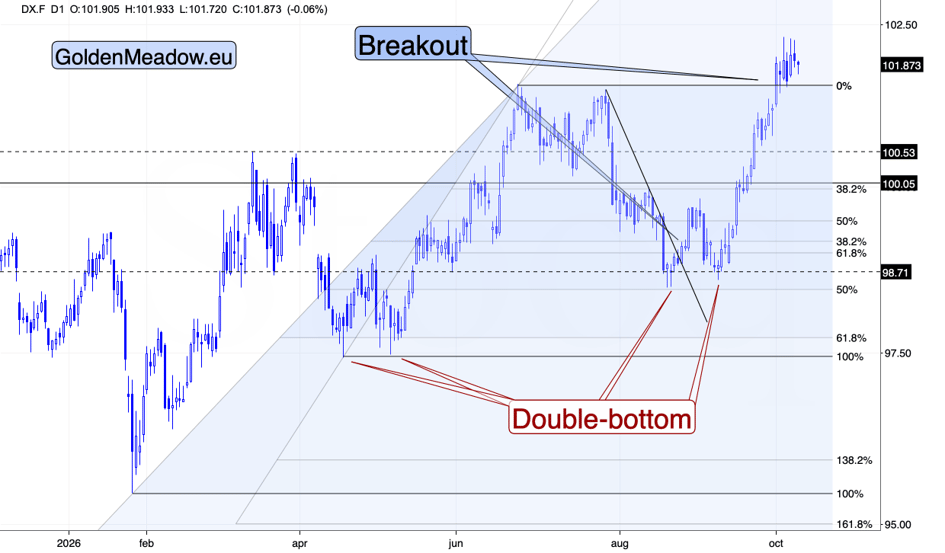
The USD Index is little changed this morning, pausing near its highest levels since April 2025. St. Louis Fed President Musalem said another hike is needed to return inflation to 2 percent, and markets price a 17 percent chance of a hike on October 28 and an 83 percent chance by December.
The Treasury sold $22 billion of 30-year bonds on Thursday at 5.618 percent, the highest yield at a 30-year auction since August 2000, with a bid-to-cover ratio of 2.54, above the 2.41 average of the previous six auctions. After Wednesday's 10-year auction at 5.300 percent, that's two days in a row of investors lining up for yields that gold doesn't pay, and the lower yields that followed are part of today's bounce.
Technically, since the consolidation is taking place above the previous 2026 highs, the breakout is fully verified, and the breather’s implications are bullish. The USD Index is simply getting ready for another powerful wave up.
If we are to view the current consolidation as a flag pattern, then the move that follows it is likely to be similar to the one that preceded it. The preceding rally took the USDX from about 99 to about 102, so a repeat of that could take the USDX to about 105 – that would be quite an event for the precious metals market – a very bearish one.
Where this leaves us
Trump ruled out strikes on Iran before the midterms, oil pulled back, the dollar paused, and gold and silver bounced, with silver outpacing gold as stocks and copper rose. The S&P 500 closed below its August high on Thursday, which invalidated Tuesday's breakout, and gold remains below the highs of its verification rebound.
Today's bounce is yesterday's decline in reverse, driven by the same links. The trend didn't reverse with it.
Want free follow-ups to the above article and details not available to 99%+ investors? Sign up to our free newsletter today!
Author

Przemyslaw Radomski, CFA
Gold Price Forecast
Przemyslaw Radomski, CFA (PR) is a precious metals investor and analyst who takes advantage of the emotionality on the markets, and invites you to do the same. His company, Sunshine Profits, publishes analytical software that any