Why did Loonie fall after BoC rate hike and where will it go from here?

While the Bank of Canada was widely expected by markets to raise the policy rate by 25 basis points to 1.25%, the adverse FX market reaction for the USD/CAD followed. While USD/CAD initially fell to C$1.2330 marking new 2018 high for Loonie, it has reversed the course soon after and the USD/CAD traded up 0.6% at around C$1.2500 minute after the rate decision.
Well, this is not completely surprising as I have already warned market participants of possible adverse move on USD after the decision in my yesterday’s piece here.
As I expected, reasons for the USD/CAD to jump higher favoring the US part of the Dollar currency pair are political and economic.
I expected the Bank of Canada to remain cautious as the free trade agreement in North America (NAFTA) is threatened by the US at the moment at the sixth round of talks is just ahead.
The Bank of Canada noted NAFTA as the key reason of uncertainty in the very first paragraph of its decision saying “uncertainty surrounding the future of the North American Free Trade Agreement is clouding the economic outlook.”
The cautiousness of the rate hike was also confirmed by the conditionality of the economic outlook of the Bank of Canada saying “the Bank’s outlook takes into account a small benefit to Canada’s economy from stronger US demand arising from recent tax changes. However, as uncertainty about the future of NAFTA is weighing increasingly on the outlook, the Bank has incorporated into its projection additional negative judgment on business investment and trade.”
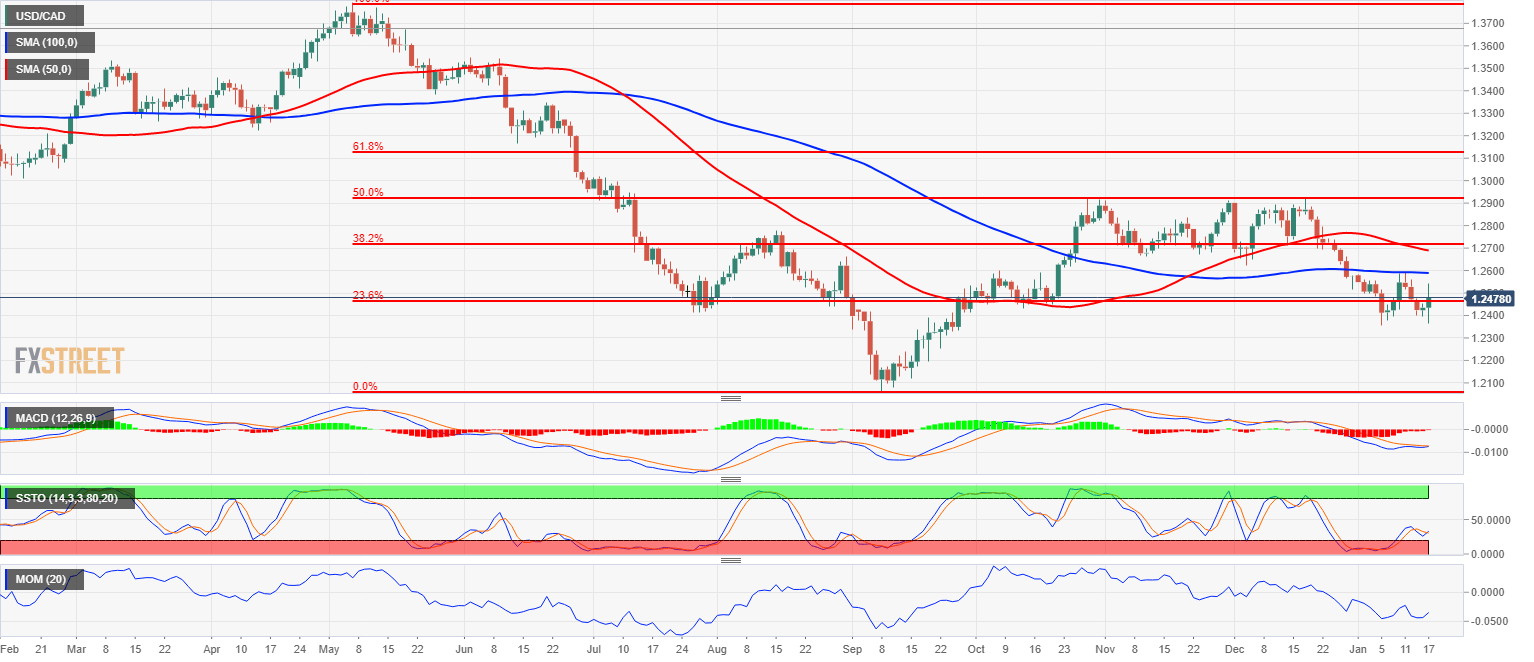
Technically the USD/CAD has moved back above C$1.2465 representing 23.6% Fibonacci retracement of a large move downwards from C$ 1.3800 to C$1.2070 back in last September. With the FX rate stabilizing above 1.2465, a new range of C$1.2465-C$1.2715 should be in play.
Author
Mario Blascak, PhD
Independent Analyst
Dr. Mário Blaščák worked in professional finance and banking for 15 years before moving to journalism. While working for Austrian and German banks, he specialized in covering markets and macroeconomics.