Which Major Economies Have Exposure to EM Economies?

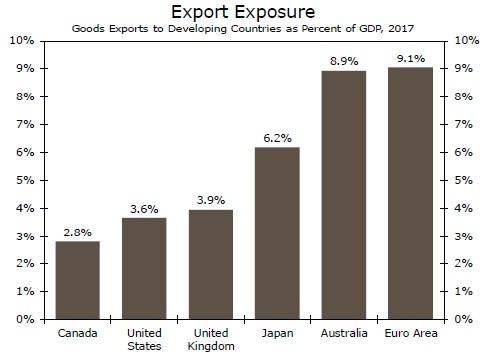
The Eurozone appears to have the most financial and economic exposure to EM economies. However, if external debt issues in the developing world are not systemic, then we are not overly concerned about that exposure.
The Eurozone May Be the Most at Risk
In the third of three reports on the fallout from financial crises potentially sweeping through the developing world, we analyze the amount of economic and financial exposure that major economies have to emerging market (EM) economies.1 In terms of exports, the euro area and Australia have the most to lose among major economies, as exports of goods to EM economies are equivalent to 9 percent of their respective GDPs (top chart). Developing Asia accounts for the vast majority of Australia's export exposure to EM economies, while the export exposure of the Eurozone is more broadly distributed among EM regions. On the other end of the spectrum, exports to the developing world are equivalent to only 3 percent of Canadian GDP.
Moving on to bank exposure, the United Kingdom appears to have the most to lose among major economies, with claims on developing economies representing 10 percent of the financial assets of British banks (middle chart). U.K.-based banks have broad exposure to EM economies, but their exposure to developing Asia is especially pronounced. In our view, developing Asia probably is the least vulnerable among EM regions to external debt crises due in part to the vast war chests of foreign exchange reserves that many countries in developing Asia possess. In other words, the risk to U.K.-based banks from potential external debt crises in EM economies likely is not as high as first meets the eye.
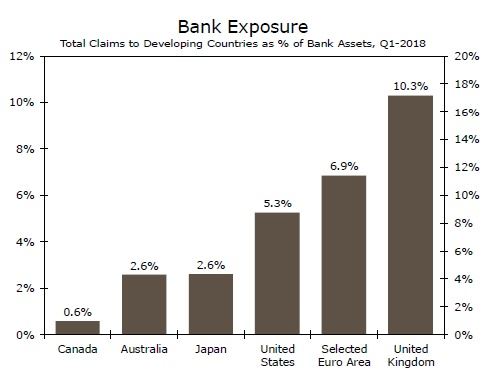
Claims on EM economies account for about 7 percent of the financial assets of the banking system in the euro area. The Eurozone of course consists of 19 individual economies, and we have banking data for 10 of these countries. (These 10 individual economies account for 95 percent of Eurozone GDP.) The Eurozone country with the most absolute amount of bank exposure to EM economies is Spain, which has more than $640 billion worth of claims on EM economies. But Spain also has some fairly large banks, which may be able to absorb some losses on their EM financial assets. So what we are really interested in is the amount of EM exposure that each country has as a percentage of its banking system assets. By that measure, Austria, which has extensive banking ties with countries in Central and Eastern Europe, has the most relative exposure to EM financial assets among Eurozone countries.
To reiterate the gist of our first two reports, however, we do not think that the financial issues that Turkey is now facing are systemic to the entire developing world. Individual economies, such as Turkey and a few others, could indeed face financial difficulties in coming weeks and months. But we do not think that a wave of financial crises will engulf the developing world à la 1997-1998. Consequently, we are not overly concerned about the economic and financial exposure that the Eurozone has to EM economies.
Author
Wells Fargo Research Team
Wells Fargo