Which Boomers Will Be Working in Their “Retirement” Years?


Boomers that are more likely to extend their careers past the traditional retirement age of 65 are more likely to be college educated, in less physically demanding jobs, self-employed or willing to work part time.
A Split Employment Outlook
For some Baby Boomers, working past the traditional retirement age of 65 will not be difficult. The types of workers best able to continue working are more likely to be in jobs that already command higher earnings, moreover. This stands to drive a further wedge between the segment of Boomers who will be adequately prepared for retirement and choose to work past 65, and those that are not as well positioned for retirement and will need to work past age 65.
Education Still Pays
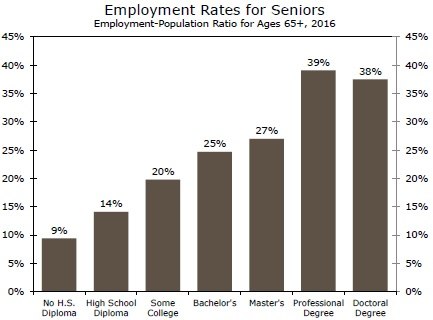
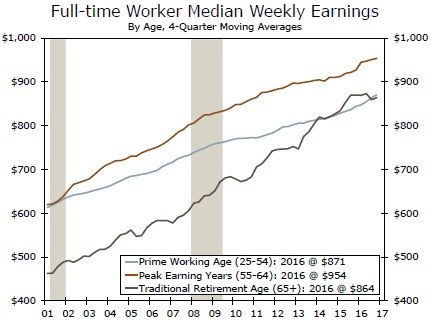
With earnings rising alongside of educational attainment, better-educated seniors are more likely to stick around the workforce longer as potential earnings (i.e., the opportunity costs of retirement) rise (top chart). Jobs in which college degrees are commonplace also tend to be less physically demanding, limiting the need for older workers to retire for health reasons. Since older workers who stay employed are likely to be more educated, earnings growth among Boomers and other workers over the age of 65 has been relatively strong in recent years. Only a decade ago, full-time working seniors took home $129 less per week than prime-age (25-54) workers, but that gap has now closed. Younger Boomers (ages 55-64) have also seen their paychecks grow faster than prime-age workers in what were already their peak earning years (middle chart).
Dare to Go It Alone
With years of experience under their belts, Boomers willing to strike out on their own will also be better able to extend their career. Workers over the age of 65 are three times more likely to be self-employed, helped in part by using retirement savings as a source of start-up capital. Like younger generations, however, the share of older workers who are self-employed has been sliding since the early 2000s, as finances have generally been more constrained and access to employer-sponsored benefits remains a key incentive for staying in the workforce.
The Part-Time
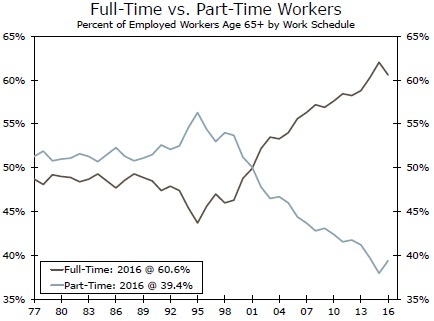
Bridge Working part time will allow Boomers who are interested in scaling back their job responsibilities but not starting their own business to stay in the workforce, while at the same time offering one way to maintain a routine. Nearly 40 percent of seniors worked part time in 2016 compared to 17 percent of workers ages 16-64. While some seniors would prefer to work full time, only a relatively small share of part-timers report being underemployed (4 percent versus 19 percent for part-time workers under age 65). It is worth noting, however, that the share of seniors working full time has risen markedly since the mid-1990s and is another sign that many older workers are successfully delaying retirement (bottom chart).
Author
Wells Fargo Research Team
Wells Fargo

















