Which American Industries Are Vulnerable to Tariff Retaliation?

The aircraft, chemicals and machinery industries have significant exposure to exports, especially to the European Union. A trade war, should one develop, could have a meaningful effect on the U.S. economy.
Some Industries Have Significant Exposure to Exports
President Trump announced on March 8 that his administration would levy 25 percent tariffs on steel imports and 10 percent tariffs on aluminum imports, and he followed up these actions on March 22 by announcing tariffs worth at least $50 billion on imports exclusively from China. China has responded with some minor actions of its own, but it could do much more. The administration has temporarily excluded the European Union (EU) from the steel and aluminum tariffs, but those countries could eventually retaliate if tariffs are instated on them. Which U.S. industries would be most vulnerable to retaliatory steps?
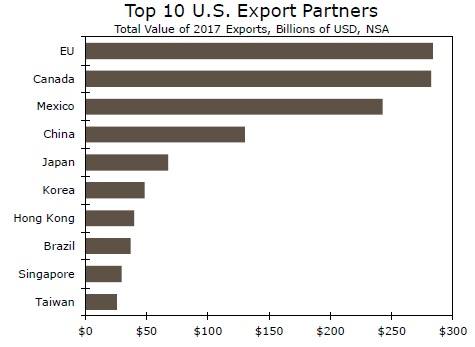
We start by looking at the top export markets for the United States. As shown in the top chart, the EU and Canada were the top export markets for the United States in 2017. (All 28 EU countries have the same trade policy so we treat them collectively as a single economy.) Mexico is a close third, and China and Japan round out the top five. We next calculate the percentage of industry value added that is accounted for by exports to America's most important trading partners outside of NAFTA. (The administration has exempted Canada and Mexico from the steel and aluminum tariffs, so we remove them from the list because they have no grounds for retaliation at this point.) As shown in the middle chart, about 30 percent of value added in the "other transport equipment" industry (largely the aircraft industry) is accounted for by exports to America's top export markets outside of NAFTA. The chart also makes it clear that exports to the EU are an important component of the value added that is generated in that industry. Meaningful proportions of value added in the chemicals, machinery & equipment rental, computer and machinery & equipment industries are also accounted for by exports to these important trading partners. In most cases, these industries also have meaningful exposure to exports to the EU, which reflects the status of the EU as one of America's most important trading partners.
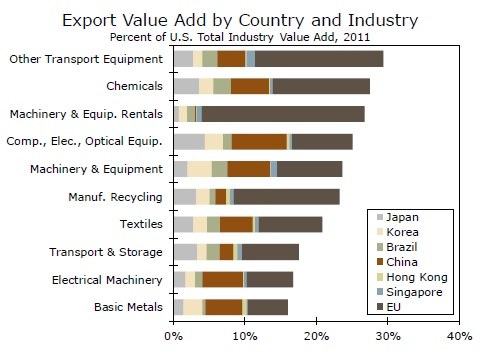
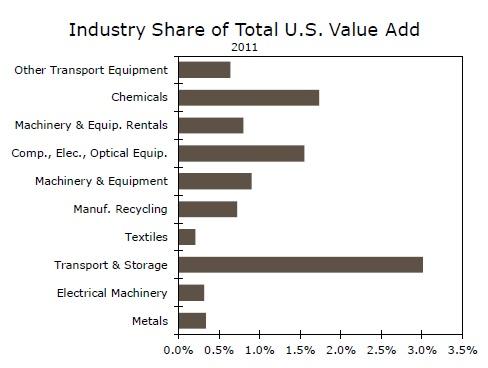
Clearly, retaliation that focused on the industries shown in the middle chart could have significant detrimental effects on those individual industries. But how big would the overall macroeconomic effect be? The bottom chart shows value added contributions of the industries shown in the middle chart. For example, the "other transport equipment" industry, which we have determined would be most vulnerable to foreign retaliation, accounts for only 0.6 percent of total value added in the U.S. economy. Retaliation that focused solely on this industry would not have a meaningful effect on the macro U.S. economy. But, foreign governments do not need to limit their retaliation to just this one industry. The 10 industries that are shown in the bottom two charts account for roughly 10 percent of the value added in the economy. An all-out trade war, should one develop, could have a noticeable effect on the U.S. economy.
Author
Wells Fargo Research Team
Wells Fargo