What's happening to unemployment in States that cancelled Federal benefits early?


Let's explore the claim that Republican states ending benefits early has improved unemployment rates.
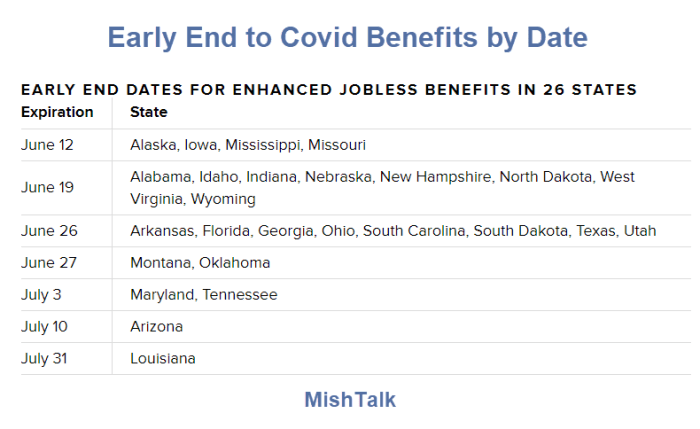
The WSJ reports Americans Are Leaving Unemployment Rolls More Quickly in States Cutting Off Benefits
The number of unemployment-benefit recipients is falling at a faster rate in Missouri and 21 other states canceling enhanced and extended payments this month, suggesting that ending the aid could push more people to take jobs.
Federal pandemic aid bills boosted unemployment payments by $300 a person each week and extended those payments for as long as 18 months, well longer than the typical 26 weeks or less. The benefits are set to expire in early September, but states can opt out before then.
Missouri Gov. Mike Parson said the benefits were helpful during the height of the pandemic, but their continuation has “worsened the workforce issues we are facing.”
The number of workers paid benefits through regular state programs fell 13.8% by the week ended June 12 from mid-May—when many governors announced changes—in states saying that benefits would end in June, according to an analysis by Jefferies LLC economists. That compares with a 10% decline in states ending benefits in July, and a 5.7% decrease in states ending benefits in September. Workers on state programs would lose the $300 weekly federal enhancement but could continuing receiving the state benefits.
Davina Roberson of Fenton, Mo., said she is scrambling now that her benefits have been cut off. The 45-year-old mother of two boys with special needs was furloughed last year from a corporate-travel agent job that paid her $26 an hour and allowed her to work from home, which helped her manage the boys’ care.
“It’s not that I don’t want to go back to work,” Ms. Roberson said. But “if I took a minimum wage job, I’d be working for health insurance and child care and have nothing left to live on.”
Unemployment Rate US vs Missouri
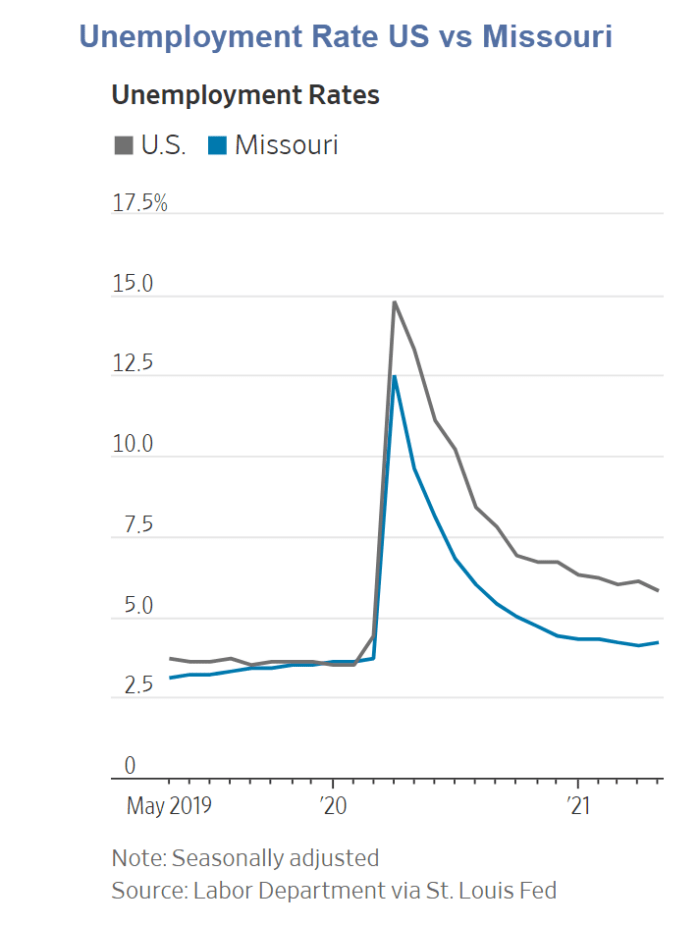
Seasonally Adjusted?
The WSJ posted that chart as evidence. It looks compelling until you dive into the details.
The chart is also mislabeled. State data is not seasonally adjusted.
Unemployment Rate Percent 4 States
The national average is seasonally adjusted, state data isn't.
Key Points
- The unemployment rate for Iowa was 3.6% in January and has been ticking up. As of May, it's 3.9%
- The unemployment rate for Missouri was 4.1% in April and ticked up to 4.2% in May.
- The unemployment rate for Alaska bottomed at 6.5% on October of 2020 and inched up to 6.7% in May of 2021.
- Of the four states, only Mississippi fits the bill, falling from 6.2% in April to 6.1% in May.
Is the WSJ Article Wrong?
No. The WSJ used the wrong chart. Unemployment data is only as of May. The early cutoff was June 12.
Actual unemployment results might start showing up with the June report that comes out Friday, July 2.
"Might Start"?
The BLS reference period for its unemployment surveys is the week that contains the 12th of the month. Alaska, Iowa, Mississippi, and Missouri cut benefits on the 12th.
Seasonal adjustments, rather the lack of them, also come into play.
Thus, may not see the full impact on unemployment in those states until the July report released Friday, August 6, if then.
The August report on September 3 will show nearly the full impact in 25 states. However, seasonal adjustments remain an issue.
Continued Claims
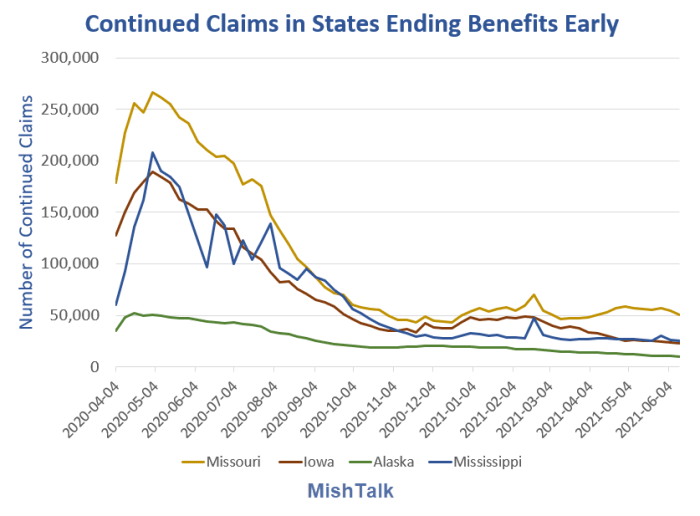
Jefferies analysts used continued claims in their analysis, not state unemployment rates.
Let's hone in on that idea.
Continued Claims in States Ending Benefits Early Detail
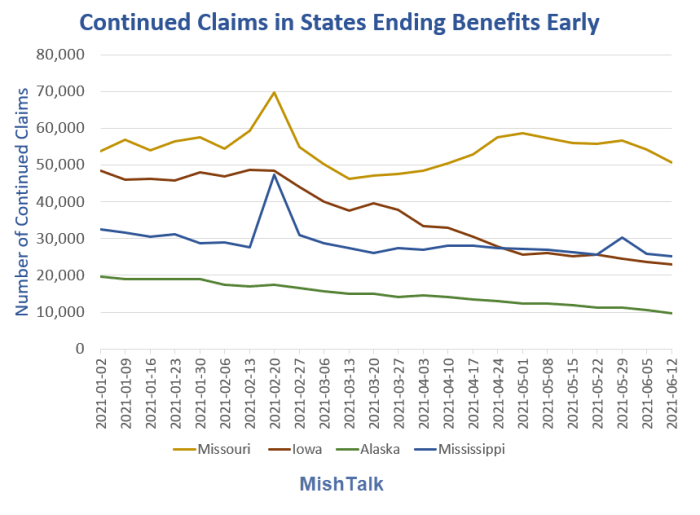
Missouri shows the impact Jefferies stated.
However, I have a few issues: The data only goes to June 12, it is not seasonally adjusted, and it is aligned with the overall national Trend.
How much of the benefit is simply ongoing improvement vs anything Republican governors did?
National Trends
State vs National Comparison
The seasonal adjustments are massive. The National Trends, seasonally adjusted, show steady improvement. Unadjusted state data shows upticks starting at the beginning of the year.
Anecdotal Data
The best data we have as to what is happening is anecdotal.
The WSJ article had anecdotes on Missouri. I have some from Utah.
Last evening we ate out at Olive Garden, a national chain. (There is a huge dearth of restaurants open late (after 9:00) here.
The place was half empty, as was the parking lot. Yet, even with Covid restrictions lifted, we had a 35-minute wait to get seated.
Why?
I was sure of the answer but I asked the server anyway. He responded that they were having a very difficult time getting help and that he was working a double shift.
However, he went on to say: "We had a recent uptick in applications". Then he added his belief that the uptick in applications was "due to Utah ending unemployment benefits soon".
How soon? Note my lead chart: June 26.
Believe the Anecdotes, Not Lagging Data
The actual data is out of date and seasonally skewed.
Let's return to Missouri for this clip: “It’s not that I don’t want to go back to work,” Ms. Roberson said. But “if I took a minimum wage job, I’d be working for health insurance and child care and have nothing left to live on.”
The unfortunate reality is that it is not government's job to forever pay people what they were making pre-Covid.
Believe the anecdotes!
Major Attitude Adjustments Coming
Multiply the above scenarios by millions of workers and think about what a sudden decline in income will do to spending.
A forced attitude adjustment (any job is better than no job), complete with spending repercussions, will soon be underway.
Author
Mike “Mish” Shedlock's
Sitka Pacific Capital Management,Llc