Second round effects are here

On Friday, 17th of October, Andrew Bailey stated that there was “little evidence yet” of “inflation becoming embedded in the UK economy”, he went on to say that “second round effects have been quite limited”. I doubt he feels so sure now, with core CPI rising from 2.4% to 2.6%, ONS figures this morning revealed.
Second round effects are what the BoE uses to refer to a self-reinforcing cycle where companies raise their output prices in response to higher input costs, leading to workers demanding higher pay, completing the cycle as this feeds into output costs.
Take recreation and culture prices, for example, usually dominated by prices of household electronics as well as holidays, its YoY CPI rate increased from 1.6% in August to 2.3% in September, the second fastest rise after transportation.
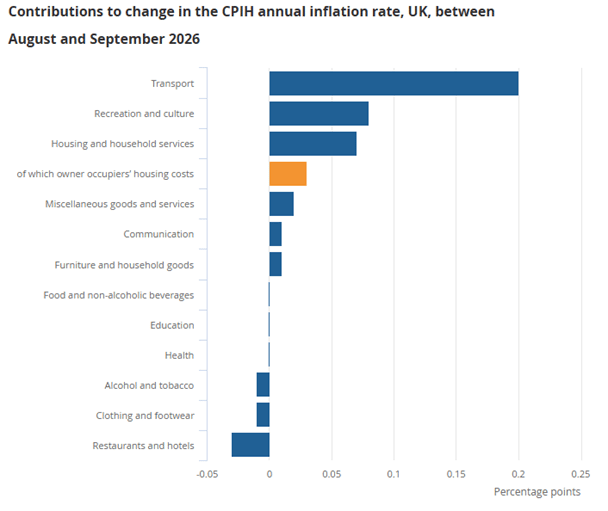
Increases in the cost of Communication and Furniture also represent similar concerns over second round effects. A 25bps hike on November 5th by the Monetary Policy Committee seems guaranteed, although the 44% chance given to a back-to-back hike by the BoE in December seems a little high. Even if markets are modestly peeling away from their expectations of a 5% terminal rate by September of next year.
Wage data on Tuesday did break the second-round effects cycle in September however, with average weekly wage growth slowing, preventing the full circle forming. But this pulls at the thread of the reliability of UK labour data, which is becoming less coherent with each release.
What has not really played any meaningful role in discussions of the Pound as of recent is the budget, due now in a week. Possibly due to Burnham only taking the reins in June, possibly due to John Healey’s reputation as a steady hand, likely a combination of both. This is what has likely allowed the Pound to reach its recent heights, even despite the fact that the UK’s fundamental’s are built on energy inflation, too high terminal rate expectations and shaky jobs data.
Author

David Stritch
Caxton
Working as an FX Analyst at London-based payments provider Caxton since 2022, David has deftly guided clients through the immediate post-Liz Truss volatility, the 2020 and 2024 US elections and innumerable other crises and events.
















