What Japan's new Prime Minister Takaichi means for the Yen
- The Japanese Yen steadies as markets absorb the appointment of Sanae Takaichi as Japan’s new Prime Minister.
- Investors weigh the risk of a mismatch between Japan's expansionary fiscal policy and gradual monetary normalization.
- The composition of the new government and signals sent to the Bank of Japan fuel cautious repositioning in the currency.


The Japanese Yen (JPY) stabilizes against the US Dollar (USD), with the USD/JPY pair hovering just below the 152.00 threshold on Wednesday, as markets digest the arrival of a new tandem at the helm of Japan’s economic policy. The election of Sanae Takaichi as Prime Minister, followed by the appointment of Satsuki Katayama as Finance Minister, reshapes the balance between fiscal discipline and growth support.
For investors, the message is twofold: fiscal policy will be more active, while the Bank of Japan’s (BoJ) monetary room for maneuver will remain intact, which explains the relative stability of the Japanese Yen despite recent political turbulence.
Sanae Takaichi, Japan’s first female Prime Minister, combines a conservative stance with a determination to act. She is preparing a stimulus package estimated at more than ¥13.9 trillion, focused on three pillars:
- Measures to fight inflation.
- Targeted support for strategic industries such as semiconductors and artificial intelligence.
- Stronger national security.
This “responsible expansionism” aims to support household purchasing power without undermining Japan’s debt sustainability. However, the coalition formed with the Japan Innovation Party (Ishin) lacks an absolute majority, forcing the government to negotiate each measure. This parliamentary constraint acts as a fiscal safeguard, reducing the risk of policy slippage but potentially slowing reform execution.
Moreover, the appointment of Satsuki Katayama as Finance Minister strengthens the government’s economic credibility. A former senior official at the Ministry of Finance (MoF), Katayama is deeply familiar with fiscal policymaking and monetary diplomacy. Her past remarks suggest a preference for a stronger JPY, which she once estimated to be around 120-130 per USD based on fundamentals.
Her presence in the cabinet could deter speculators from testing Japanese authorities again on the issue of excessive JPY weakness. Katayama also represents a pragmatic approach as she proves supportive of proactive fiscal measures but committed to financial stability and Japan’s credibility with investors. For markets, this duality is reassuring, tempers fears of uncontrolled inflation and limits bearish bets on the Japanese Yen.
On the monetary front, the Bank of Japan (BoJ) remains on course toward gradual normalization. Despite the political transition, domestic fundamentals remain solid: inflation has been above 2% for three years, wages are rising, and the economy has expanded for five consecutive quarters.

Japan National Consumer Price Index (CPI) ex Fresh Food (YoY). Source: FXStreet
Recent comments by BoJ Deputy Governor Shinichi Uchida, confirming that interest rate hikes will continue if conditions warrant, reinforce expectations of another adjustment before year-end. Economists surveyed by Reuters still largely expect a rate increase in October or December, suggesting that the new government does not fundamentally alter the BoJ’s trajectory. At most, it could shift the timing slightly.
Against this backdrop, the interest rate differential between the United States and Japan remains a key driver for USD/JPY. Markets continue to price in two 25-basis-point rate cuts from the US Federal Reserve (Fed) by year-end, according to the CME FedWatch tool, which could gradually narrow the US Dollar’s yield advantage.
However, the Greenback’s relative strength, supported by the resilience of the US economy and renewed appetite for carry trades, keeps the pair near its recent highs. Until the BoJ provides a clearer signal or adopts a more hawkish tone, the Japanese Yen remains weighed down by the effective divergence in monetary policies.

US 2-year yields and Japan 2-year yields. Source: TradingView.
Japanese authorities, aware of the sensitivity of the foreign exchange market, emphasize coordination between the government and the BoJ. Katayama reiterated that exchange rates should reflect economic fundamentals, giving an implicit signal to traders that the MoF is closely monitoring volatility. In this context, the most likely scenario is a period of sideways JPY movement in the short term with limited volatility ahead of Japan’s September inflation data due Thursday and the BoJ’s policy meeting scheduled for late October.
Research houses also adopt a balanced view. Some, such as Brown Brothers Harriman, expect a slightly more hawkish BoJ tone in the near term, while others, like Commerzbank, highlight that the new government is unlikely to deliberately weaken the currency. This points to a phase of consolidation around current levels if political noise continues to fade.
Overall, three channels currently drive the Japanese Yen’s valuation. First, the fiscal channel: a more targeted than indiscriminate stimulus, financed through a supplementary budget, supports demand without yet challenging fiscal discipline. A compromise that does not prompt the BoJ to deviate from its normalization path. Second, the monetary channel: inflation remains near but above target, and improving wages justify the BoJ’s patient hawkish stance. The question is 'when,' not 'if.' Third, the political channel: Japan's Prime Minister Sanae Takaichi must govern with a relative majority and a heterogeneous coalition. This arithmetic reduces extreme uncertainty but leaves room for tactical delays and policy adjustments.
In short, the combination of renewed political leadership, an ambitious but contained fiscal program, and a still cautious BoJ creates a transitional environment for the Japanese Yen. Markets await a clearer signal, either from the fiscal side if stimulus exceeds expectations, or from the monetary side if the BoJ accelerates tightening. Until then, USD/JPY trades in a fragile equilibrium, above 151.50 but below the psychological 152.00 mark, reflecting Japan’s ongoing search for the right balance between growth, discipline, and monetary credibility.
USD/JPY technical analysis: Firm in a bullish channel
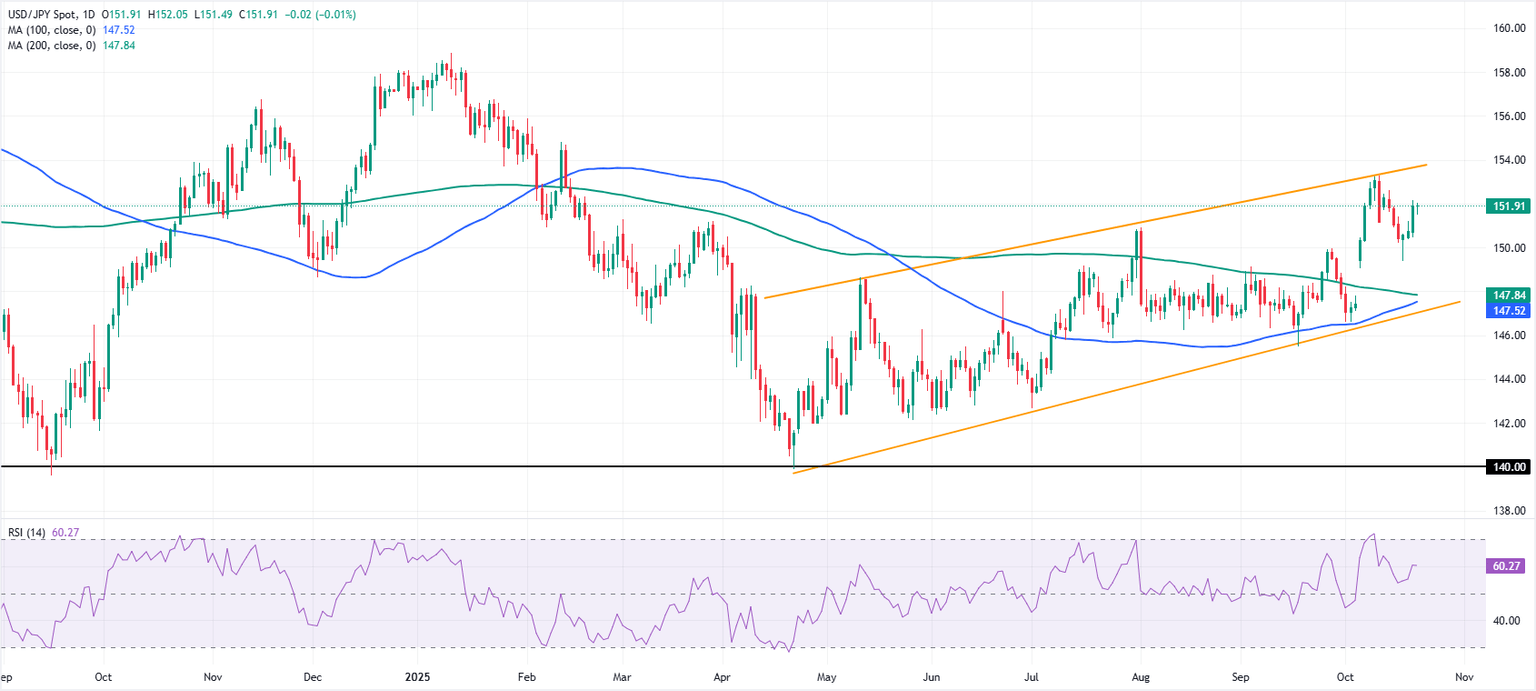
USD/JPY daily chart. Source: FXStreet.
The USD/JPY pair remains in an uptrend on the daily chart, trading in a bullish channel since the new rebound from the 140.00 region in April, which has offered solid support since August 2023.
Further weakening of the Japanese Yen could push the pair to retest the upper band of the channel, currently at 153.60. A breakout from the top of the channel could then prompt a bullish acceleration to test the January high at 158.88.
On the downside, a return below the psychological 150.00 level could lead to a test of a zone of confluence around 147.00-147.84, where we find the 100-day Simple Moving Average (SMA) at 147.85, the 200-day SMA at 147.84, and the lower channel bound around 147.00. A move below this level would put the round 146.00 mark in sight.
Premium
You have reached your limit of 3 free articles for this month.
Start your subscription and get access to all our original articles.
Author
Ghiles Guezout
FXStreet
Ghiles Guezout is a Market Analyst with a strong background in stock market investments, trading, and cryptocurrencies. He combines fundamental and technical analysis skills to identify market opportunities.