What does a trading signal look like? – EUR/USD, GBP/USD, USD/JPY


Weekly thoughts
What does a trading signal look like?
And I’m not talking about the ‘buy/sell signals’ you get asked to pay for on Telegram!
I mean what does it look like when the market signals to you that there is a trade you can place to earn a potential profit?
Of course, it can look a million different ways but there are some common components to all trading signals.
I show you what we are looking for every week in our setups and signals. And hopefully that serves as some good inspiration.
But ultimately, you need to know what you’re looking for.
Think of the signal as the bridge between the idea (setup) and the execution (trigger).
- Setup = Why → The context. What’s going on? What trade idea makes sense?
- Signal = When → The market condition that validates your idea.
- Trigger = How → The precise entry tactic you use once the signal has flashed.
Components of a good signal
1. In alignment with setup
The signal should directly tie back to your scenario.
- Setup: Pullback in an uptrend, want to buy dip.
- Signal: Price touches 50-day MA + prints bullish pin bar.
2. Objective and repeatable
A signal is not a feeling. It’s something you can write down and backtest.
- “Price looks like its too high” = vague.
- “Daily close above prior resistance, making a new 20-day high” = testable.
3. Condition-based, not action-based
This is where it's easy to conflate a signal with a trigger. A signal is not “I enter on candle close” (that’s the trigger). The signal is: “A candle closes above resistance.”
4. Often multi-layered (confluence)
Most strong signals involve more than one confirming condition:
- A level (support/resistance, supply/demand).
- A price action pattern (inside bar, engulfing, pin bar, breakout).
- A filter/indicator (MA, RSI, VWAP, volume, volatility).
The more conditions that line up, the “louder” the signal.
5. Clear invalidity
Every signal should imply a point where it’s no longer valid.
- Breakout signal → invalid if price falls back inside the range.
- Reversal signal → invalid if price closes beyond the support/resistance zone.
Examples of signals
- Reversal setup:
Signal = Price enters a demand zone and prints a bullish engulfing candle.
- Breakout setup:
Signal = A 4H candle closes above the consolidation range with above-average volume.
- Trend continuation setup:
Signal = Price pulls back to the 20 EMA and forms an inside bar that breaks upward.
Above I’ve given some brief examples for educational purposes but any trading signal must be much more detailed to be able to trade it. But worry not!
In future weeks we will give more detailed examples of trading signals, as well as triggers and setups - that you can test out and see what works for you.
Setups and signals
We look at hundreds of charts each week and present you with three of our favourite setups and signals.
EUR/USD
Setup
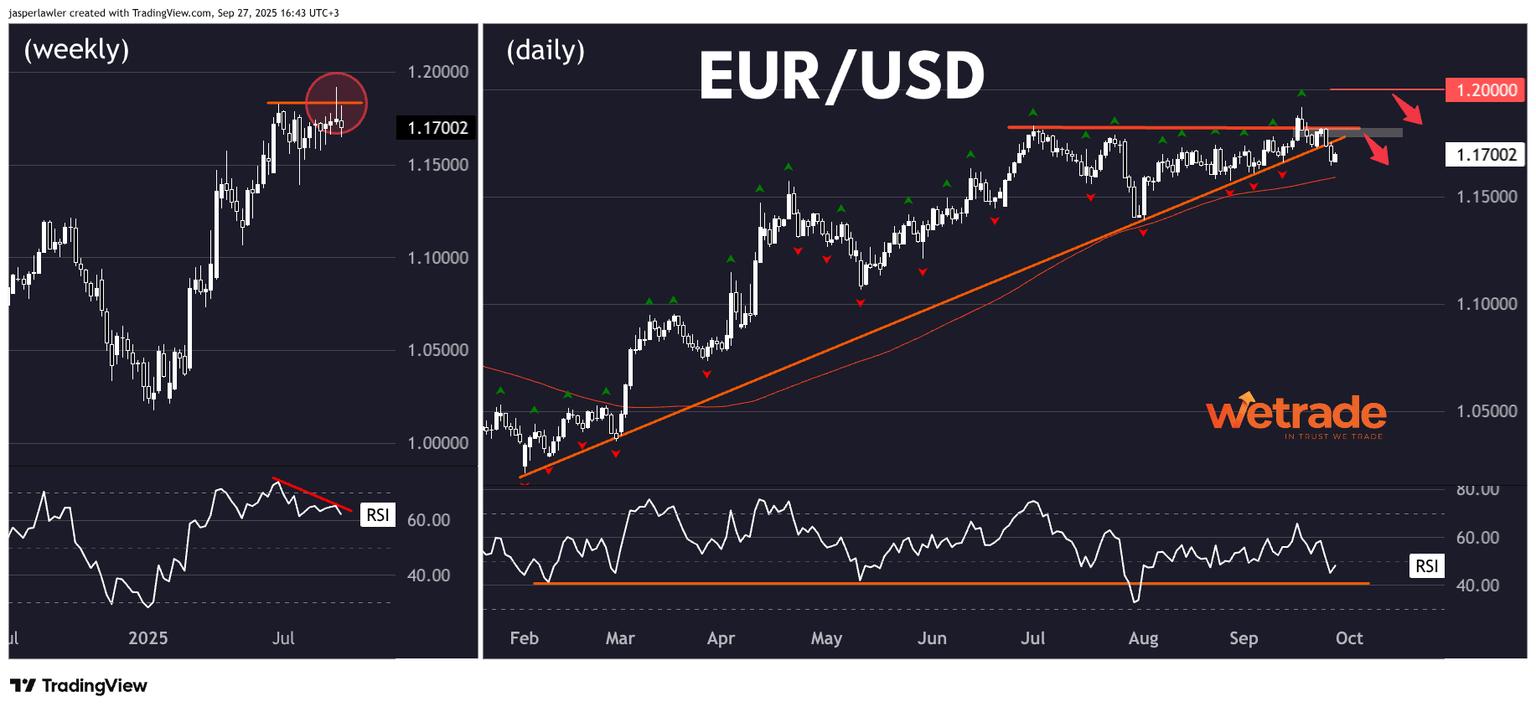
Likely market top and possible trend reversal. A shooting star candle pattern produced a fakeout above the prior highs alongside bearish RSI divergence, with price again unable to reach the 1.20 round number.
Signal
A broken long term uptrend line as well as RSI shifting to a bearish regime holding under the 65 level suggests the uptrend has begun to reverse. A supply zone around 1.18 could offer a sell signal, as could the 1.20 figure if the market puts in one more ‘failed’ higher high.
GBP/USD
Setup
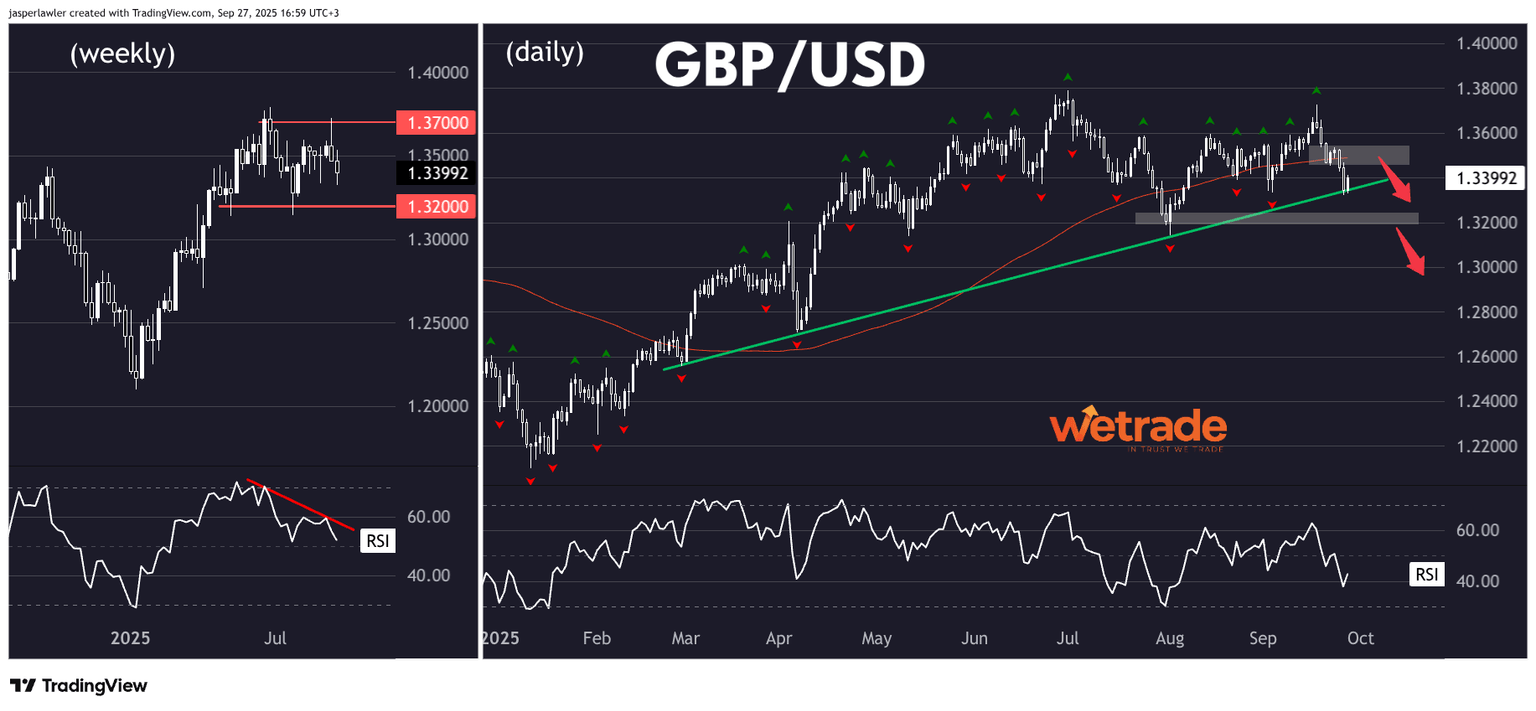
The uptrend has already turned into a sideways range between around 1.32 and 1.37 setting up a possible market top and new downtrend.
Signal
RSI already reached oversold levels in early August and has failed to get overbought since, while price has failed several attempts to break and hold above 1.36. A bounce towards the supply zone around 1.35 could present a sell trigger while a break of the uptrend line would confirm the bearish reversal.
USD/JPY
Setup
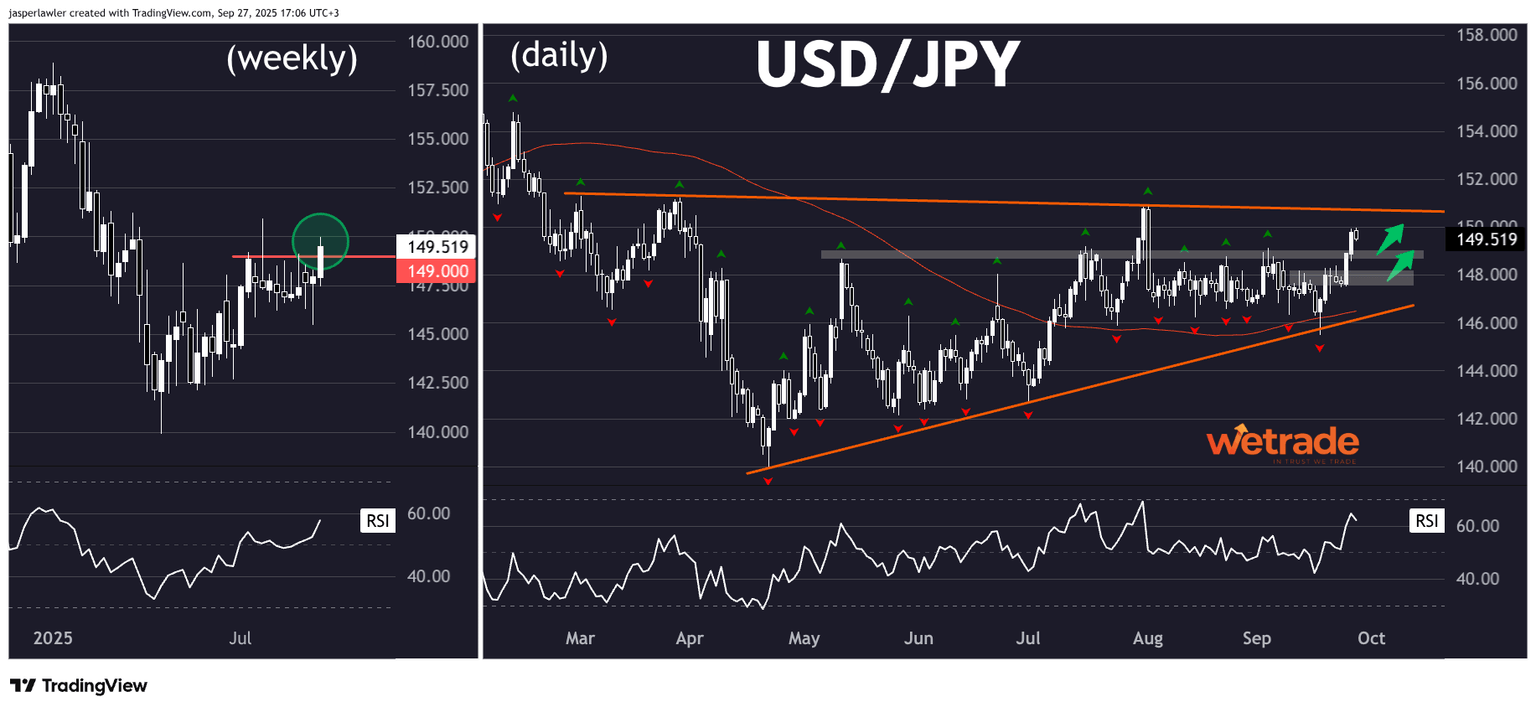
The price just made its highest weekly close since March, signalling a likely market bottom and new uptrend.
Signal
Price has held above its 100-day MA and support at the 146 level - hitting 150 last week. Another pullback to 149 or 148 could offer a buy trigger with a break of the long term triangle pattern’s upper trendline confirming the bullish reversal.
Author
Jasper Lawler
Trading Writers
With 18 years of trading experience, Jasper began his career as a stockbroker on Wall Street in New York City before sharpening his analytical skills at top trading firms in the City of London.