Week ahead – Fed, BoE and BoJ face inflation test as markets reprice interest rate paths
- Fed decision in focus as markets price in more US rate hikes
- Middle East tensions, oil rally, and tariffs reignite inflation fears
- BoE and BoJ meetings could drive sterling and yen volatility
- Big Tech earnings to test Wall Street sentiment

Middle East and Trump’s tariffs revive inflation fears
The US dollar gained against the other major currencies this week amid the escalating tensions in the Middle East as well as US President Trump’s decision to proceed with a new round of tariffs after previously imposed levies expired.
Although the latest inflation data showed that US prices slowed more than expected in June, the hostilities in the Middle East, the reclosure of the Strait of Hormuz, the resulting rally in oil prices, and Trump’s fresh trade levies have all revived fears about inflation spiraling out of control again.
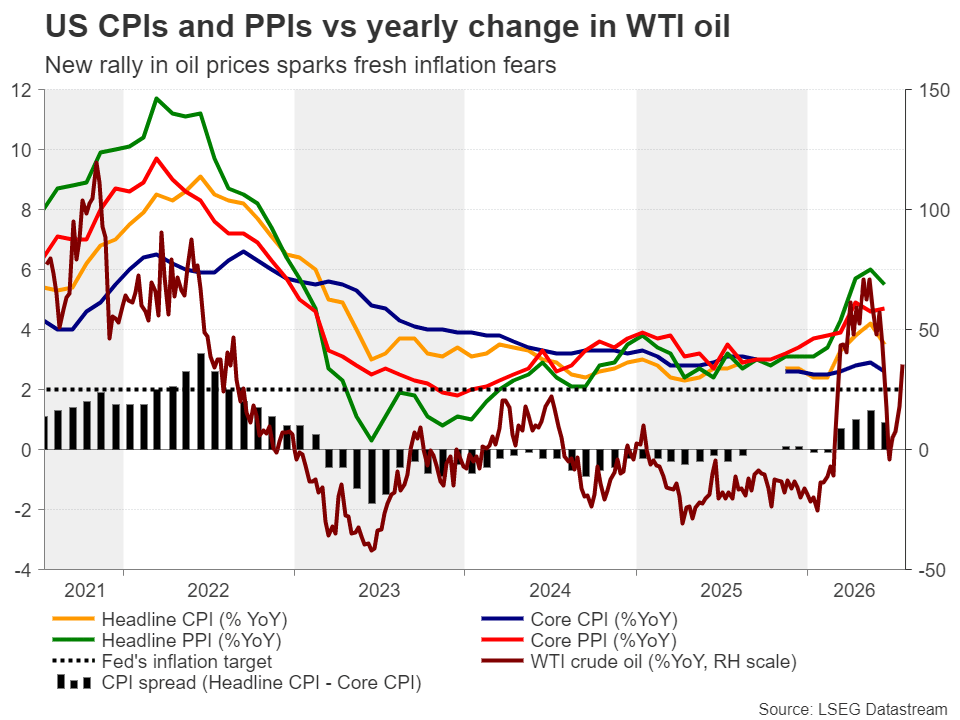
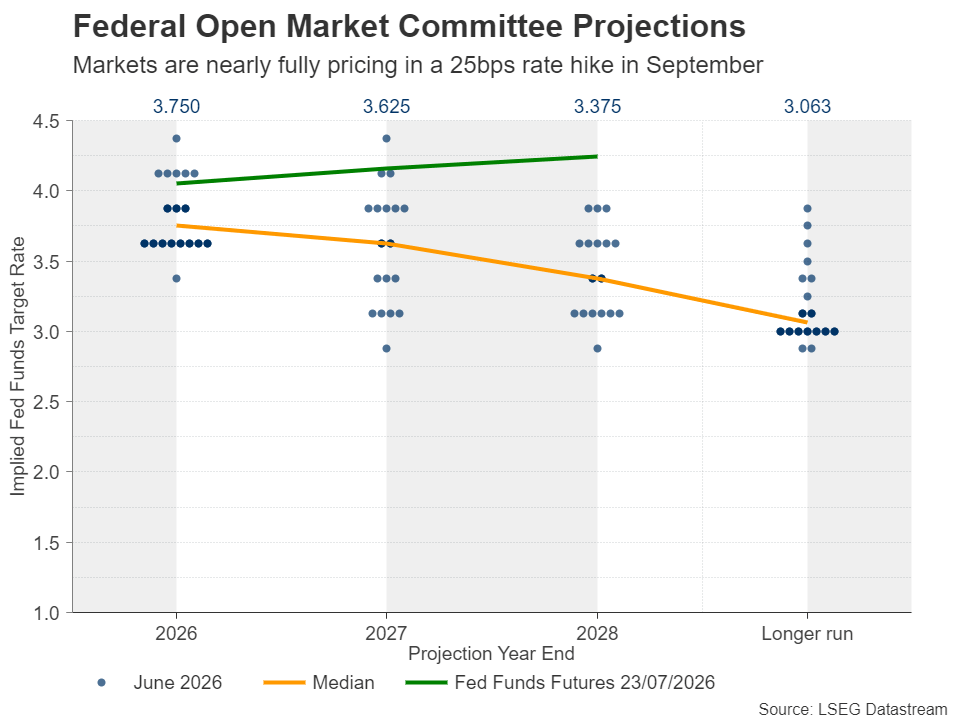
According to Fed fund futures, investors are now fully pricing in a quarter-point hike by the Fed in September, while another one is factored in for March. There is even a decent 35% chance that policymakers could press the rate hike button this week.
Fed decision takes center stage
With all that in mind, Wednesday’s decision may attract special interest. Even if the Fed does not act at this gathering, any hints corroborating the notion that they could do so in September are likely to add further fuel to the dollar’s engines as Treasury yields could drift higher. At the same time, gold may come under renewed pressure as the opportunity cost for holding the metal increases.
That said, with Kevin Warsh avoiding providing clear signals and the forward guidance being removed from the statement under his leadership, investors may find it difficult to arrive at safe conclusions from the statement and the Chair’s press conference, especially with no fresh updated interest rate projections to accompany this decision.
Now in the case of the Fed pressing the hike button at this meeting, the market will react in a similar manner, with the only difference being that the aforementioned moves will be magnified as the implied rate path could become much steeper.
The PCE inflation data for June will be released the day after the Fed decision. Although the PCE indices are the Fed’s favorite inflation metrics, they may pass largely unnoticed this time. After all, they concern a period before the latest escalation in the Middle East and the new rally in oil prices, let alone that the CPI data have already revealed how inflation fared during that month. What’s more, investors will already have the Fed decision to digest and reevaluate their own rate projections.
Will the BoE hint at a September rate hike?
On Thursday, the central bank torch will be passed to the Bank of England. At their June meeting, UK policymakers held interest rates unchanged via a 7-2 vote, with the two dissenters favoring a 25bps rate increase. However, in the statement accompanying the decision there was no evidence that policymakers are in a rush to raise interest rates. Investors interpreted the overall message as neutral and continued expecting the Bank to remain on hold in July as well. They were fully penciling in a 25bps hike in November.
However, the latest CPI data revealed that although the headline rate slowed by more than expected in June, due to the steep fall in oil prices, the core CPI rate held steady at 2.6%. Combined with recent remarks by MPC member Alan Taylor, who stressed the importance of learning from past inflation episodes and warned about the resurgence of inflation risks, this allowed investors to assign a strong 75% chance of a September hike, with another one being nearly fully priced in by December.
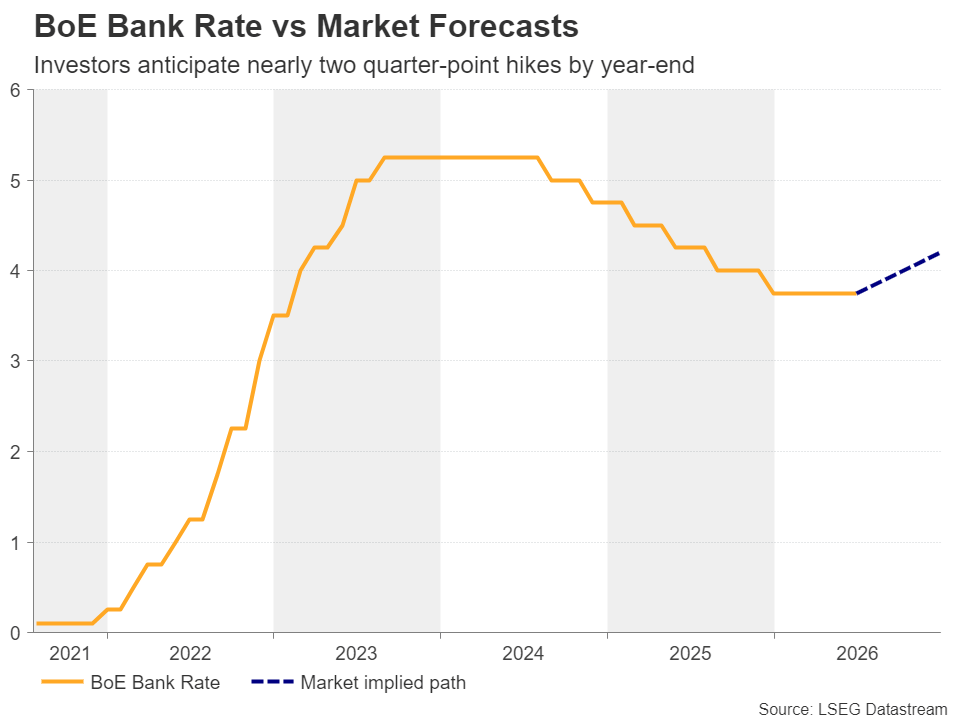
Thus, for the pound to benefit from this decision, the Committee needs to convince traders that a rate hike is looming at the next gathering, either through the voting pattern (more dissenters than in June), or through the statement and Governor Bailey’s press conference.
Can the BoJ come to the yen’s rescue?
Next in line will be the Bank of Japan. When they last met, Japanese policymakers raised interest rates to a three-decade high of 1% via a 7-1 vote, noting that they expect the yearly CPI to “speed up well above 2%” and to ease back to the Bank’s objective between the second half of fiscal 2026 and fiscal 2027.
Since then, remarks by several policymakers have leaned to the hawkish side. Board member Tamura said that the BoJ should raise rates roughly every few months if the economy evolves as expected, while Ayano Sato, who is considered a dove, stressed the need to monitor the impact of the weak yen on inflation and added that the BoJ will remain independent from the government. Taking into account Prime Minister Takaichi’s dovish view, this is considered a hawkish tilt by Sato. What’s more, a recent Bloomberg report revealed that BoJ officials are open to raising rates faster than the previously expected pace if inflationary pressures intensify.
Although the market is still penciling in another 25bps rate hike by the end of the year, the yen did not capitalize on this hawkishness. Perhaps investors do not believe that the BoJ can become more hawkish than it is now, especially with PM Takaichi calling for interest rates to remain low. Takaichi cannot directly intervene in the BoJ’s plans but deciding whom to appoint to the Board could make a big difference.
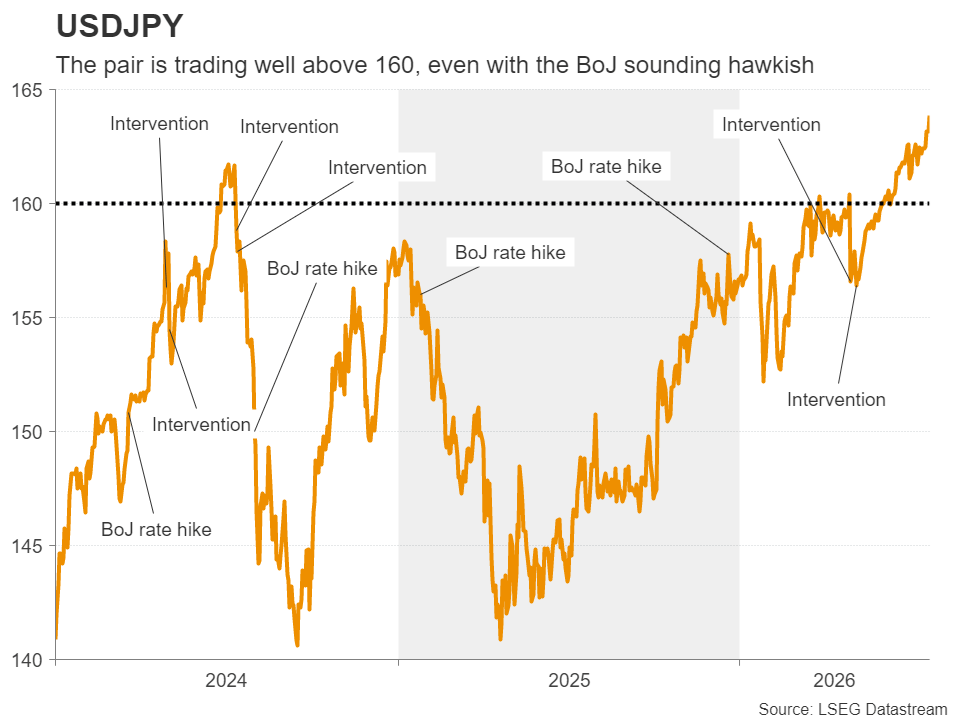
The dissenter at the latest meeting was one of her appointees, while another one, who joined the Board more recently, is also seen favoring looser policy moving forward. What’s more, the term of two hawks will end next summer, allowing Takaichi to appoint more doves within the Board.
Thus, even if a hawkish message boosts the yen on Friday, any decline in dollar/yen is likely to remain limited and short-lived. Even intervention seems unable to change the yen’s fate. Speculation that the BoJ could start leaning to the dovish side in the coming months, combined with mounting Fed hike bets, could keep dollar/yen bulls into the game.
Ahead of the BoJ announcement, the Tokyo CPI data for July will provide a first glimpse as to how the resurgence of US-Iran hostilities and the new rally in oil prices have impacted consumer prices after June’s relative calmness. June retail sales will also be released.
Australian and Eurozone CPI data also on the agenda
Elsewhere, Australia releases CPI data for Q2, while in the Eurozone, the preliminary GDP for Q2 and the flash CPI data for June will be released. Following three rate hikes and a new wave of tensions in the Middle East, investors anticipate a nearly 40% chance of a rate hike at the upcoming meeting. A slowdown in prices during Q2 is unlikely to change that chance, thereby leaving the aussie unphased.
As for the Eurozone, the ECB remained on hold this week and said that it is "well positioned to wait and see." This marks a less-hawkish-than-expected stance in the midst of all this uncertainty and soft GDP and CPI data could prompt traders to push back the timing of when they expect the ECB to press the hike button again.
China will release its official PMI data for July on Friday.
Earnings results to stay in the spotlight
Besides the central banks and the data, the earnings parade continues with results from tech-giants Microsoft, Meta, Amazon and Apple, as well as the semiconductor designers ARM and Qualcomm.
The latest earnings updates from large tech firms brought back to light fears over heavy AI spending that it is not translating into profitability. This week, Tesla stock fell more than 10% after the EV carmaker reported weaker-than-expected profitability, despite upbeat revenue, while Alphabet also sank after the firm revealed high spending plans. Therefore, it will be interesting to see whether more results will add to investors’ anxiety and, thereby, add more pressure on Wall Street.
Author

Charalampos joined Trading Point in August 2022 as a senior market analyst. He has extensive experience in analyzing financial markets, gained through a decade-long career, with his primary focus being on the currency market.