|

NZD/USD Elliott Wave: Price reaches an extreme zone from the 0.5897 peak

In this technical blog, we’re going to take a quick look at the Elliott Wave charts for the NZDUSD Forex pair, published in the members’ area of the website. Recently, NZDUSD made a significant decline within the cycle from the 0.5897 peak. In the following analysis, we will examine the Elliott Wave structure in more detail.

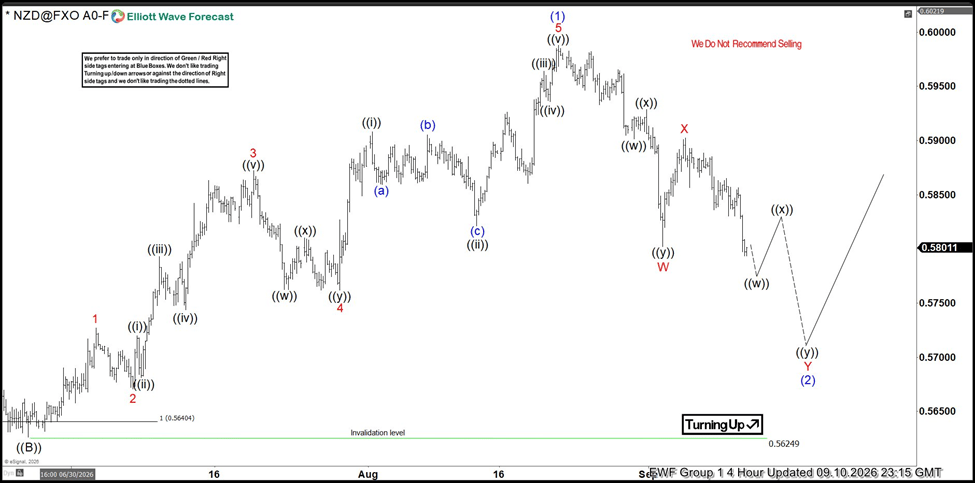
NZD/USD Elliott Wave four-hour chart  09.10.2026

NZDUSD is currently correcting the cycle from the 0.56249 low. Recently, the pair made a new short-term low, which made the price structure of the pullback incomplete. Our members know the importance of incomplete swing structures, as they can help us determine the market’s next path with greater accuracy. The current view suggests more short-term weakness before the next rally takes place. The target is measured using the Fibonacci Extension tool. The pullback is forming an Elliott Wave Double Three pattern. Therefore,  we identify the reversal/buying zone by measuring the W-X Equal Legs area using the Fibonacci Extension tool. In this case, the Equal Legs zone comes at 0.5715-0.5671.  From this area, we expect buyers to step in and regain control, potentially driving the price higher in a three-wave bounce at least.
Chart

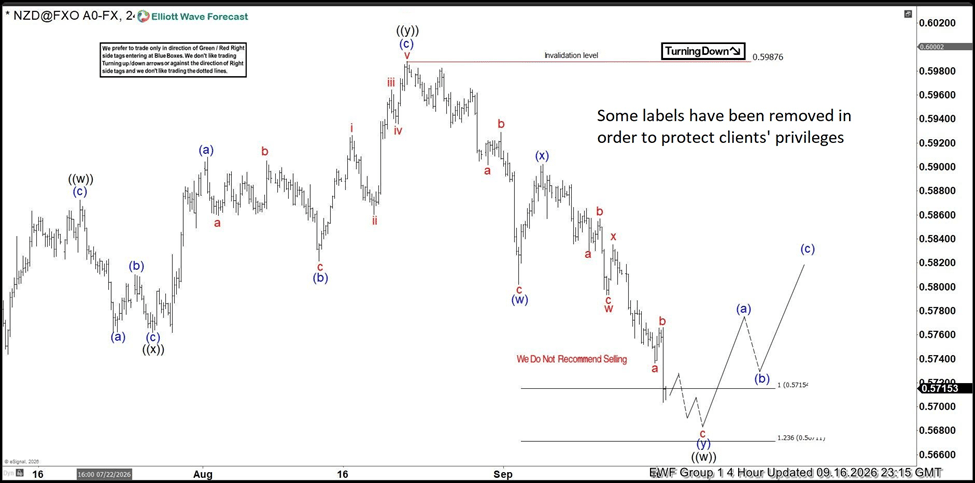
NZD/USD Elliott Wave four-hour chart  09.10.2026

The pair has continued to trade lower, as expected, reaching a key technical area at 0.5715–0.5671, defined by an equal-legs measurement. This zone is important for the current structure. Sellers may look to take profits here, while buyers could step in and provide support. As a result, we may see a short-term corrective bounce developing over the coming days, potentially unfolding in a three-wave structure.

Important note: Our analysis is not based on Elliott Wave in isolation. We perform detailed higher-time-frame cycle analysis, which shows an incomplete market structure. This is one of the key drivers of price action, along with correlation analysis and broader market context.
Chart

Author

Elliott Wave Forecast Team

Elliott Wave Forecast Team

ElliottWave-Forecast.com

More from Elliott Wave Forecast Team
Share:

Editor's Picks

AUD/USD gains traction near  0.7100 as the post-Fed USD rally pauses

AUD/USD finds fresh buyers and retakes 0.7100 in the Asian session on Thursday as the US Dollar pauses its hawkish Fed-inspired rally to its highest level since late July. However, RBA rate-hike bets and hopes for US-Iran diplomatic efforts lift risk sentiment and support the risk-sensitive Australian Dollar and the major.

USD/JPY reverses a dip below 156.00 as focus shifts to BoJ

USD/JPY is reversing a brief dip below 156.00 in the Asian session on Thursday, looking to snap a three-day winning streak to a nearly two-week top set the previous day. The US Dollar pauses following the post-Fed rally to seven-week highs, while a more hawkish repricing of the BoJ's policy normalization path supports the Japanese Yen. This keeps the pair's upside limited, with the focus now shifting to the BoJ policy decision due on Friday.

Gold pops to weekly highs near $4,400

Gold climbs sharply and clinches fresh weekly peaks around the $4,480 zone per troy ounce on Thursday. The precious metal’s bounce leaves behind three daily declines in a row and follows the marked retracement in the US Dollar as well as another negative performance of crude oil prices.

BoE recap: A cautious stance amid rising inflation risks

The Bank of England left Bank Rate unchanged at 3.75% but delivered a distinctly hawkish message as its inflation outlook deteriorated sharply.

One hike down, more to come? The Fed’s new rate path says yes

The Federal Reserve (Fed) raised its Fed Fund Target Range (FFTR) range by 25 basis points to 3.75%-4.00% in a unanimous decision, saying the move would support a timelier return to its 2% inflation goal.

How Japan became the World's Banker and why that era may be ending

Japan's ultra-low interest rates helped finance trillions of dollars in global investments for more than a decade, making the Japanese Yen one of the world’s cheapest sources of funding. With the Bank of Japan expected to tighten policy again this week, that advantage may be entering a new phase. While most major economies raised interest rates, Japan remained the world's outlier.