|

USD/CAD on a slippery slope, 1.23 next in focus [Video]

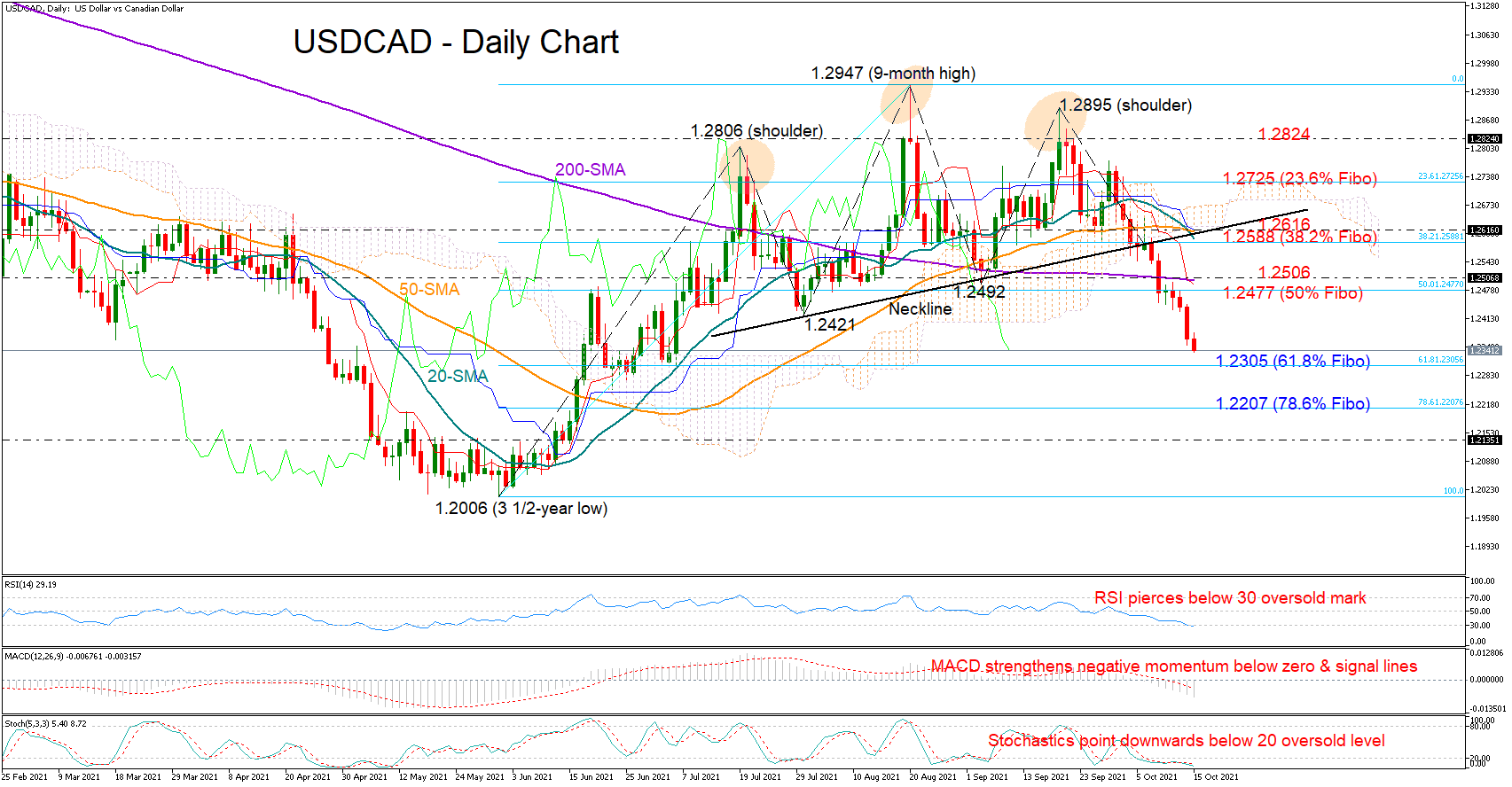
USDCAD bears show no sign of abating as the sell-off continues for the fourth week, with the price crossing aggressively through the 1.2400 area to hit an almost three-month low of 1.2349 on Friday. 

The sharp downfall follows the confirmation of a bearish head and shoulder pattern (H&S) below the neckline at 1.2588 - a sign that the previous upward pattern has completed its cycle. The recent crossover of the 20-day simple moving average (SMA) by the 50-day SMA also came to signify a negative trend reversal in the market, though the prolonged decline is now creating questions about when the pair will apply the brakes on this slippery slope lower.

The RSI and the Stochastics haven't found a pivot point in the oversold area yet, while the MACD remains negatively charged below its zero and signal lines, suggesting selling tendencies could persist a bit longer in the market.

The 61.8% Fibonacci retracement of the 1.2006 – 1.2947 upleg is currently under the spotlight at 1.2305. Should it give way, the door would open for the 78.6% Fibonacci of 1.2207, while in the event of a more aggressive downfall, traders may also keep an eye on the 1.2135 restrictive region.

In the positive scenario, the price may push for a close above the 1.2477 resistance and the 200-day SMA at 1.2500. If efforts prove successful, the bulls will next attempt to dissolve the negative H&S pattern above the broken neckline and the shorter-term SMAs seen between 1.2588 and 1.2618.

All in all, sellers may keep leading USDCAD in the short term, though to gain more fuel they will probably need to clear the 1.2305 support as well.
USDCAD

Author

Christina Parthenidou

Christina joined the XM investment research department in May 2017. She holds a master degree in Economics and Business from the Erasmus University Rotterdam with a specialization in International economics.


More from Christina Parthenidou
Share:

Editor's Picks

EUR/USD weakens to near 1.1900 as traders eye US data

The EUR/USD pair loses ground to around 1.1905, snapping the two-day winning streak during the early European trading hours on Tuesday. Markets might turn cautious ahead of the release of key US economic data, including US employment and inflation reports that were pushed back slightly due to the recently ended four-day government shutdown.

GBP/USD edges lower below 1.3700 on UK political risks, BoE rate cut bets

The GBP/USD pair trades on a weaker note around 1.3685 during the European session on Tuesday. The Pound Sterling edges lower against the US Dollar amid political risk in the United Kingdom and rising expectations of near-term Bank of England rate cuts. 

Gold drifts lower as positive risk tone tempers safe-haven demand; downside seems limited

Gold drifts lower during the Asian session on Tuesday and snaps a two-day winning streak, though it lacks strong follow-through selling and shows some resilience below the $5,000 psychological mark amid mixed cues. The outcome of Japan's snap election on Sunday removes political uncertainty, which, along with signs of easing tensions in the Middle East, remains supportive of the upbeat market mood.

Bitcoin Cash trades lower, risks dead-cat bounce amid bearish signals

Bitcoin Cash trades in the red below $522 at the time of writing on Tuesday, after multiple rejections at key resistance. BCH’s derivatives and on-chain indicators point to growing bearish sentiment and raise the risk of a dead-cat bounce toward lower support levels.

Follow the money, what USD/JPY in Tokyo is really telling you

Over the past two Tokyo sessions, this has not been a rate story. Not even close. Interest rate differentials have been spectators, not drivers. What has moved USD/JPY in local hours has been flow and flow alone.

Bitcoin Cash trades lower, risks dead-cat bounce amid bearish signals

Bitcoin Cash (BCH) trades in the red below $522 at the time of writing on Tuesday, after multiple rejections at key resistance. BCH’s derivatives and on-chain indicators point to growing bearish sentiment and raise the risk of a dead-cat bounce toward lower support levels.