USD/CAD loses battle with key resistance, uptrend stagnates [Video]
![USD/CAD loses battle with key resistance, uptrend stagnates [Video]](https://editorial.fxstreet.com/images/Markets/Currencies/Majors/USDCAD/dollars-11347249_XtraLarge.jpg)

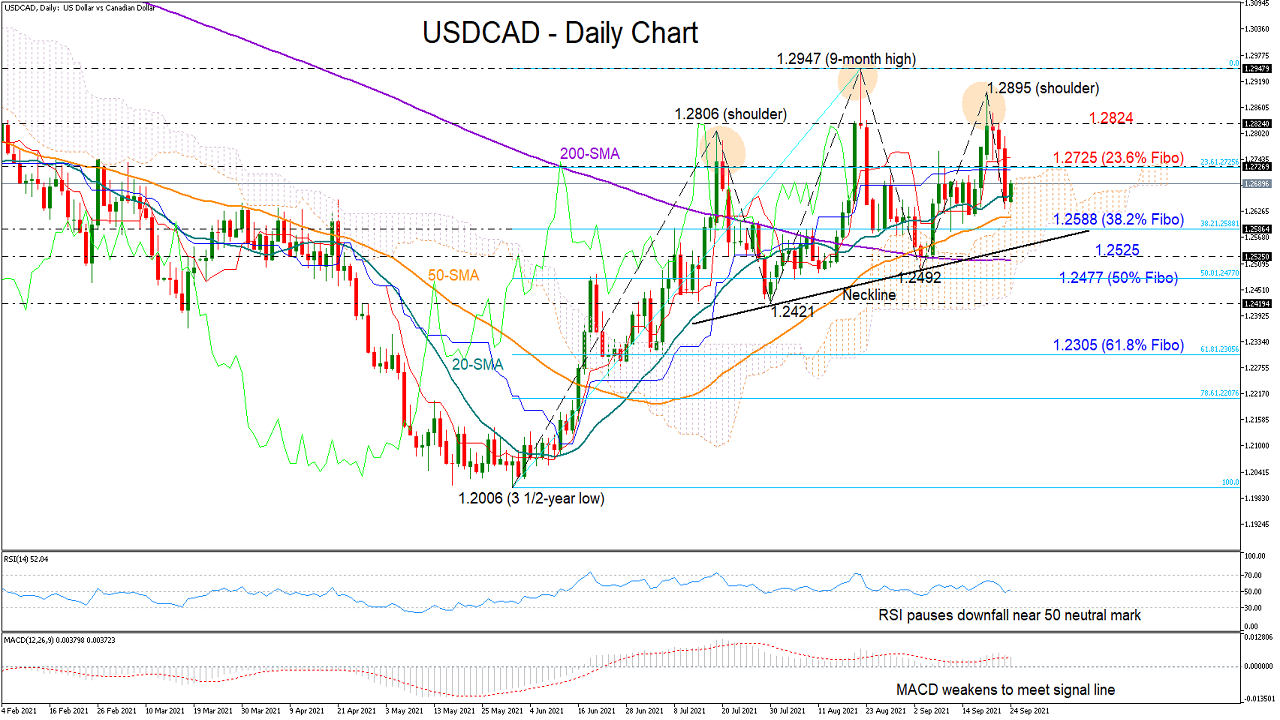
USDCAD saw its bullish efforts evaporate near the tough resistance of 1.2824 for the second time at the start of the week despite the peak at 1.2895, with the price aggressively slumping to 1.2832 in the aftermath.
The short-term risk is currently viewed as neutral as the RSI has paused its downfall around 50, while the MACD has pulled lower within the positive area to test its red signal line.
As regards the market trend, the bullish intersections between the simple moving averages (SMAs) are still endorsing the upward trajectory from the June lows, though the pair’s incapability of creating fresh higher highs this month has degraded the quality of the trend.
Nevertheless, unless the price dives below the 200-day SMA and the previous low of 1.2492, confirming a bearish head and shoulder structure, the upward pattern will remain valid. Prior to that, support could occur near the 50-day SMA and the 1.2588 mark, where the 38.2% Fibonacci retracement of the 1.2006 – 1.2947 is also positioned. Should the market close below 1.2492, the spotlight will shift to July’s trough of 1.2421.
In the positive scenario, if the price sets a strong foothold around the surface of the Ichimoku cloud, the 23.6% Fibonacci of 1.2725 may immediately block the way towards 1.2824, as it did early in August. A sustainable move above 1.2824 would open the door for the nine-month high of 1.2947, a break of which is required to upgrade the outlook in the medium-term picture.
In summary, USDCAD is currently holding a neutral short-term bias, but its medium-term uptrend seems to be languishing. Yet, only a decisive close below 1.2492 would officially signal a trend reversal.
Author
Christina joined the XM investment research department in May 2017. She holds a master degree in Economics and Business from the Erasmus University Rotterdam with a specialization in International economics.