USD/JPY Weekly Forecast: A pause before renewed yen weakness
- BOJ maintains monetary accommodation, interest rate at -0.1%.
- GDP forecast lowered to 3.4% from 3.8%, inflation to flat from 0.6%.
- BOJ’s Kuroda says weak yen “definitely positive” for Japan’s economy.
- FXStreet Forecast Poll sees extended technical weakness for USD/JPY.

The USD/JPY moved sideways in five sessions as a dovish Bank of Japan contrasted with the expected Federal Reserve announcement of its bond taper next Wednesday.
Markets have largely priced in the Fed restriction but with the amount and timing of the purchase reduction uncertain, and with US bank officials offering little guidance, traders have been unwilling to speculate heavily on the program’s apparent demise.
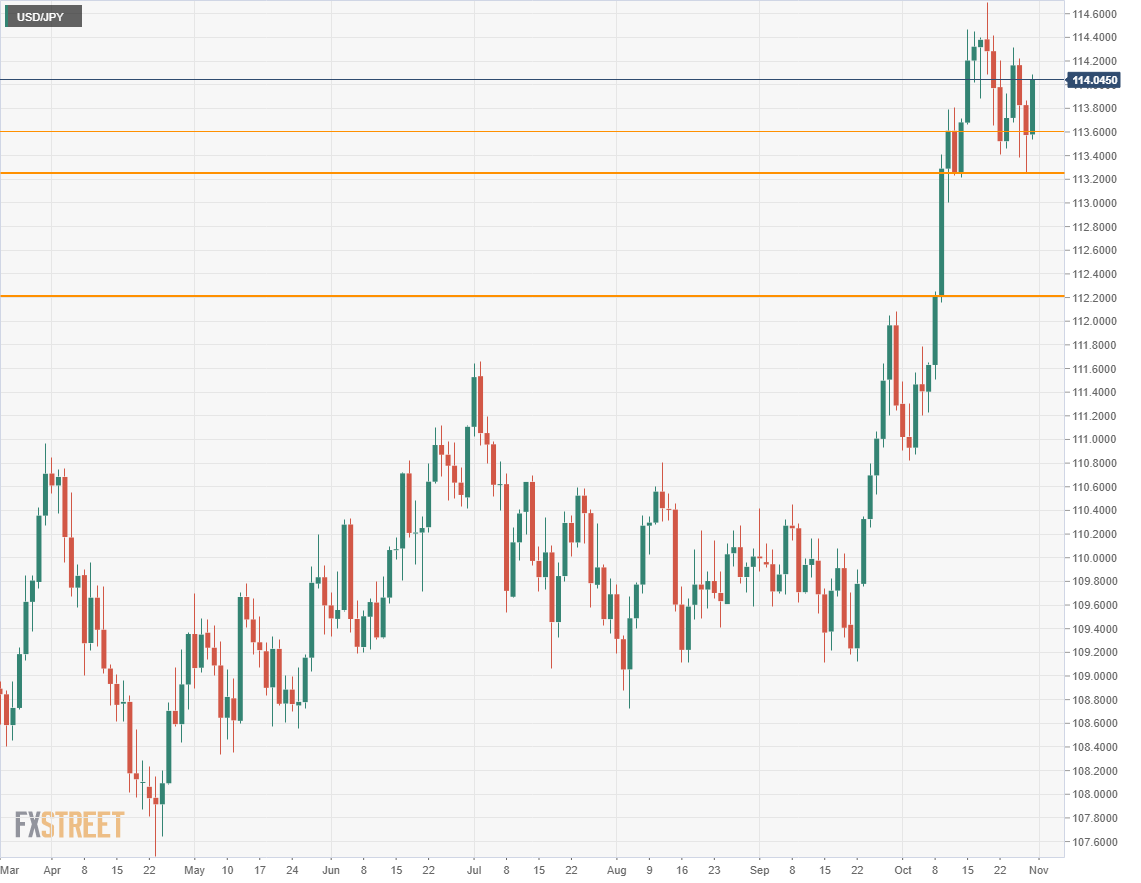
This week’s minimal gain in the USD/JPY, opening at 113.52 and finishing at 114.04, elides its 4.2% improvement since the Federal Open Market Committee (FOMC) meeting on September 22.
Treasury yields in the US have spiked while Japanese Government Bond (JGB) rates have been stagnant. The return on the 10-year US Treasury note has climbed 29 basis points to 1.61% while the JGB equivalent has added just 7 points to 0.108%.
To no one’s surprise, the Bank of Japan (BOJ) kept its ultra-loose monetary policy in place, with its main rate remaining at -0.1%, where it has been since 2016.
“Downward pressure stemming from Covid-19 is likely to remain on service, consumption, and exports and production are expected to decelerate temporarily due to supply-side constraints,” noted the policy statement accompanying the decision.
Ironic understatement is not a central banker's style, but BOJ president Hiroki Kuroda was probably not smiling when he noted that Japan is not likely to suffer the rapid inflation of other countries.The bank lowered its GDP estimate for the year to March 2022 to 3.4% from 3.8% and its inflation prediction to flat from 0.6%.
More in keeping with Tokyo’s traditional approach to currency values was Mr. Kuroda’s comment that a softer yen is “definitely positive” for the Japanese economy.
Japanese national elections this Sunday are expected to produce a full term for the Prime Minister and Liberal Democratic Party (LDP) candidate, Fumio Kishida. He has promised yet another fiscal stimulus package when elected and the weakening recent economic data could add to the size of the potential program. The BOJ will likely add to its massive policy accommodation in some fashion as well. Neither effort is likely to bear fruit for the economy.
The central bank currently owns about half of all outstanding government debt.
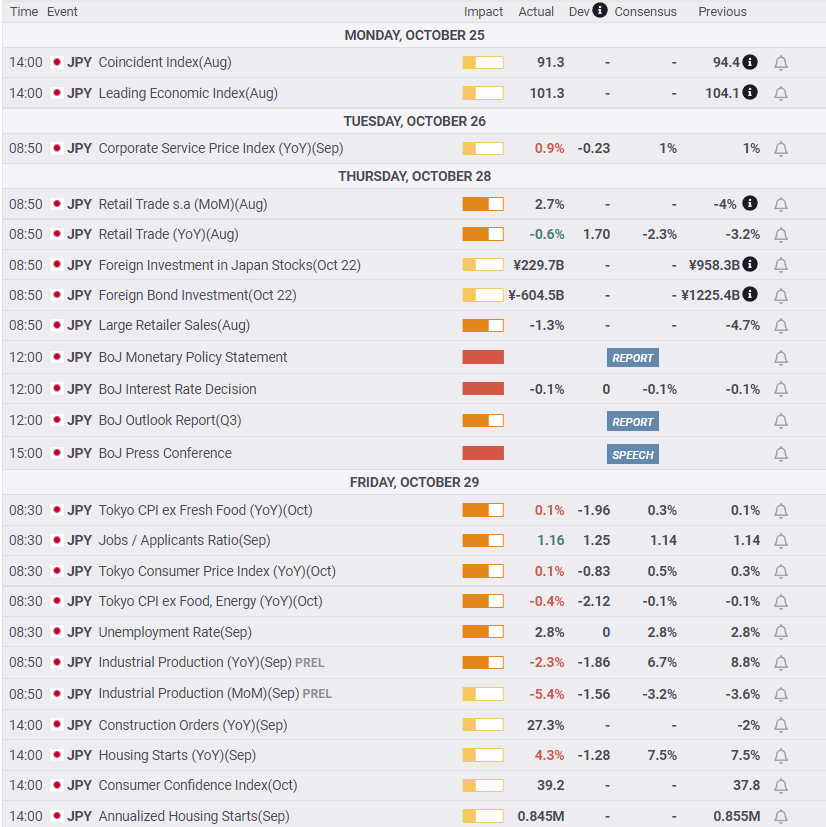
Japanese data this week was disappointing. October inflation in Tokyo rose 0.1%, missing the 0.5% forecast by a wide margin, and dropping from September's 0.3% increase. Core CPI was even weaker, slipping 0.4% in the month on a -0.1% prediction and September score.
Headline CPI in September had been the first positive month in a year and core CPI has been flat or negative for seven months.
Consumer prices in Tokyo were elevated by sharply higher food and energy costs, without those increases, Japanese prices would have slipped back into deflation.
Industrial production in September fell 5.4%, much more than the -3.2% estimate. It was the third negative month in a row and the fourth of the last six. On the year, production dropped 2.3% instead of rising to the 6.7% estimate. This decline in factory and utility production is not due to the base effect of last year's lockdown. Industrial Production fell 9% in September 2020. The decline in the past 12 months is from that baseline.
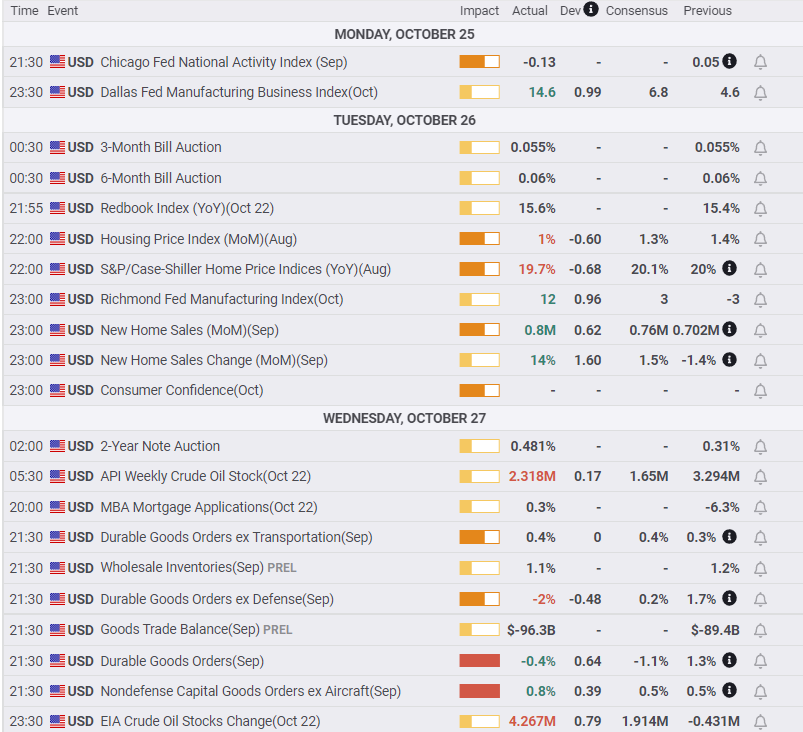
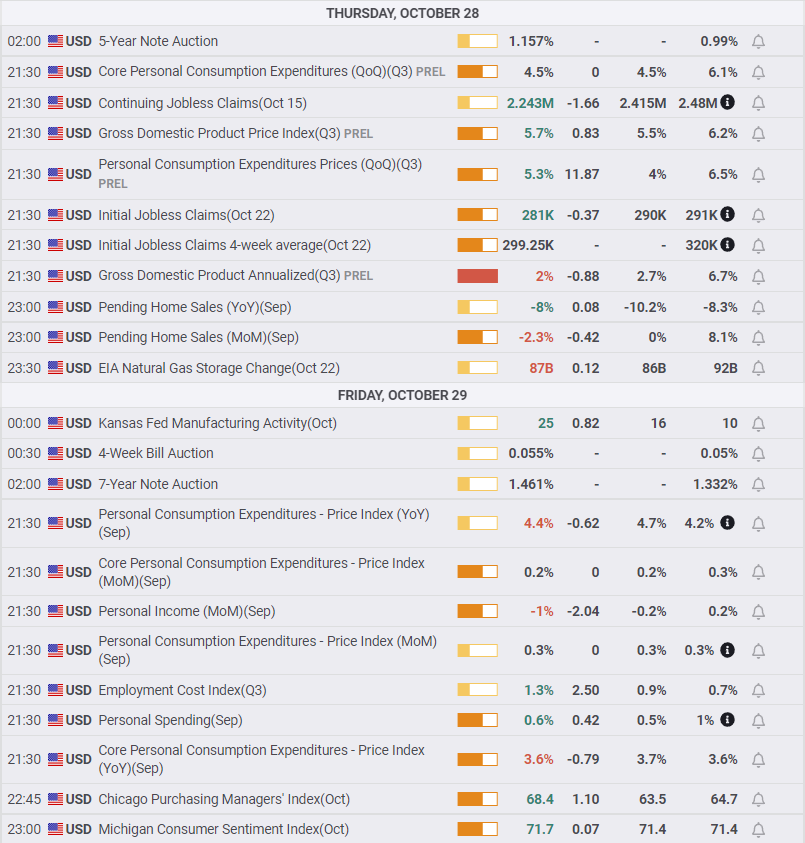
American economic data was led by third quarter annualized Gross Domestic Product (GDP) at 2%, almost one-third below its 2.7% forecast and a steep fall from the prior 6.7%. Labor and supply shortages have hampered the US recovery and the product scarcity in the face of strong consumer demand has exacerbated inflation.
The overall Personal Consumption Expenditure Price Index (PCE) rose in September to 4.4% from 4.2%, while the core rate was unchanged at 3.6%.
USD/JPY outlook
The minor two-week decline in the USD/JPY is a pause before fundamental factors renew yen weakness.
Treasury rates in the US are headed higher. The speed of the ascent may be uncertain but the direction is not.
Credit markets have been hesitant to run with the anticipated bond taper having been burned earlier by the Fed’s year long wait to change policy. That discretion should end next Wednesday. The yield on the benchmark 10-year Treasury has moved higher in the past five weeks but it is still 14 basis points below its 2021 high of 1.746% from March 31.
Once the Fed announcement is out of the way, the widening spread between US and Japanese rates should prove an insurmountable obstacle to USD/JPY bears. If the Fed reduces its $120 billion in monthly bond purchases by more that the expected $15 billion, it will be strong positive signal for the dollar.
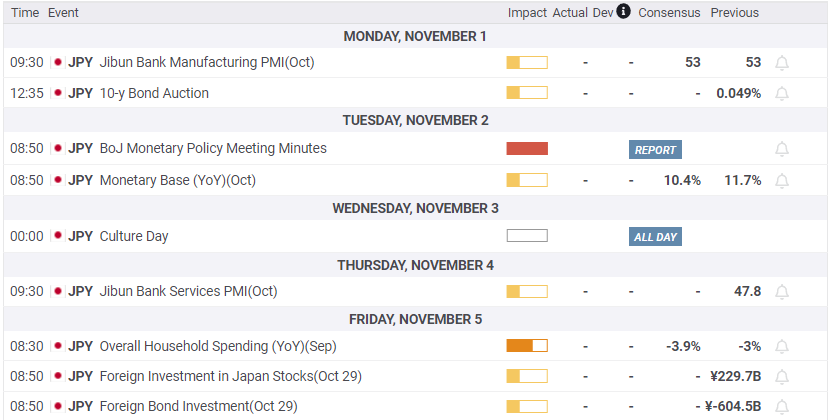
Japanese data in the week ahead is scarce with only Overall Household Spending for September of note.
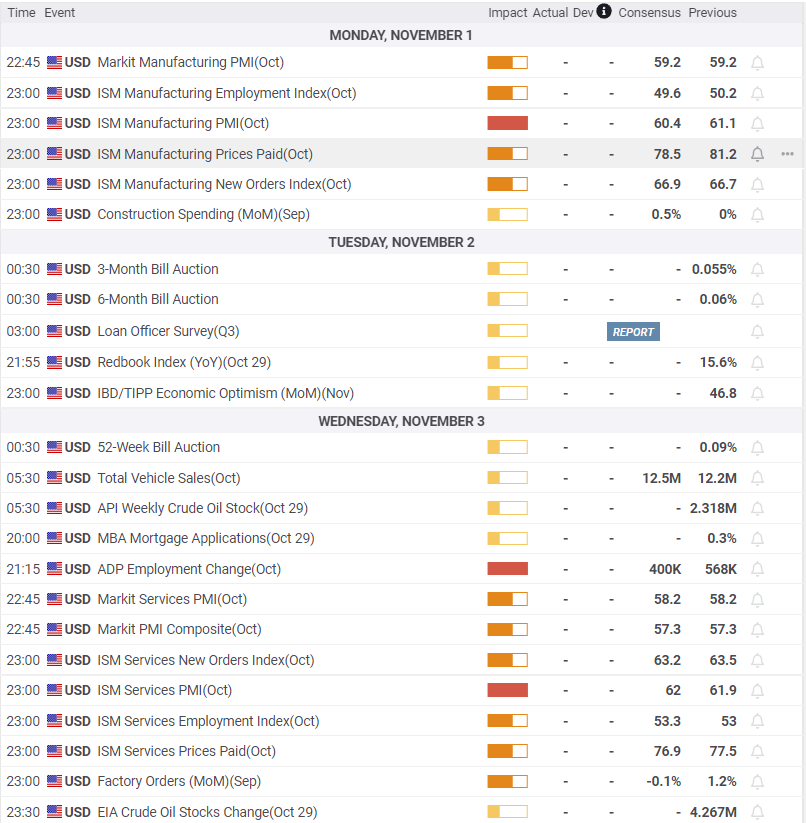
The US has an abundance of information aside from the Fed decision on Wednesday. Purchasing Managers' Indexes are expected to show that the weakness in third quarter GDP is not reflected in business outlook. October's Nonfarm Payrolls is again forecast for a large increase despite the disappointments of the last two months.
Prime Minister Kishida’s election will unleash more yen weakening fiscal stimulus and with the BOJ rather explicit endorsement of a lower yen, it is hard to conjure a different scenario for the Japanese currency.
Japan statistics October 25–October 29
FXStreet
US statistics October 25–October 29
FXStreet
Japan statistics November 1–November 5
FXStreet
US statistics November 1–November 5

USD/JPY technical outlook
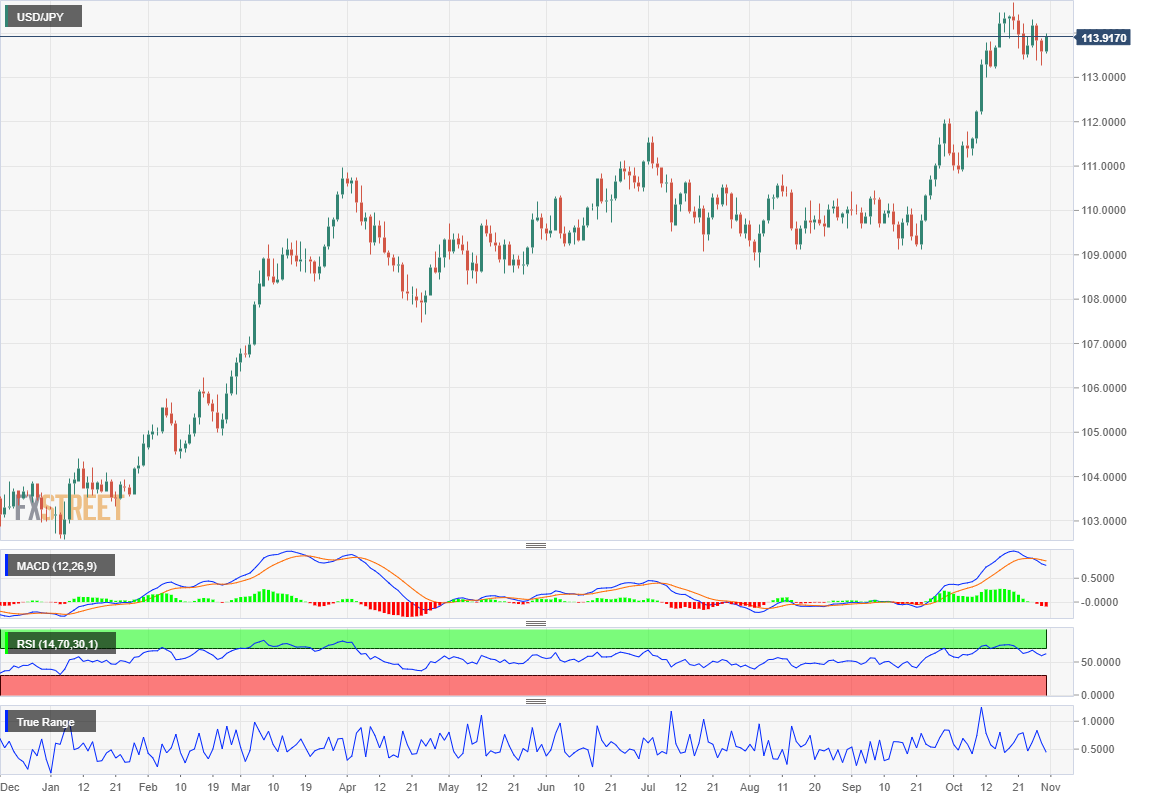
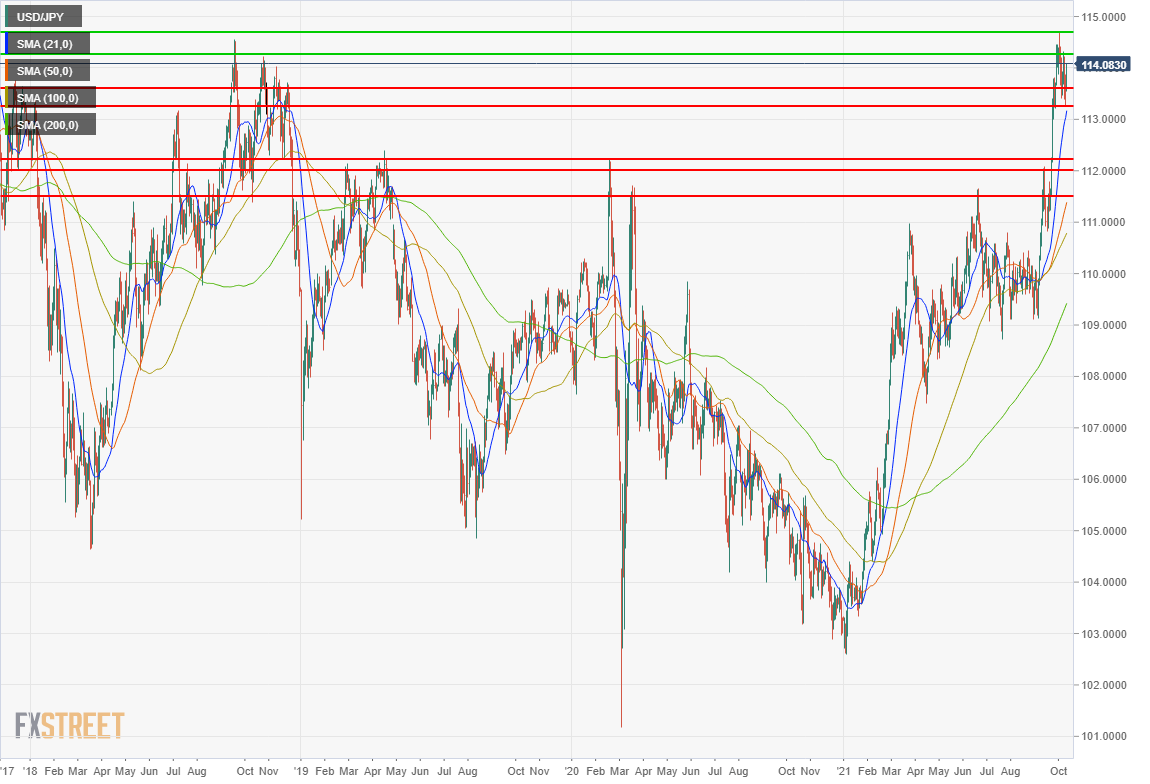
The USD/JPY has had an indecisive six sessions since closing below 114.000 last Friday. The lack of direction is reflected in the momentum indicators. The MACD (Momentum Average Convergence Divergence) slipped into sale territory on Wednesday but the Relative Strength Index (RSI) is just below overbought and turned higher on Friday. True Range drifted down from Wednesday as trading movement declined. These indicators appear poised to return to USD/JPY strength.
The moving averages (MA) have been barely affected by the week's consolidation. The sharp upward tilt acquired by all four averages in early October is the dominant feature and the staggered display is typical of an emerging trend. The 21-day MA at 113.17 reinforces support at 113.25.
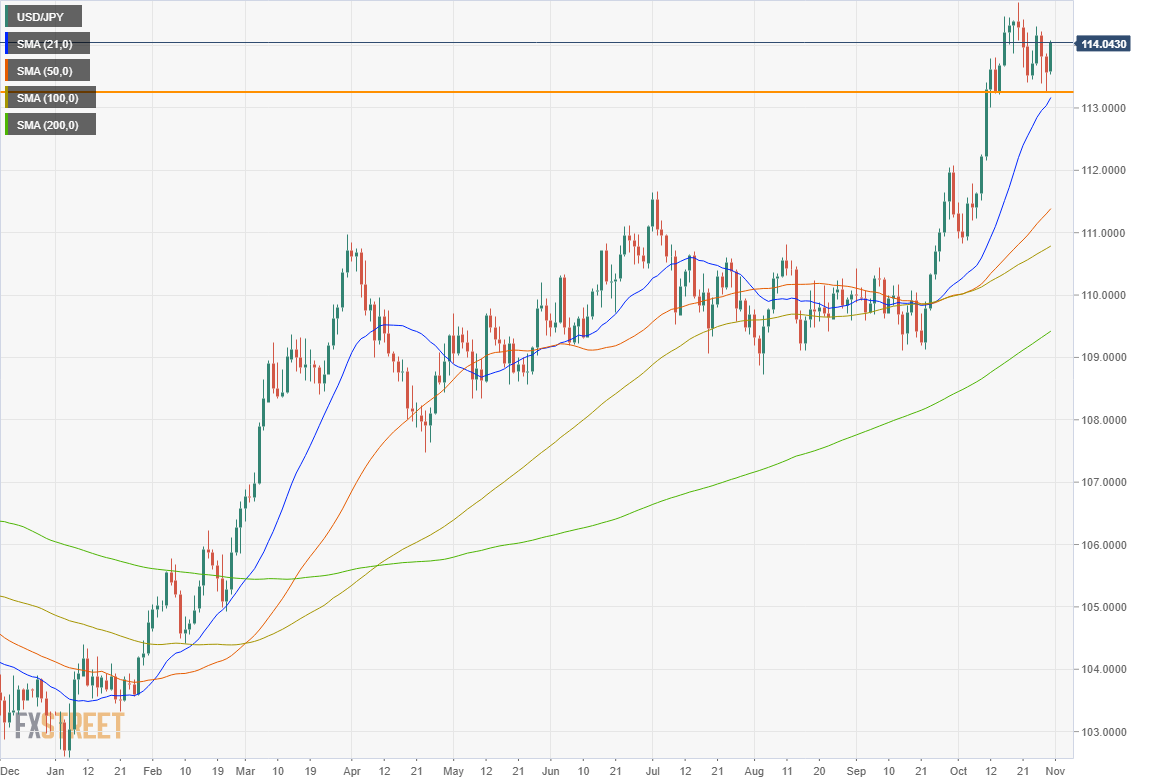
Support and resistance lines are unusually situated with striking weaknesses on either side. Support is negligible for the figure between 113.25 and 112.25, that distance having been traversed in one session on October 11. Resistance lines above the current market are based on a limited number of sessions after October 14. Prior references are from the second half of 2018 or earlier. The pandemic panic spike in February 2020 only reached 112.23.
Resistance : 114.25, 114.70
Support: 113.60, 113.25, 113.17 (21-day MA), 112.22, 112.00, 111.50
FXStreet Forecast Poll
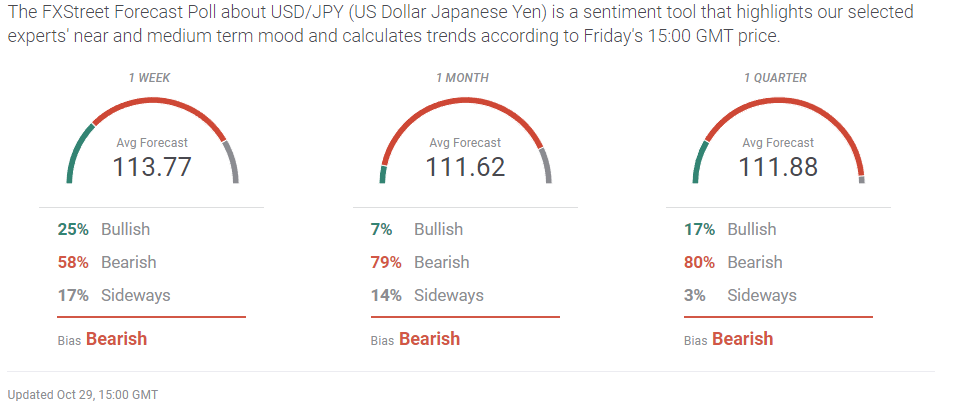
The bearish technical outlook of the FXStreet Forecast Poll is likely to be overwhelmed by the widening US-Japan interest rate spread.
Author

Joseph Trevisani
FXStreet
Joseph Trevisani began his thirty-year career in the financial markets at Credit Suisse in New York and Singapore where he worked for 12 years as an interbank currency trader and trading desk manager.

















