USD/JPY Weekly Forecast: Does Japan favor a weaker yen?
- Dollar yen scores a fresh 24-year high at 139.39 on Wednesday.
- US inflation and recession fears propel US dollar, euro breaks parity.
- BOJ-Federal Reserve policy divergence drives USD/JPY.

The US dollar continued its rampage in the currency markets, reaching quarter century highs against the yen and euro on Thursday.
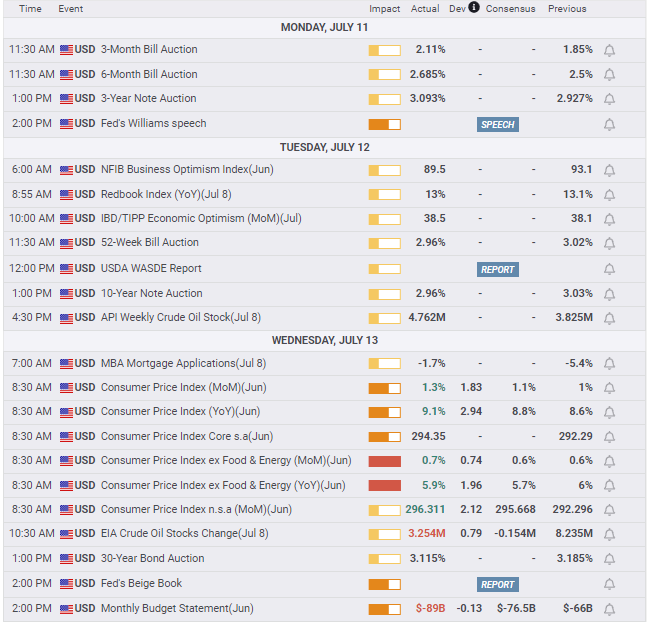
Consumer inflation in the US jumped to 9.1% in June, initially making a 100 basis point hike in the fed funds a better than even bet in the Treasury futures market. Consumer spending was slightly stronger than forecast in June though the difference and more, is likely due to price inflation and not higher spending volumes. The apparent lack of a negative impact from inflation on consumer purchases pulled Treasury yields and the dollar lower on Friday and dropped the futures odds for a 100 basis point increase on July 27 back to under 30%.
Fears of a US and global recession in the second or third quarters kept the safety-trade lively and funds flowing to the US assets and the dollar.
It is highly unusual to find US interest rates moving higher in an uncertain and fragile economy. Interest rates are normally counter cyclical, rising as the economy overheats and falling when growth weakens.
Friday’s US Retail Sales release gave dollar bulls a reason for some mild profit-taking after this week’s 2.1% run to Thursday’s top and the 9.4% climb since May 30.
 intro-637934931798101768.png)
The Bank of Japan (BoJ) rate decision next Wednesday, or perhaps non-decision is a better description, will draw a stark contrast with the Federal Reserve’s hyper-active policy. Whether the Federal Open Market Committee (FOMC) opts for a 75 or 100 basis point hike, the sovereign rate spread is likely to widen in the weeks ahead. The BoJ’s devotion to its failed accommodation policy is one of the great puzzles of modern economic and political policy.
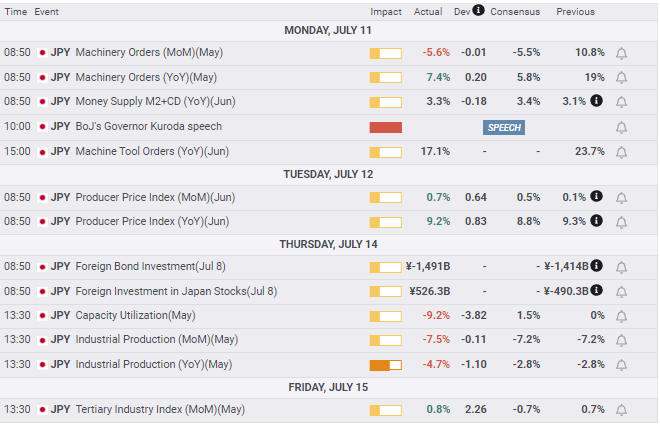
Japanese Industrial Production for May was revised lower and has now fallen for three straight months. Capacity Utilization dropped 9.2% in May, its largest decline since the initial pandemic lockdowns. Initial Jobless Claims rose to their highest level since February and are 46% above their April low.
In addition to the CPI and Retail Sales releases, producer prices rose 11.3% in June up from 10.9% in May with core prices fading a bit to 8.2% from 8.5%. Industrial Production and Capacity Utilization were weaker than expected in May though Michigan Consumer Sentiment for July did not fall into contraction as had been forecast.
USD/JPY outlook
Even though markets have largely priced the BoJ-Fed policy divergence, with the Japanese meeting this coming week and the Americans the following, rate policy will stay center stage until the decisions are complete. Treasury futures reversed a near 75% certainty that the Fed would choose the more aggressive 100 basis point increase early in the week, to the same percentage for a 75 point increase on Friday, but the market impact was nil.
Before the last BoJ meeting there were some comments in the Diet and an oblique reference by Governor Haruhikoo Kuroda to inflation’s impact on Japanese households that seemed to hint that a policy discussion was current in the bank. Since that moment Kuroda has warned that Japan faces "very high uncertainty" over the economic outlook and repeated the BoJ’s willingness to accelerate stimulus to bolster the fragile recovery. The entire central banking world is moving to hihger interest rates. Has the BoJ decided that a weaker yen is the best option for a moribund Japanese economy?
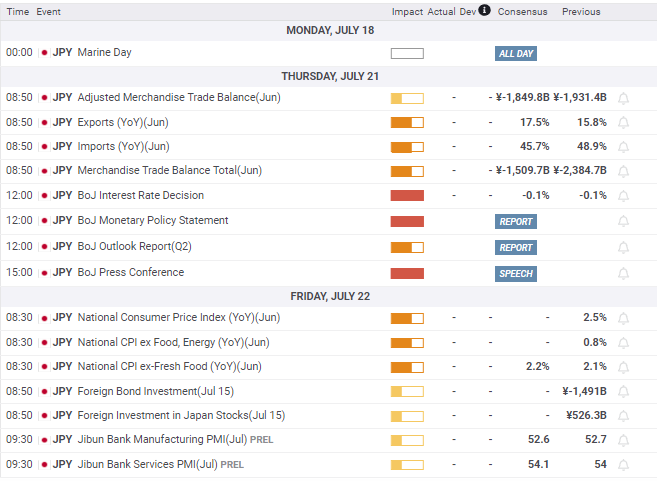
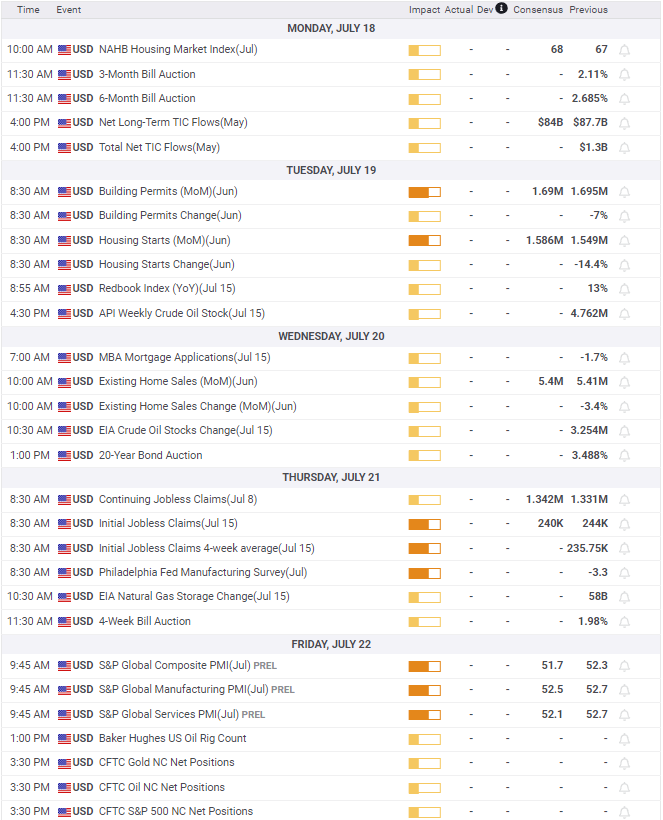
Japanese information is limited to National CPI and trade data for June, which will not move markets. In the US, Existing Home Sales and S&P Global PMIs headline a liimited release calendar.
With Fed rate ascendance restored to the heavy favorite, the outlook for the USD/JPY is higher regardless of any intermediate profit-taking. The base at 137.50 should remain inviolate.
Japan statistics July 11–July 15
US statistics July 11–July 15

Japan statistics July 18–July 22
FXStreet
US statistics July 18–July 22
FXStreet
USD/JPY technical outlook
The June 30 negative cross of the signal line by the MACD (Moving Average Convergence Divergence) price line did not signal a lower trend, as it was easily negated by the powerful fundamental factors favoring the USD/JPY. The positive cross of the signal line on Wednesday was seconded by the Relative Strength Index's (RSI) touch on overbought status but it does not signal a technical trend higher. Volatility in the Average True Range (ATR) has been declining for three weeks and Wednesday's blip higher did not restore a larger outlook. Nothwithstanding the supportive cast of these indicators, a continuation of the higher trend in the USD/JPY depends on fundamental, not technical factors.
 tech 1-637934964177840290.png)
Resistance: 139.40, 140.00, 140.50, 141.00
Support: 138.00, 137.40, 137.00, 136.55
Moving Averages; 21-day 136.22, 50-day 132.77, 100-day 127.88, 200-day 121.13
 tech 2-637934970362473328.png)
Author

Joseph Trevisani
FXStreet
Joseph Trevisani began his thirty-year career in the financial markets at Credit Suisse in New York and Singapore where he worked for 12 years as an interbank currency trader and trading desk manager.