USD/JPY Price Forecast: Seems vulnerable as BoJ rate hike bets offset retreating JGB yields
- USD/JPY struggles to capitalize on a modest uptick and is pressured by a combination of factors.
- BoJ rate hike bets continue to underpin the JPY and weigh on the pair amid renewed USD selling.
- Declining JGB bond yields do little to inspire the JPY bears or lend any support to spot prices.

The USD/JPY pair attracts fresh selling following an intraday uptick to the 150.30 area on Tuesday and stalls the previous day's modest bounce from its lowest level since early December. Spot prices extend the steady intraday descent through the early European session and slide further below mid-149.00s amid bets that the Bank of Japan (BoJ) will continue raising interest rates this year in the wake of broadening inflation in Japan. Data released last Friday showed that Japan's core inflation touched a 19-month high in January. Moreover, the Services Producer Price Index (PPI) from Japan validated the view that rising wages are persuading firms to pass on higher costs and hawkish BoJ expectations, which, in turn, provides a goodish lift to the Japanese Yen (JPY).
The US Dollar (USD), on the other hand, struggles to capitalize on the previous day's bounce from over a two-month low amid the growing acceptance that the Federal Reserve (Fed) will cut rates further. A disappointing sales forecast from Walmart raised doubts about US consumer health amid worries that US President Donald Trump's tariff plans would undermine the purchasing power of shoppers. Adding to this, the flash PMIs released last Friday pointed to a weaker expansion in overall business activity across the private sector and raised concerns about the US growth outlook. This, in turn, keeps the USD bulls on the defensive and contributes to the offered tone surrounding the USD/JPY pair, which remains well within striking distance of the year-to-date low.
The aforementioned negative factors, to a larger extent, overshadow BoJ Governor Kazuo Ueda's warning last Friday, saying that the central bank could increase bond buying if abnormal market moves trigger a sharp rise in the government bond yields. This leads to a further steep decline in Japanese government bond (JGB) yields, though it does little to inspire the JPY bears or lend any support to the USD/JPY pair. Traders now look to Tuesday's US economic docket – featuring the Conference Board's Consumer Confidence Index and the Richmond Manufacturing Index. Furthermore, speeches by FOMC members would drive the buck and the currency pair. The focus, however, remains on the US Personal Consumption Expenditure (PCE) Price Index, due on Friday.
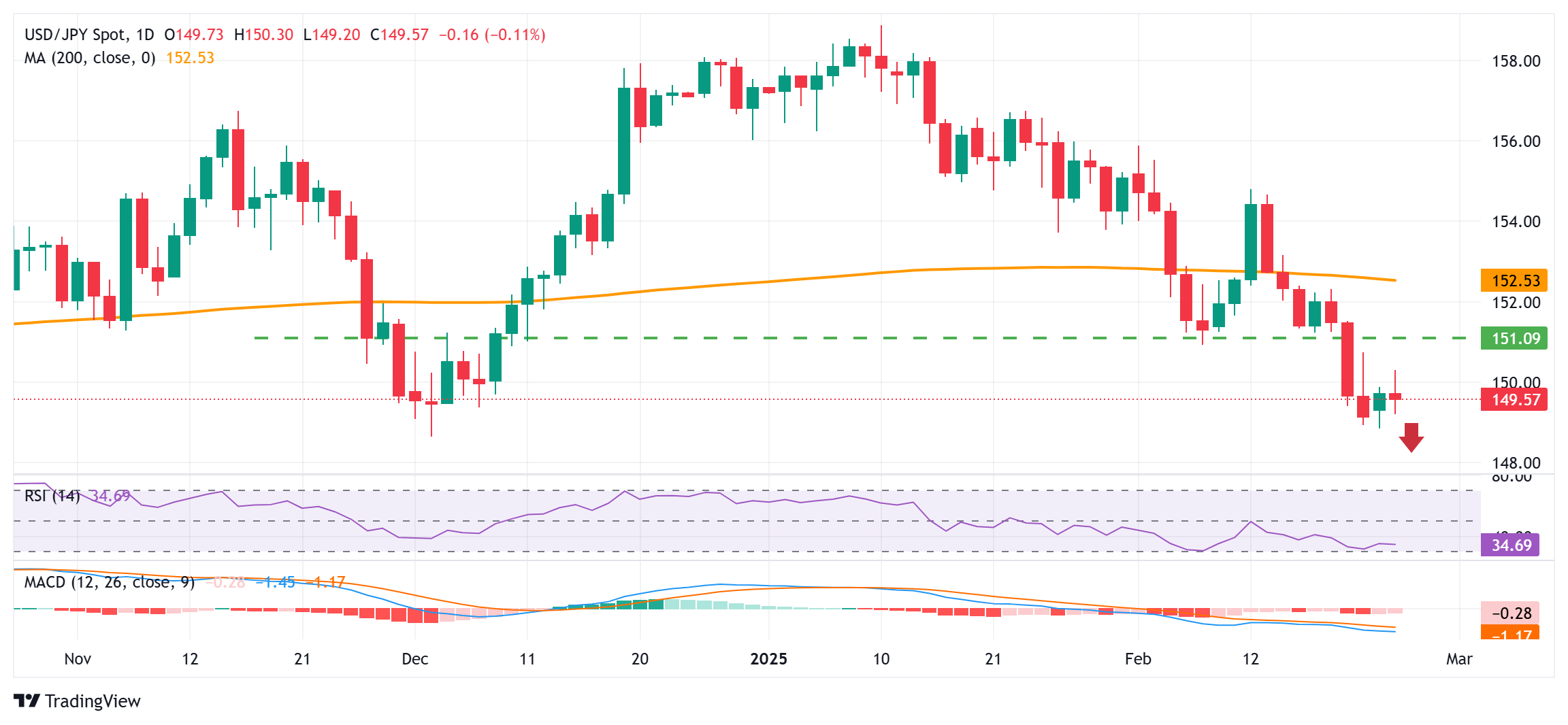
USD/JPY daily chart
Technical Outlook
From a technical perspective, the emergence of fresh selling on Tuesday comes on top of last week’s sustained breakdown below the 151.00-150.90 horizontal support. Moreover, oscillators on the daily chart are holding deep in negative territory and are still away from being in the oversold zone. This, in turn, suggests that the path of least resistance for the USD/JPY pair is to the downside and supports prospects for further losses towards the 149.00 round figure. Some follow-through selling below the 148.85 region, or the multi-month low touched on Monday, will set the stage for an extension of the downtrend from the 159.00 neighborhood, or the year-to-date high touched in January.
On the flip side, the 150.00 psychological mark now seems to act as an immediate hurdle. This is followed by the Asian session swing high, around the 150.30 region, above which a bout of a short-covering could lift the USD/JPY pair to the 150.90-151.00 support-turned-resistance. The recovery momentum could get extended further towards the 151.45 intermediate hurdle, the 152.00 mark, and the 152.55 region. The latter represents the very important 200-day Simple Moving Average (SMA) and should act as a strong near-term barrier for spot prices.
Author

Haresh Menghani
FXStreet
Haresh Menghani is a detail-oriented professional with 10+ years of extensive experience in analysing the global financial markets.