USD/JPY Price Forecast: Retreats sharply after verbal intervention; Fed/BoJ meetings in focus
- USD/JPY drops sharply on Tuesday amid renewed fears of a possible government intervention.
- The divergent BoJ-Fed policy expectations exert additional pressure and contribute to the fall.
- Traders might refrain from placing aggressive bets ahead of the Fed and BoJ policy decisions.

The USD/JPY pair attracts heavy selling on Tuesday following the overnight failure near the 153.25-153.30 area, or the monthly peak, and retains its negative bias through the first half of the European session. The Japanese Yen (JPY) outperforms its G-10 peers in reaction to a verbal intervention from Japan’s Economics Minister Minoru Kiuchi, emphasising the importance of stable foreign exchange (FX) moves that reflect economic fundamentals. Kiuchi added that he plans to assess the impact of FX changes on Japan’s economy.
Furthermore, traders cheered the outcome of a high-profile meeting between Japan’s new Prime Minister Sanae Takaichi and US President Donald Trump in Tokyo. In fact, Trump and Takaichi signed an agreement laying out a framework to secure the mining and processing of rare earths and other critical minerals. Moreover, Takaichi vowed to realise a golden age of the Japan-US alliance. This, along with a broadly weaker US Dollar (USD), exerts additional downward pressure on the USD/JPY pair and contributes to the intraday downfall.
Softer-than-expected US consumer inflation figures released on Friday reaffirmed dovish Federal Reserve (Fed) expectations and continue to undermine the USD. According to the CME Group's FedWatch Tool, traders have fully priced in that the US central bank will lower borrowing costs by 25-basis-points (bps) on Wednesday and cut interest rates again in December. In contrast, a rise in Japan’s service-sector inflation for the second straight month in September reinforced bets for potential interest rate hikes by the Bank of Japan (BoJ).
The BoJ, however, could resist tightening at its meeting this week in the wake of Takaichi's pro-stimulus stance and aggressive fiscal spending plans to revitalize the economy. Hence, the BoJ policy update on Thursday will be looked for guidance about a rate hike in December or early next year. This, in turn, will play a key role in determining the next leg of a directional move for the JPY. Heading into the key central bank event risks, traders might opt to move to the sidelines, which, in turn, should help limit further losses for the USD/JPY pair.
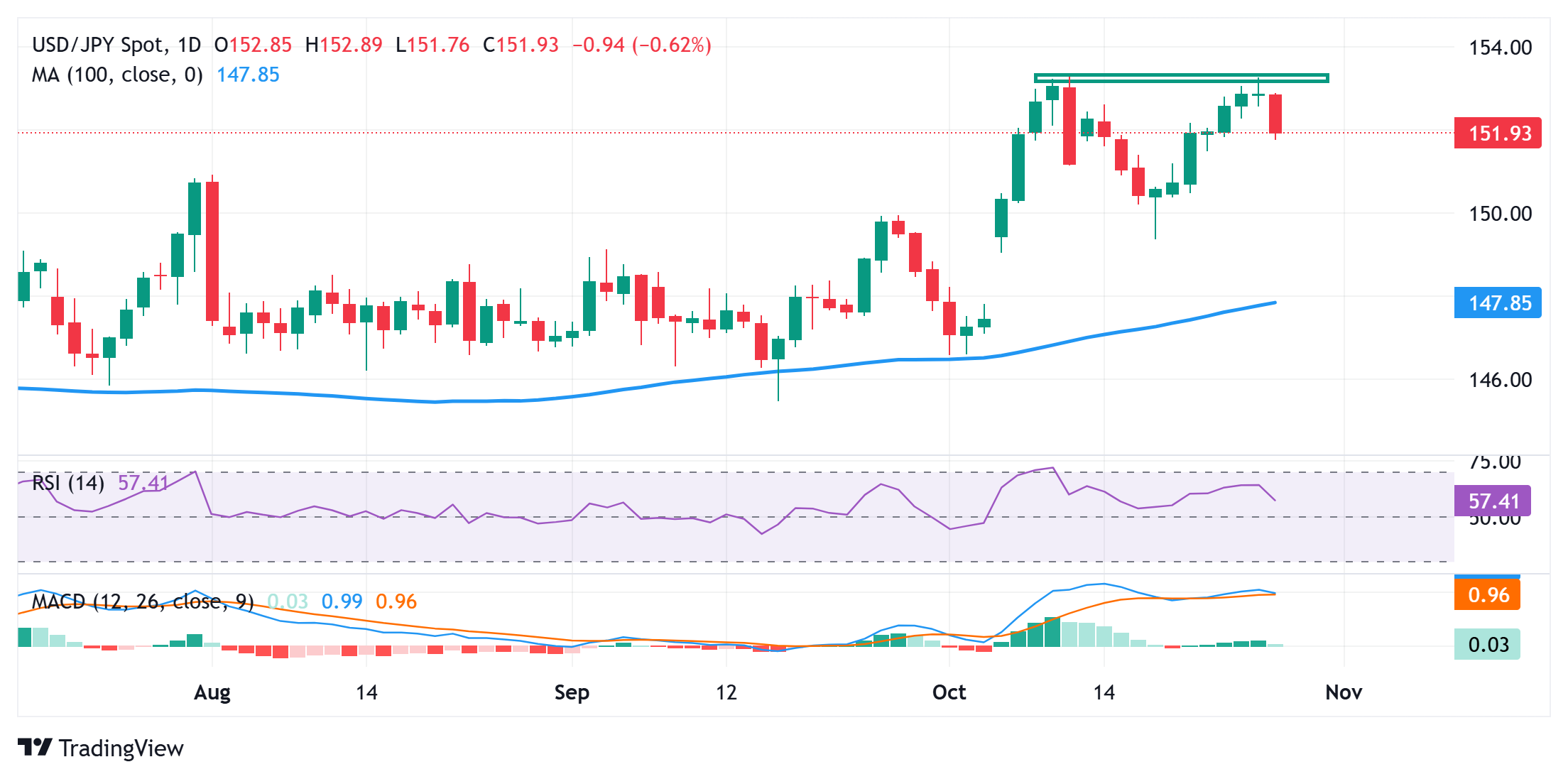
USD/JPY daily chart
Technical Outlook
The overnight failure near the 153.25-153.30 hurdle, or the monthly swing high, constitutes the formation of a bearish double-top pattern on the daily chart. The subsequent weakness and acceptance below the 152.00 mark favor the USD/JPY bears. That said, oscillators on the said chart are holding in positive territory, suggesting that any further decline could find some support near the 151.50-151.45 area ahead of the 151.10-151.00 region. A convincing break below the latter, however, should pave the way for a further near-term depreciating move.
On the flip side, any meaningful recovery beyond the 152.20-152.25 immediate hurdle is likely to attract fresh sellers and remain capped near the 152.90-153.00 region. Some follow-through buying, leading to a further strength beyond the 153.25-153.30 zone, will be seen as a fresh breakout and allow the USD/JPY pair to reclaim the 154.00 round figure. The momentum could extend further towards the next relevant resistance near mid-154.00s en route to the 154.75-154.80 region and the 155.00 psychological mark.
Author

Haresh Menghani
FXStreet
Haresh Menghani is a detail-oriented professional with 10+ years of extensive experience in analysing the global financial markets.

















