USD/JPY Price Forecast: Could climbs further as PM Takaichi’s win fuels BoJ uncertainty
- USD/JPY scales higher for the third straight day amid a combination of supporting factors.
- Change in Japan’s leadership lifts bets for a delayed BoJ rate hike and undermines the JPY.
- A firmer USD also supports spot prices, through the divergent BoJ-Fed outlooks cap gains.

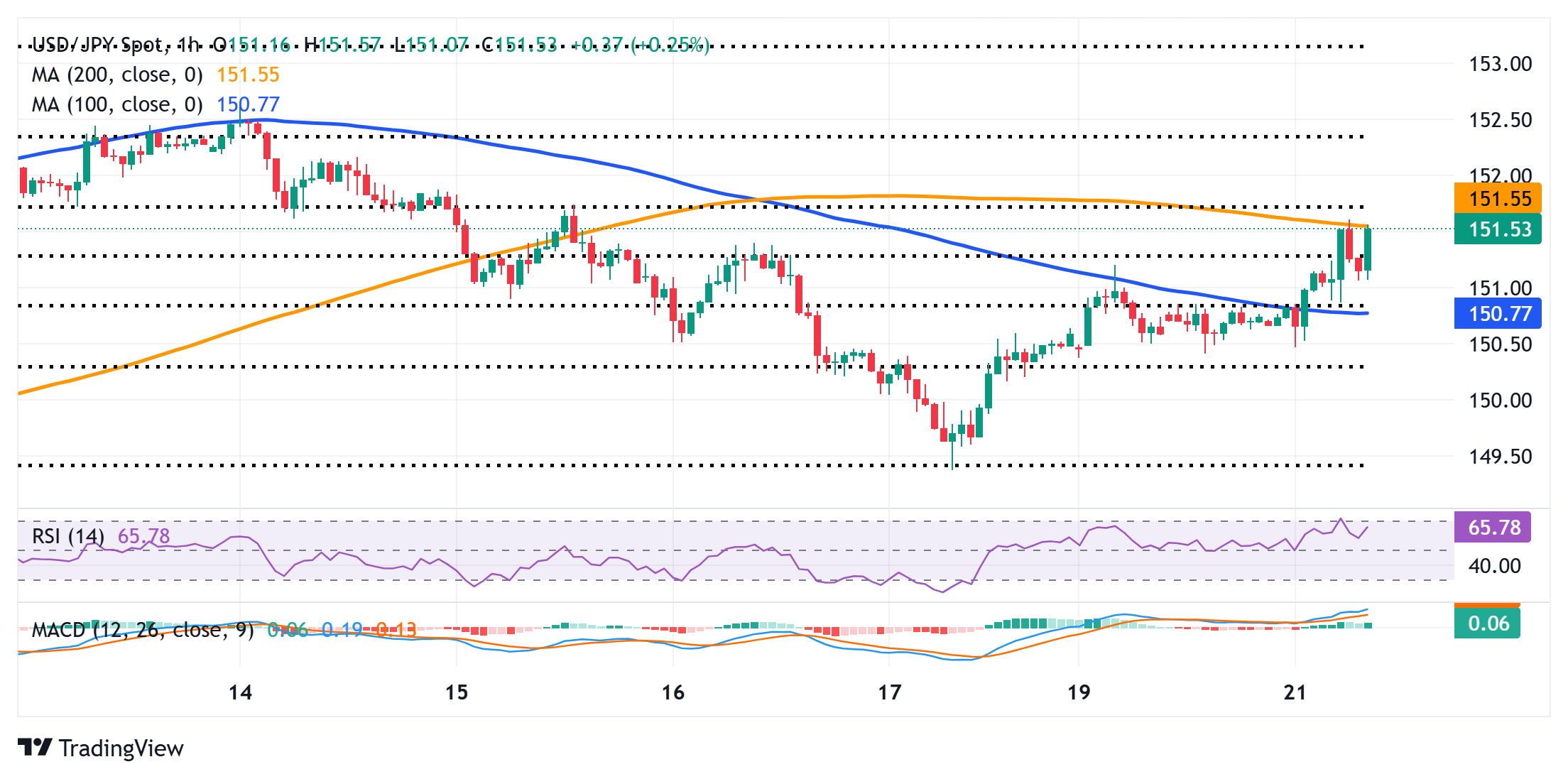
The USD/JPY pair shot to a four-day high after Sanae Takaichi secured majority votes from both the Lower and Upper Houses of parliament to become Japan's first female Prime Minister. Investors now seem convinced that Takaichi would announce more expansionary policy in Japan, which, in turn, could allow the Bank of Japan (BoJ) to delay raising interest rates further. This, in turn, weighed heavily on the Japanese Yen (JPY) amid receding safe-haven demand. Apart from this, some follow-through US Dollar (USD) buying provides an additional boost to the currency pair. The intraday move up lifts spot prices beyond the 151.50 hurdle, setting the stage for an extension of the recent bounce from the 149.40-149.35 region, or a nearly two-week low, touched last Friday.
The coalition holds a combined tally of 231 in the lower house, short of the 233 needed for a simple majority, suggesting that the government would need cooperation from other parties to pass any legislation. This, in turn, might keep a lid on the so-called "Takaichi" trade and help limit deeper JPY losses. Moreover, market participants seem convinced that the BoJ will stick to its policy normalization path as inflation in Japan remains at or above the central bank's 2% target for more than three years, and the economy registered growth for a fifth straight quarter through June. BoJ Deputy Governor Shinichi Uchida reiterated last Friday that the central bank will continue raising rates if economic and price developments move in line with its forecasts. This keeps the door open for an imminent rate hike this year.
In contrast, the CME Group's FedWatch Tool indicates that traders have fully priced in a 25-basis-point rate (bps) cut at each of the US Federal Reserve's (Fed) policy meetings in October and in December. The resultant narrowing of the rate differential between Japan and the US contributes to limiting the downside for the lower-yielding JPY. Adding to dovish Fed expectations, concerns that a prolonged US government shutdown could affect the economic performance keep a lid on any further USD appreciation and act as a headwind for the USD/JPY pair. The Senate on Monday once again voted against reopening the US government for the 11th time, extending the shutdown to a third week as Democrats and Republicans remain at odds and are unable to resolve the deadlock over a stopgap funding bill.
Meanwhile, US President Donald Trump said last Friday that a full-scale tariff on China would be unsustainable. Moreover, Trump set the tone for his upcoming meeting with his Chinese counterpart, Xi Jinping, and said on Sunday that the two countries would strike a fantastic deal, though he warned that failure to reach an agreement could see China face potential tariffs of 155%. This, along with geopolitical uncertainties, seems to benefit the JPY's safe-haven status and contributes to capping the USD/JPY pair. Traders might also opt to wait for this week's release of the latest US consumer inflation figures before positioning for a firm near-term direction ahead of key central bank event risks – the crucial FOMC meeting and the BoJ policy update next week.
USD/JPY 1-hour chart
Technical Outlook
An intraday move beyond the 150.80 confluence – comprising the 38.2% Fibonacci retracement level of the fall from the monthly peak and the 100-hour Simple Moving Average (SMA) – was seen as a key trigger for the USD/JPY bulls. The subsequent move up, however, stalls near the 200-hour SMA, around the 151.55 region. This is closely followed by the 50% Fibo. retracement level, around the 151.75 zone, which, if cleared, should set the stage for additional gains. Spot prices might then aim to surpass the 152.00 mark and the 152.25 hurdle before aiming to reclaim the 15.00 mark.
On the flip side, the 150.80 confluence resistance breakpoint now seems to protect the immediate downside ahead of the Asian session through, around the 150.50-150.45 region. A convincing break below the latter could drag the USD/JPY pair to the 150.00 psychological mark. Some follow-through selling might expose the 149.40-149.35 area, or a nearly two-week low touched on Friday. The downward trajectory could extend further towards the 149.00 mark en route to the 148.45-148.40 strong horizontal resistance-turned-support.
Author

Haresh Menghani
FXStreet
Haresh Menghani is a detail-oriented professional with 10+ years of extensive experience in analysing the global financial markets.