USD/JPY Price Forecast: Bulls retain control as easing trade tensions and politics undermine JPY
- USD/JPY kicks off the new week on a positive note in reaction to Trump’s pivot on China tariffs.
- Domestic political uncertainty could delay BoJ rate hikes and further exert pressure on the JPY.
- The emergence of some USD dip-buying remains supportive of the pair’s intraday positive move.


The USD/JPY pair builds on its weekly bullish gap-up opening and climbs to the 152.30 area during the first half of the European trading session, reversing a major part of Friday's sharp retracement slide from the highest level since February 13. US President Donald Trump backtracked on his threatened 100% tariffs on Chinese imports from November 1, which triggered a fresh wave of the global risk-on trade. Apart from this, domestic political uncertainty is seen undermining the safe-haven Japanese Yen (JPY), which, along with the emergence of some US Dollar (USD) dip-buying, acts as a tailwind for the currency pair.
Trump on Friday threatened additional tariffs of 100% on Chinese imports effective November 1 in retaliation for the latter's plans for new export controls on valuable rare earth minerals. Vice President JD Vance defended Trump’s approach and warned that any aggressive Chinese response would be met with stronger US action. Furthermore, China accuses the US of double standards and said that it will act to safeguard national interests and could introduce its own unspecified countermeasures if Trump carries out his threat, adding that it was not afraid of a possible trade war. Trump, however, softened his stance and posted on Truth Social that the US does not wish to hurt China.
Trump added that China’s economy will be fine and both countries want to avoid economic pain. This helped ease fears of a worsening trade conflict between the world’s two largest economies and hurt the JPY's safe-haven status. Meanwhile, Japan's Komeito party said Friday that it is leaving the ruling coalition led by the Liberal Democratic Party. This move is due to corruption concerns and hurts Sanae Takaichi's bid to become Japan's first woman Prime Minister. This deepens uncertainty and could delay Bank of Japan’s rate hikes even more, putting extra pressure on the JPY and helping USD/JPY.
The USD, on the other hand, regains positive traction and reverses a major part of Friday's retracement slide despite dovish Federal Reserve (Fed) expectations and concerns about a prolonged US government shutdown. In fact, traders are pricing in a greater possibility that the US central bank will lower borrowing costs two more times this year. Moreover, the US government shutdown is on track to extend into a third week as Congress remains deadlocked on a funding plan. This, however, does little to dent the recent bullish tone surrounding the USD, suggesting that the path of least resistance for the USD/JPY pair remains to the upside and backs the case for a further appreciating move.
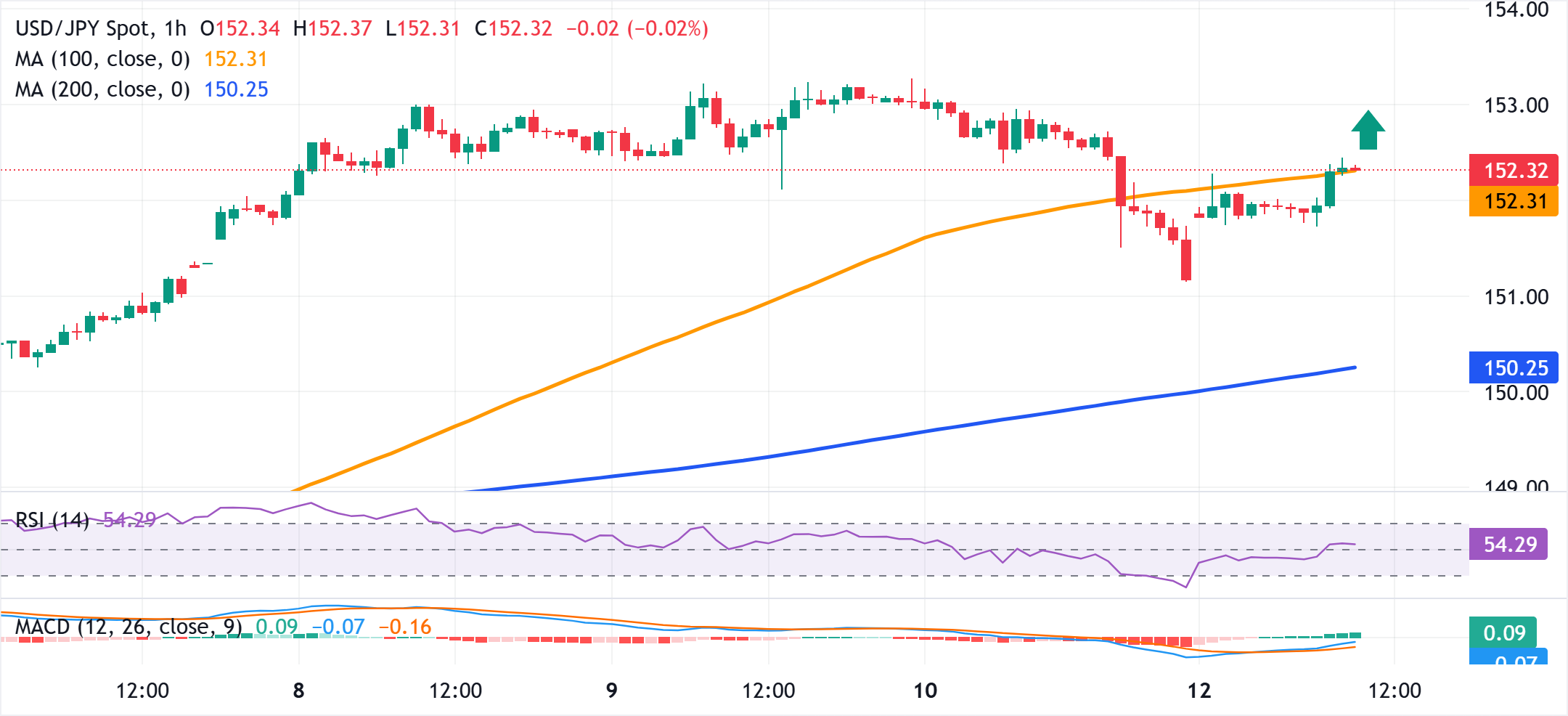
USD/JPY 1-hour chart
Technical outlook
An intraday breakout above 152.00 and the 100-hour Simple Moving Average (SMA) may set up further gains. Positive oscillators on hourly and daily charts support a bullish outlook for USD/JPY. Strength towards the 152.70-152.75 intermediate hurdle is possible, heading to the 153.00 mark. Momentum could keep building towards retesting Friday's eight-month high around 153.25-153.30.
On the flip side, weakness below the Asian session trough, around the 151.75-151.70 region, could attract some buyers near the 151.15 region (Friday's swing low). This is closely followed by the 151.00 round figure, which, if broken decisively, could make the USD/JPY pair vulnerable to weaken below the 150.70 intermediate support, towards testing the 150.00 psychological mark. The latter also represents the 200-hour SMA and should act as a key pivotal point.
Author
Haresh Menghani
FXStreet
Haresh Menghani is a detail-oriented professional with 10+ years of extensive experience in analysing the global financial markets.