USD/JPY Price Forecast: Bears await break below 147.00; US macro data in focus
- USD/JPY remains under heavy selling pressure for the fourth successive day on Wednesday.
- The divergent BoJ-Fed policy expectations turn out to be a key factor weighing on the pair.
- Geopolitical tensions and the US shutdown benefit the safe-haven JPY and also exert pressure.

The USD/JPY pair extends last week's retracement slide from the vicinity of the 150.00 psychological mark, or its highest level since August 1, and continues to lose ground for the fourth consecutive day on Wednesday. The downward trajectory drags spot prices to a nearly two-week low, around the 147.00 round figure, during the first half of the European session, and is sponsored by a combination of factors.
The Japanese Yen (JPY) continues with its relative outperformance in the wake of the growing acceptance that the Bank of Japan (BoJ) will stick to its policy normalization path. In fact, the Summary of Opinions from the BoJ's September meeting, released on Tuesday, revealed that board members debated the feasibility of raising interest rates in the near term. This reaffirms bets that the BoJ would hike interest rates by 25-basis-points (bps) in October. This, along with rising geopolitical tensions and the US government shutdown, benefits the JPY's relative safe-haven status.
A Republican spending bill failed to pass through the Senate on Tuesday, forcing the US government to start shutting down its operations from 04:00 GMT this Wednesday. A prolonged shutdown could have an adverse effect on economic performance, which, in turn, is seen as weighing on investors' sentiment and benefiting traditional safe-haven assets. The immediate effect of a government shutdown will likely be a delay in key US macro releases, including the highly anticipated US monthly employment details – popularly known as the Nonfarm Payrolls (NFP) report on Friday.
Apart from the political deadlock over a funding deal, bets that the US Federal Reserve (Fed) will lower borrowing costs two more times by the end of this year drag the US Dollar (USD) to a one-week low. In fact, traders see a nearly 95% chance of a rate reduction at the next FOMC meeting in October and an over 75% probability of another rate cut in December. This marks a significant divergence in comparison to hawkish BoJ expectations. The resultant narrowing of the US-Japan rate differential benefits the lower-yielding JPY and exerts additional pressure on the USD/JPY pair.
Traders now look forward to the release of the US ADP report on private-sector employment and the US ISM Manufacturing PMI for some impetus later during the North American session. Apart from this, speeches from influential FOMC members might further contribute to producing short-term trading opportunities. Nevertheless, the aforementioned fundamental backdrop suggests that the path of least resistance for the USD/JPY pair remains to the downside and backs the case for an extension of a nearly one-week-old depreciating trend.
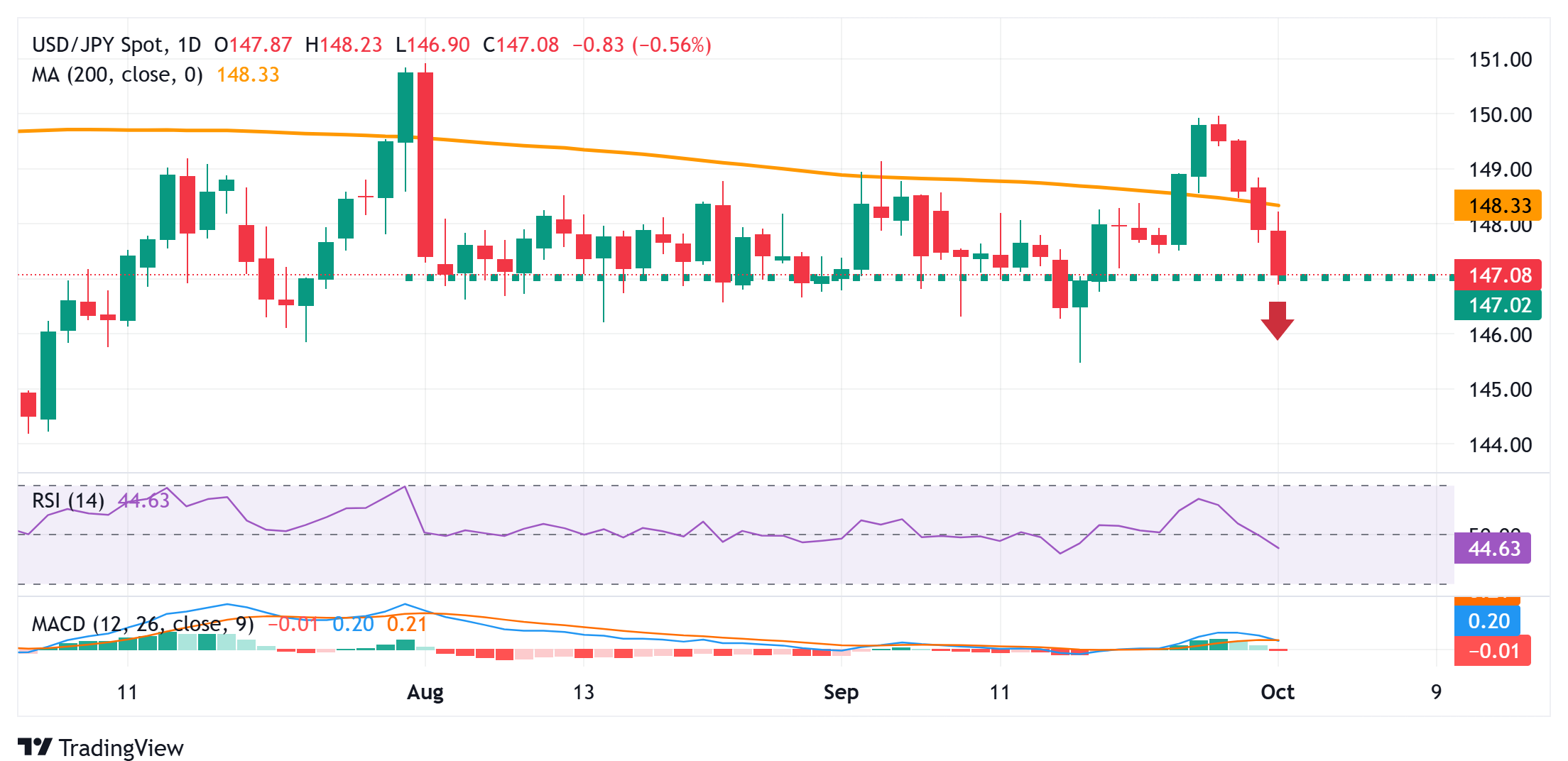
USD/JPY daily chart
Technical Outlook
From a technical perspective, the USD/JPY pair's intraday uptick early this Wednesday faltered ahead of the 200-day Simple Moving Average (SMA), and the subsequent downfall validates the negative outlook. Moreover, oscillators on the daily chart have again started gaining negative traction. Some follow-through selling and acceptance below the 147.00 mark will set the stage for a fall towards the 146.30-146.25 support. This is closely followed by the 146.00 round figure, below which spot prices could aim to retest the September monthly swing low, around the 145.50-145.45 region, before eventually dropping to the 145.00 psychological mark.
On the flip side, attempted recoveries might now confront an immediate hurdle near mid-147.00s. Any further move up could be seen as a selling opportunity near the 148.00 mark and remain capped near the 200-day SMA, currently pegged near the 148.35 region. A sustained strength beyond the latter, however, might trigger a short-covering move and lift the USD/JPY pair to the 149.00 round figure. The momentum could extend further towards the 149.35-149.40 region before spot prices make a fresh attempt to conquer the 150.00 psychological mark.
Author

Haresh Menghani
FXStreet
Haresh Menghani is a detail-oriented professional with 10+ years of extensive experience in analysing the global financial markets.