|

USD/JPY outlook: Japanese Yen fails to benefit more from BoJ rate hike
USD/JPY

USDJPY dipped early Friday on widely expected BoJ rate hike by 25 basis points, but the weakness was so far short-lived, despite interest rate rising to the highest in 17 years.

Subsequent bounce (approx. 100 pips) suggests that the dollar remains well supported, particularly by wide gap between the monetary policies of Fed and BoJ.

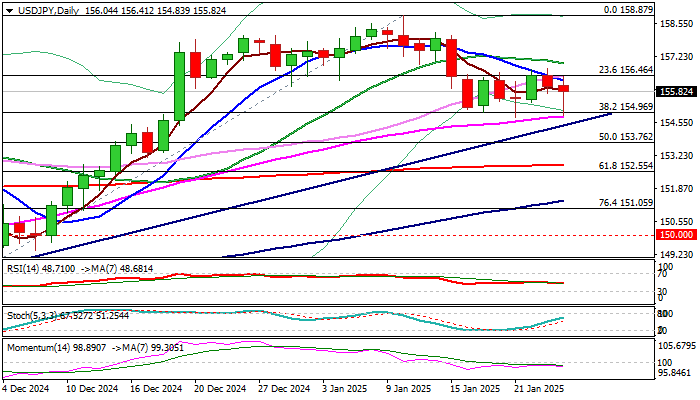
Repeated failure at pivotal Fibo support at 154.97 (38.2% retracement of 148.64/158.87, reinforced by nearby 55DMA and trendline support) where a higher base is forming (still needs confirmation) signals that the pair lacks strength for final break lower.

Near-term action remains within the narrow range for the seventh consecutive day, still looking for direction signal after BoJ’s decision proved to be insufficient to spark stronger move lower.

Formation of bear trap pattern on daily chart adds to initial positive signal which would require more work at the upside to be confirmed (close above rent range top at 156.75 and 20 DMA at 156.94 to verify completion of higher base).

Alternative scenario would see firm break of Fibo support, 55 DMA and trendline support (154.97/50 zone) as strong negative signal, pointing to continuation of pullback from a multi-month peak (157.87).

Technical studies on daily chart remain mixed and lack clearer signal, though overall picture is still firmly bullish, suggesting that limited correction would precede fresh push higher.

Res: 156.46; 156.75; 156.94; 158.08.
Sup: 154.97; 154.76; 154.50; 153.76.
USDJPY

Interested in USD/JPY technicals? Check out the key levels

    1. R3 157.58
    2. R2 157.16
    3. R1 156.57
  1. PP 156.16
    1. S1 155.56
    2. S2 155.15
    3. S3 154.55

Author

Slobodan Drvenica

Slobodan Drvenica

Windsor Brokers

Industry veteran with over 22 years’ experience, Slobodan Drvenica joined Windsor Brokers in 1995 when he was an active trader for more than 10 years, managing the trading desk and own account departments.


More from Slobodan Drvenica
Share:

Editor's Picks

GBP/USD stays below 1.3400 after soft UK CPI data

GBP/USD struggles to gain traction and stays below 1.3400 in the second half of the day on Wednesday. The UK annual Consumer Price Index (CPI) inflation cooled to 2.6% in June against the market forecast of 2.7%, making it difficult for the British Pound gather recovery momentum. Meanwhile, investors keep a close eye on headlines coming out of the Middle East.

EUR/USD stabilizes near 1.1400 as markets focus on geopolitics

EUR/USD trades in a narrow channel at around 1.1400 on Wednesday. In the absence of high-impact data releases, escalating geopolitical tensions in the Middle East caps the pair's upside. On Thursday, the European Central Bank (ECB) will announce monetary policy decisions.

Gold holds gains above $4,100 undaunted by risk-off markets

Gold extends gains for the fourth consecutive day, standing comfortably above $4,100, unfazed by the risk-off market amid rising tensions in Iran and higher Oil prices. The pair has rallied nearly 2.5% so far this week and is on track for its best weekly performance in more than three months.

XRP consolidates as inflows and volume climb
Ripple (XRP) retains a slightly bullish outlook on Wednesday despite logging a minor correction from the supply range near $1.15. The remittance token is down 0.5% on the day, reflecting a broader cryptocurrency market drawdown, primarily driven by persistent geopolitical tensions between the United States (US) and Iran in the Middle East.
US – Fed preview: A divided hold
The first month after Kevin Warsh's debut at the FOMC's June meeting has brought mixed signals on the inflation front. On one hand, the re-escalation of the war in Iran has lifted energy prices higher again. Yet on the other hand, Warsh's hawkish comments have already lifted real rates, supported broad USD and tightened financial conditions while realized inflation surprised to the downside in June.
US Dollar mid-year outlook: Exceptional currency, exceptional risks?
The US Dollar enters the second half of 2026 in a markedly different position from a year ago. The King currency has recovered, reflecting persistent US inflation, changing expectations for Fed policy, geopolitical tensions and renewed demand for defensive assets.















