USD/JPY lower on US intervention, buy the dip? US indices record highs, Nasdaq to catch up? [Video]
![USD/JPY lower on US intervention, buy the dip? US indices record highs, Nasdaq to catch up? [Video]](https://editorial.fxsstatic.com/images/i/discover-58.jpg)
You may have noticed that JPY suddenly got very strong last Thursday, just after our last video.
Let’s take a good look at why that happened.
The answer is both fascinating and crazy.
In today’s Market Outlook, let’s take a look at Forex trading on EURUSD, the S&P500, the NASDAQ, the Dow Jones Industrial Average, Silver, XAGUSD, EURAUD, and USDJPY.
On Friday, there was a note on Treasury Secretary Scott Bessent’s place in a cabinet meeting to buy 5 to 10 billion USD in yen, but the yen rally had already started on Thursday.

JPY sellers tried to control the market or take profit, but the actual transaction had USDJPY, and all JPY pairs falling further.
From the technical side, this may look like a “Buy the Dip” moment, but this is not a technical trade so be careful.
Many analysts believe that this intervention will not hold BUT, Bessent said they may do it again, so watch your positions.
So, why?
The official line from the White House is that they just wanted to help Japan stabilise their currency and the economy.
The more practical reason is that they did not want Japan to buy yen by selling their US Treasury bills, of which they have about a trillion dollars worth.
This would be very bad for the US economy.
So, where did the US Treasury get these extra billions of USD?
They bought JPY with EUR, thereby attempting to isolate the USD and not send a signal that the US wants a weaker USD.
However, the ECB is likely unimpressed by this and may have ideas of their own about US Treasury bills.
The bottom line is that if foreign central banks and large institutions start selling vast amounts of T-bills, it will weaken USD and create more domestic inflation, causing the Fed to take action.
The EUR was not affected by this yet, but we see a potential double top forming on EURAUD, so we will keep an eye on this.
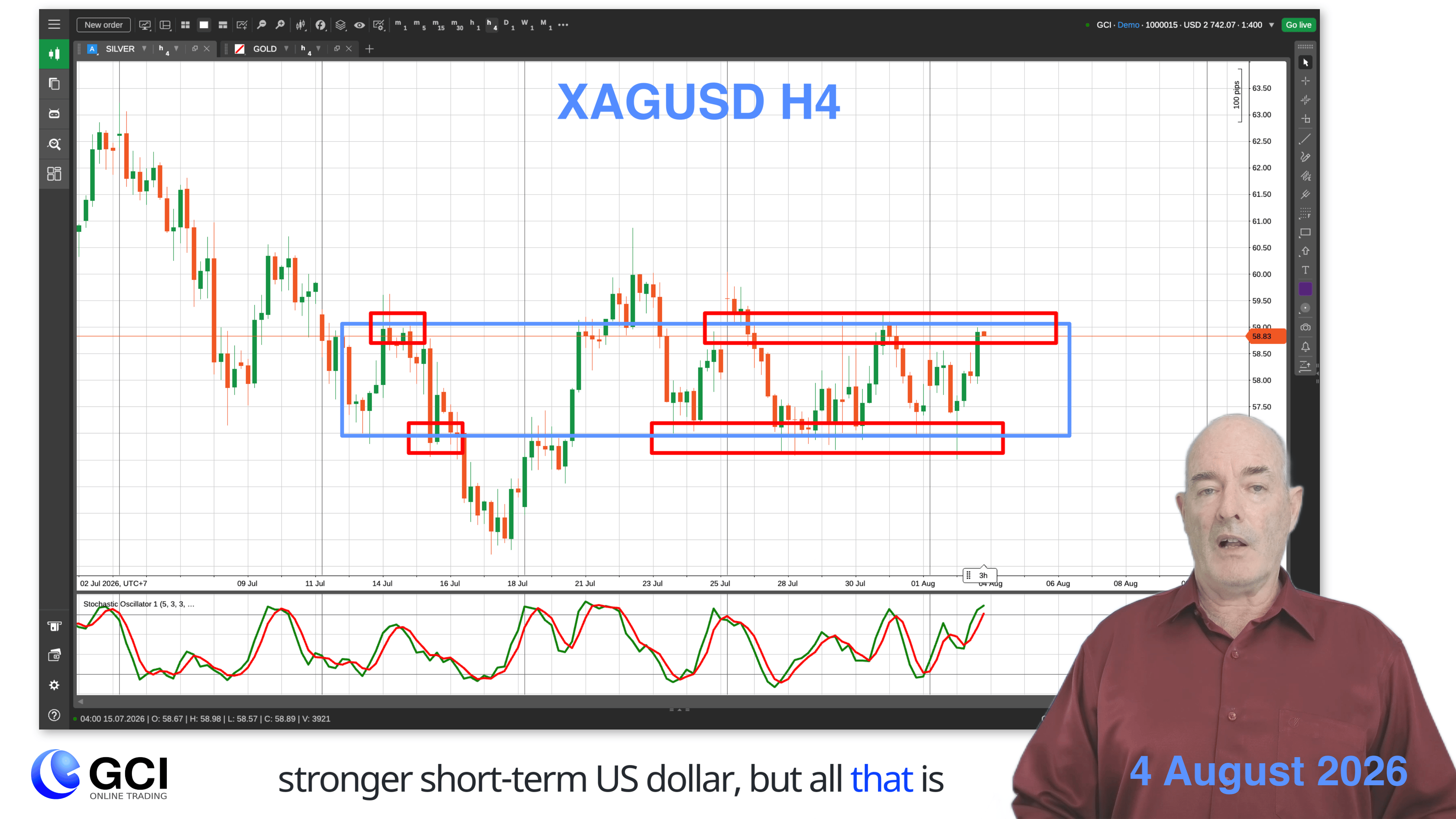
We are now following a ranging market on silver as the range narrows a bit from $57 to $59.
To see price fall, we may need a stronger short-term USD, but with all that is going on with the US Treasury, be careful.
In fact, we are NOT seeing this in USD, with every pair showing short-term weakness but consolidating over the last few days.
Of course, we have to talk about Brent and WTI Crude Oil, but, as you can see, the chaotic price action is at the mercy of the chaotic war where the US literally has no plan, and Iran is striking targets all through the Gulf region.
Again, be careful.
Despite the chaos, the US Indices are flying again to record highs, and even the NASDAQ is recovering, even during the confusion over data centres.
Now we are into August, and the latest tech earnings from Meta and Amazon, among others, were quite strong, but the NASDAQ has a long way to go to catch up to the other major US indices.
That’s all for now.
CFDs and FX are leveraged products, and your capital may be at risk.
Author

Brad Alexander
FX Large Limited
Brad became fascinated with the Currency Markets from a young age and researched fundamental analysis.