USD/JPY Forecast: Traders seem hesitant as Japan’s fiscal concerns counter hawkish BoJ
- USD/JPY struggles to gain any meaningful traction as fiscal concerns offset BoJ rate hike bets.
- A positive risk tone also undermines the JPY and supports the pair amid a modest USD uptick.
- Dovish Fed expectations cap the upside for the USD and spot prices amid intervention fears.

The USD/JPY pair lacks any firm intraday directional bias on Friday and seesaws between tepid gains/minor losses, above the 156.00 mark, through the first half of the European session. Concerns about Japan's ailing fiscal position, along with the upbeat market mood, offset higher-than-forecast consumer inflation figures from Tokyo. Moreover, a modest US Dollar (USD) uptick acts as a tailwind for the currency pair. That said, speculations that Japanese authorities could step in to stem weakness in the domestic currency and the divergent Bank of Japan (BoJ)-US Federal Reserve (Fed) policy expectations cap spot prices.
Government data showed earlier today that the headline Tokyo Consumer Price Index (CPI) rose 2.7% YoY in November, while a gauge, which excludes volatile fresh food prices, came in at 2.8% YoY. Moreover, the core CPI, excluding both fresh food and energy prices, held steady at 2.8%. The data points to sticky inflation in Japan's capital city and backs the case for further policy tightening by the Bank of Japan (BoJ). However, BoJ board member Asahi Noguchi signaled on Thursday that the monetary tightening must follow an incremental path, forcing investors to reassess expectations for the central bank's next policy move.
Meanwhile, Japanese Prime Minister Sanae Takaichi's cabinet on Friday approved a draft supplementary budget worth ¥18.303 trillion for the fiscal year ending March 2026, stoking concerns about the nation's fiscal health. The extra budget will be financed by additional bond issuance of at least ¥11.5 trillion. Expectations about the supply of new government debt had pushed longer-dated government bond yields to their highest in more than two decades earlier this month and contributed to the JPY's relative underperformance. Furthermore, hopes for a Russia-Ukraine peace deal fail to assist the JPY to attract any buying.
The USD, on the other hand, looks to build on Thursday's modest bounce from an over one-week low and further supports the USD/JPY pair. The upside for the USD, however, seems limited in the wake of dovish Federal Reserve (Fed) expectations. Comments from several Fed officials recently suggested that another interest rate cut in December is a live option. Moreover, reports that White House economic adviser Kevin Hassett has emerged as the frontrunner to become the next Fed Chair, and is expected to enact US President Donald Trump's calls for sharply lower interest rates, hold back the USD bulls from placing aggressive bets.
Moving ahead, there isn't any relevant market-moving economic data due for release from the US on Friday. Moreover, the aforementioned mixed fundamental backdrop warrants some caution before placing fresh directional bets and positioning for an extension of this week's retracement slide from the 158.00 neighborhood, or the highest level since mid-January.
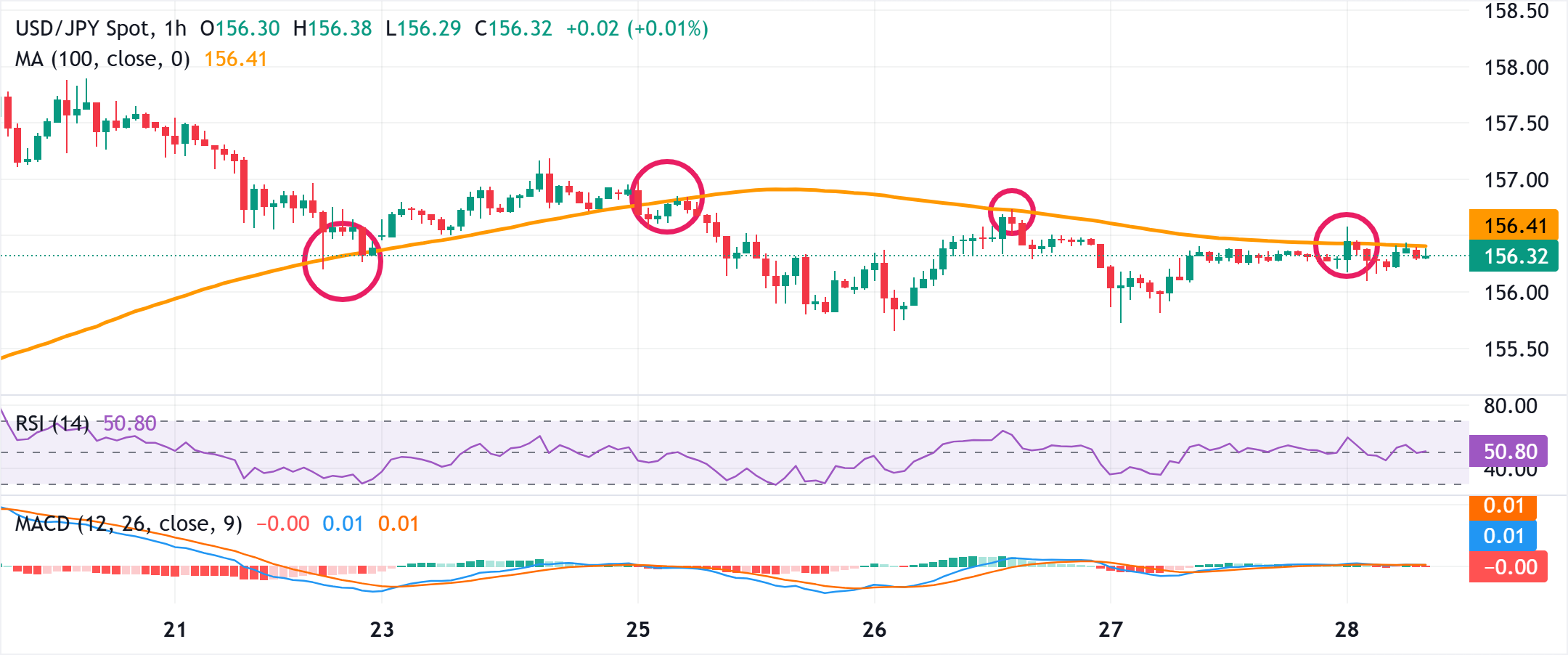
USD/JPY 1-hour chart
Technical Outlook
The USD/JPY pair is flirting with the 100-hour Simple Moving Average (SMA) pivotal resistance, just below mid-156.00s, which, if cleared decisively, should pave the way for additional gains. The subsequent move up could allow spot prices to reclaim the 157.00 mark and climb further toward the 157.45-157.50 intermediate hurdle before aiming to challenge the multi-month high, just ahead of the 158.00 round figure.
On the flip side, the 156.00 round figure could protect the immediate downside. This is followed by the weekly low, around the 155.70-155.65 region, below which the USD/JPY pair could accelerate the fall to the 155.00 psychological mark. A convincing break below the latter will be seen as a fresh trigger for bearish traders and set the stage for an extension of a one-week-old downtrend.
Author

Haresh Menghani
FXStreet
Haresh Menghani is a detail-oriented professional with 10+ years of extensive experience in analysing the global financial markets.