USD/JPY Forecast: Bears retain control ahead of Tokyo CPI and US PCE Price Index on Friday
- USD/JPY attracts heavy selling and is pressured by a combination of negative factors.
- Concerns over the Fed’s independence weigh on the USD and lift the safe-haven JPY.
- The divergent Fed-BoJ policy expectations contribute to the steep intraday decline.

The USD/JPY pair resumes this week's sharp retracement slide from the 146.00 mark, or its highest level since May 13, and dives to a one-and-half-week low during the first half of the European session on Thursday. Spot prices slip below the 144.00 mark in the last hour and seem vulnerable to weaken further amid a bearish fundamental backdrop.
US President Donald Trump escalated his criticism of Federal Reserve Chair Jerome Powell for not cutting rates and floated the idea of firing him. Powell, testifying before Congress for the second day on Wednesday, acknowledged that the recent inflation reading had been more moderate, but he warned that new tariffs could change that. Powell reiterated that the central bank is well-positioned to wait to cut interest rates until they have a better handle on the impact of Trump's trade policies on consumer prices.
Meanwhile, reports suggest that Trump was considering naming Powell's successor by September or October, stoking concerns over the central bank’s independence. When asked if he is interviewing candidates to replace Powell, Trump said he has three or four people in mind as contenders for the top Fed job. This, along with bets that the US central bank could resume its rate-cutting cycle as soon as July, drags the US Dollar (USD) to its lowest level since March 2022 and is seen weighing heavily on the USD/JPY pair.
Moreover, traders have fully priced in that the Fed will lower rates by at least 50 basis points before the end of this year. In contrast, the Bank of Japan – although has been hesitant to raise interest rates – is still expected to stay on the path of monetary policy normalization as inflation persistently exceeds its target. Japan's core inflation has remained well above the BoJ's 2% target for well over three years and rose to a more than two-year high in May. Furthermore, Japan's Corporate Services Producer Price Index – a leading indicator of consumer price inflation – has been trending above the 3% YoY rate for several consecutive months.
The divergent Fed-BoJ policy expectations turn out to be another factor exerting downward pressure on the USD/JPY pair and validate the near-term negative outlook. Traders now look forward to the US economic docket – featuring the final Q1 GDP print, the usual Weekly Initial Jobless Claims, Durable Goods Orders, and Pending Home Sales. Apart from this, speeches from influential FOMC members could provide some impetus to the pair ahead of the Tokyo CPI and the US Personal Consumption Expenditure (PCE) Price Index on Friday. Nevertheless, the aforementioned factors suggest that the path of least resistance for spot prices is to the downside.
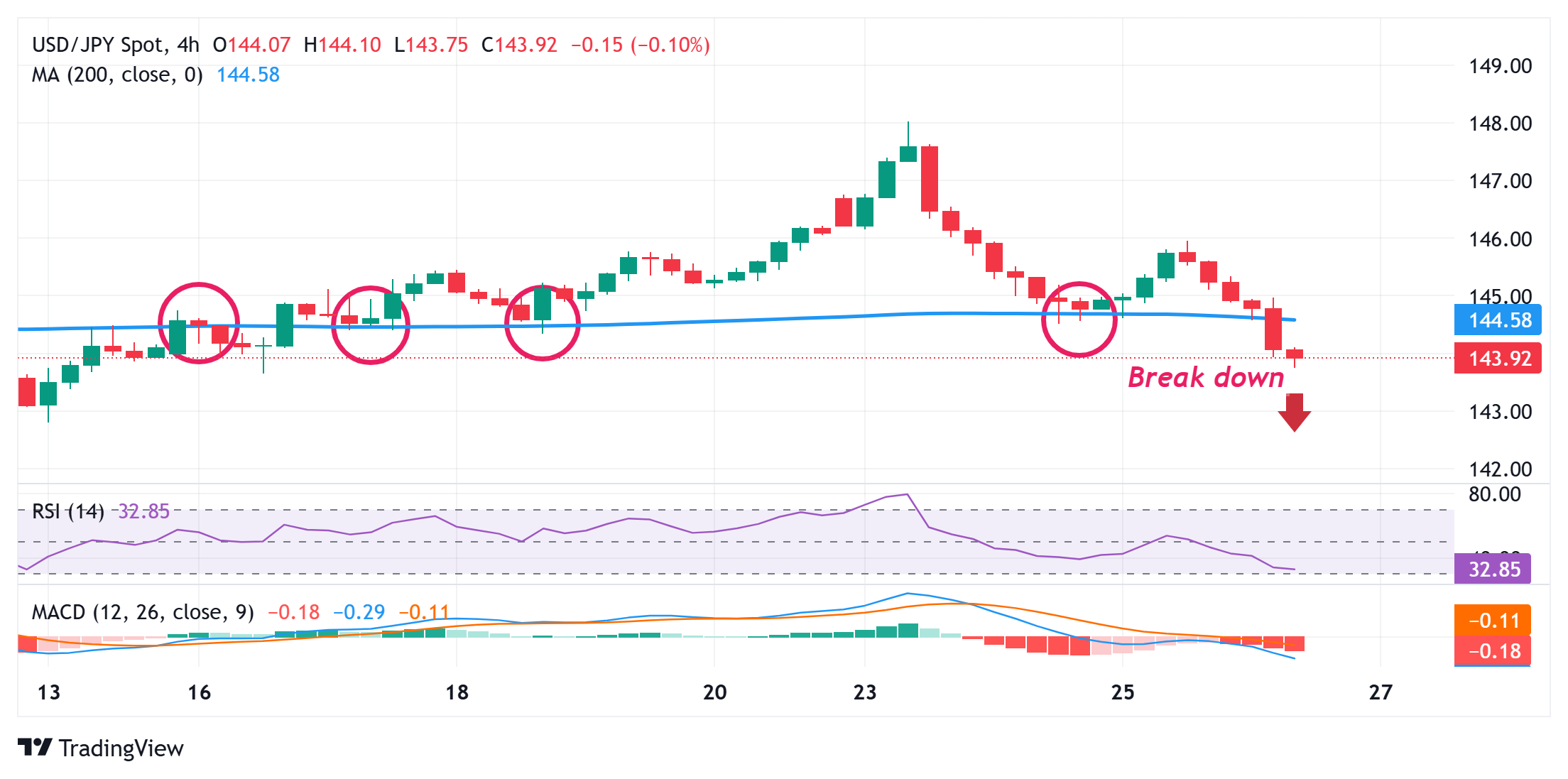
USD/JPY 4-hour chart
Technical Outlook
The overnight failure ahead of the 146.00 mark and a subsequent break below the 144.70-144.65 area, or the 200-period Simple Moving Average (SMA) on the 4-hour chart, validates the negative outlook for the USD/JPY pair. Moreover, oscillators on hourly/daily charts have just started gaining negative traction and back the case for a slide towards intermediate support near the 143.70-143.65 region en route to sub-143.00 levels.
On the flip side, the 200-SMA support breakpoint, around the 144.65-144.70 zone, now seems to act as an immediate hurdle ahead of the 145.00 psychological mark and the 145.25-145.35 static barrier. A sustained strength beyond the latter could allow the USD/JPY pair to make a fresh attempt to conquer the 146.00 mark. The said handle might now act as a pivotal point, which if cleared could shift the near-term bias in favor of bulls and pave the way for additional near-term gains.
Author

Haresh Menghani
FXStreet
Haresh Menghani is a detail-oriented professional with 10+ years of extensive experience in analysing the global financial markets.

















