USD/JPY Forecast: Bearish potential seems intact ahead of US PCE Price Index
- USD/JPY attracts sellers for the third consecutive day amid the divergent BoJ-Fed expectations.
- The BoJ is seen raising rates in December, while the Fed could lower borrowing costs next week.
- Bearish traders, however, seem reluctant and opt to wait for the crucial US PCE inflation data.

The USD/JPY pair prolongs its recent well-established downtrend for the third consecutive day and drops to a three-week low during the early part of the European session on Friday. The Japanese Yen (JPY) continues with its relative outperformance amid rising bets for further policy normalization by the Bank of Japan (BoJ). The US Dollar (USD), on the other hand, languishes near its lowest level since late October amid dovish Federal Reserve (Fed) expectations and turns out to be another factor exerting pressure on the currency pair.
BoJ Governor Kazuo Ueda said on Monday that the likelihood of the central bank's economic and price projections being met is rising. Ueda added that real interest rates were deeply negative, and another hike would still leave borrowing costs low. This was seen as the clearest hint so far of an impending rate hike. Moreover, Ueda appears to have successfully navigated his first major political hurdle under Prime Minister Sanae Takaichi and secured a broad acceptance for a quarter-point interest rate hike, to 0.75%, at the end of the December 18-19 monetary policy meeting.
This helps offset Friday's dismal macro data, which showed that Household Spending in Japan unexpectedly fell 2.9% YoY in October, marking the fastest pace of decline since January 2024. This fueled concerns about the economic outlook, though it did little to dent the bullish sentiment surrounding the JPY amid prospects for further BoJ tightening. Furthermore, PM Takaichi's reflationary push and massive spending plan, to be funded by new debt issuance, pushed the yield on the benchmark 10-year Japanese government bond (JGB) to its strongest level since 2007 on Thursday. Moreover, 20-year and 30-year JGB yields reached levels not seen since 1999.
The resultant narrowing of the yield differential between Japan and other major economies contributes to driving flows towards the lower-yielding JPY. Meanwhile, the USD struggles to capitalize on the overnight recovery, led by a duo of upbeat US labor market reports, amid bets for another interest rate cut by the Fed in December. Global outplacement firm Challenger, Gray & Christmas said that planned job cuts declined 53%, to 71,321 in November. Separately, the US Initial Jobless Claims dropped to 191K in the week ended November 29, or the lowest level in more than three years, which eased fears of a sharp deterioration in labor market conditions.
Market players, however, are still pricing in an over 85% probability that the US central bank will lower borrowing costs by 25-basis-points (bps) at its upcoming policy meeting next week. This marks a significant divergence in comparison to the BoJ's hawkish outlook and suggests that the path of least resistance for the USD/JPY pair is to the downside. That said, bears seem reluctant to place aggressive bets and opt to wait for the release of the US Personal Consumption Expenditure (PCE) Price Index. Nevertheless, spot prices remain on track to register weekly losses and extend the recent retracement slide from a multi-month peak, touched in November.
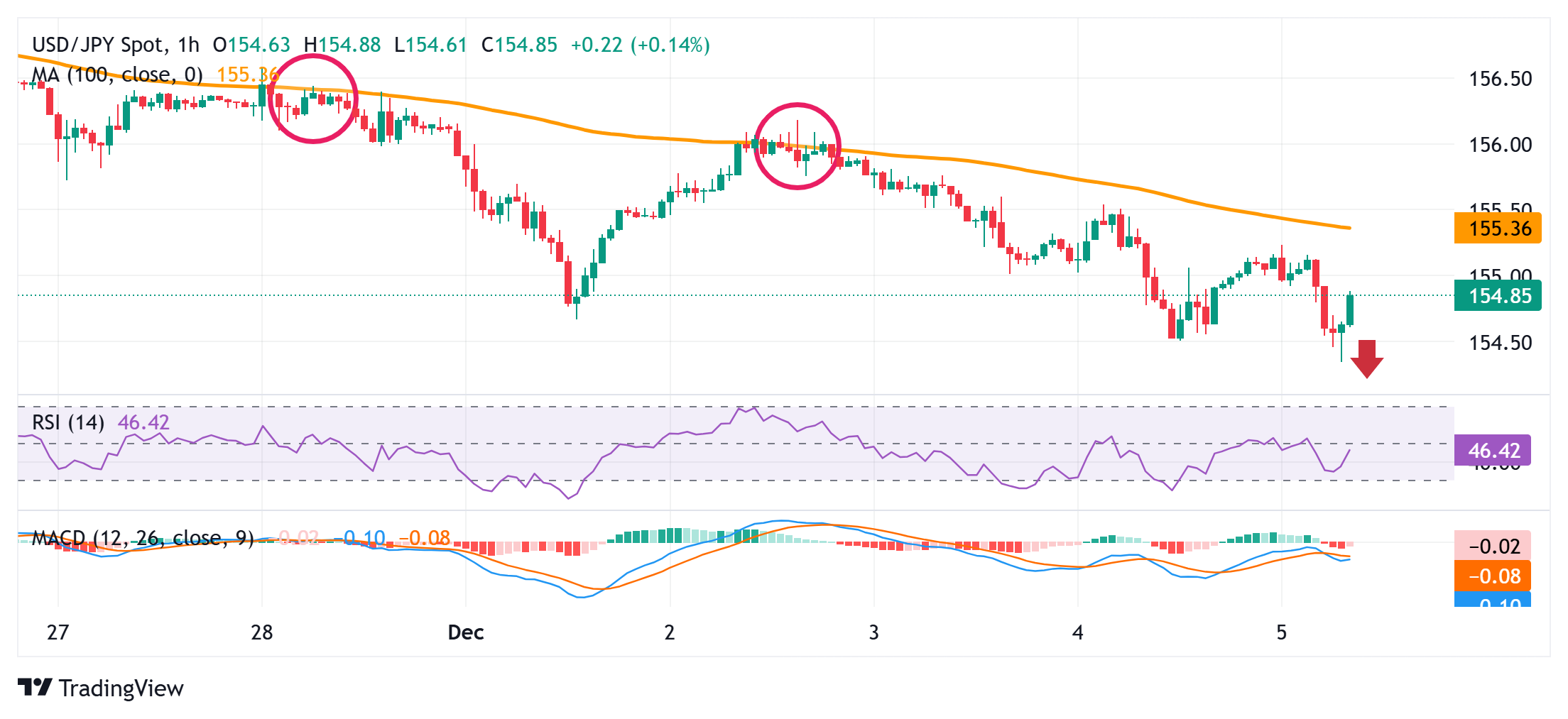
USD/JPY 1-hour chart
Technical Outlook
The recent repeated failures to move back above the 100-hour Simple Moving Average (SMA) and acceptance below the 155.00 psychological mark favor the USD/JPY bears. Furthermore, technical indicators on the daily chart have just started gaining negative traction and back the case for a further depreciating move. Hence, a subsequent fall towards the 154.00 mark, en route to the mid-November swing low, around the 153.60 area, looks like a distinct possibility.
On the flip side, any meaningful recovery back above the 155.00 mark is likely to confront a stiff barrier near the 155.40 region, or the 100-hour SMA. A sustained strength beyond might trigger a short-covering move and allow the USD/JPY pair to reclaim the 156.00 mark. Some follow-through buying should pave the way for a further move up to the next relevant hurdle near the 156.60-156.65 region and the 157.00 round figure.
Author

Haresh Menghani
FXStreet
Haresh Menghani is a detail-oriented professional with 10+ years of extensive experience in analysing the global financial markets.