|

USD/JPY: Cautious ahead of the Fed

  • USD/JPY's ascendance showing potential signs of cooling
  • Insufficient evidence yet of any dramatic retracement or reversal
  • 135 and 131.50 are key levels to watch

Warning Signs Flashing

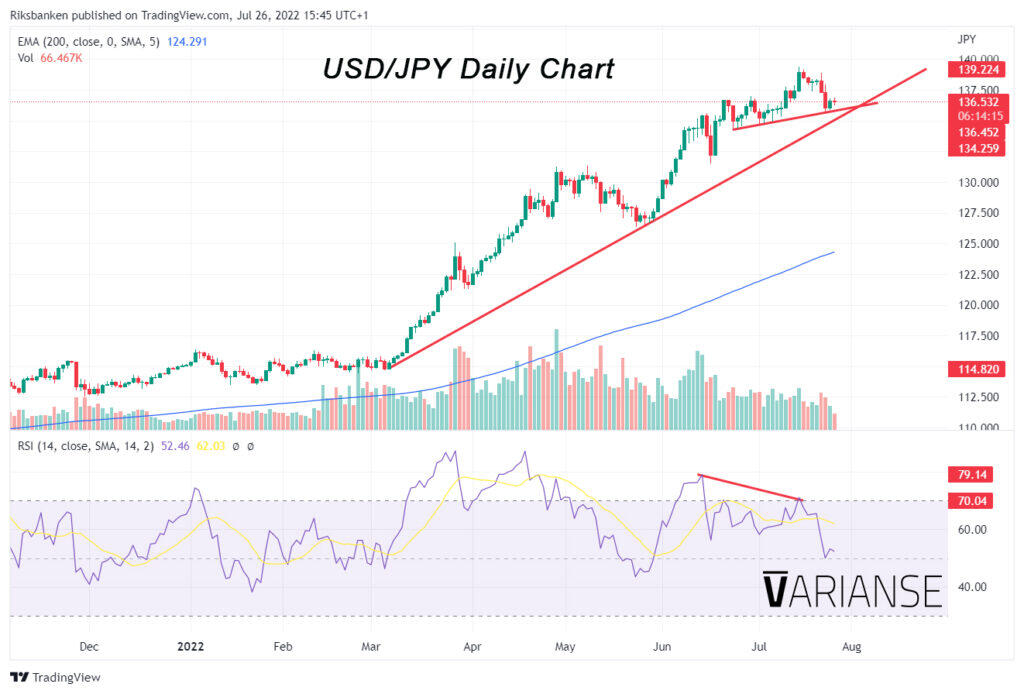
USD/JPY has been one of the latest entries into my higher frequency watchlists after price failed to make a substantive new higher low on the 22 July. As a result, I’m more vigilant for possible signs of reversal and see some pretty big risks buying ahead of Wednesday’s Fed decision. I’m too worried that either the 21 June 22 high of 136.710 or 29 June 22 high of 137.005, mark the first shoulder in a yet to be formed head and shoulders pattern or set the path toward a double top or triple tip formation. RSI divergence between the 14 June swing high of 135.495 and the subsequent 14 July swing high of 139.394 also adds to my new found caution.
Waiting for a Catalyst  

Still, ample evidence to suggest that USD/JPY has reached its peak is lacking. Granted, down by c. 19% against the US dollar year to date, the Japanese yen has been the worst performing currency, but that alone doesn’t mean it is ripe for a reversal. Most of the fundamental conditions that have led the pair higher haven’t shifted; aggressive Fed tightening vs. ultra loose monetary policy from the BoJ persists, as do high energy prices and fears of global recession. In my opinion, the fundamental catalysts needed to reverse the yen’s fortunes, although brooding, have yet to appear.

Key Levels to Be Broken

Likewise, price is still well above its 200-day exponential moving average. This makes me cautious of being too bearish USD/JPY, even if the gap between the current price and the moving average look extreme. Were price to break below 135 underpinned by decent volumes I might become more convinced that USD/JPY’s fortunes have taken a shift for the worse. Even more substantive, would be a sustained break below the 131.50 level. At the moment, we are still a long way off from that level. 

Author

Carl Paraskevas

Carl Paraskevas has over twenty years’ experience in finance and banking, primarily in research related roles at several institutions.


More from Carl Paraskevas
Share:

Editor's Picks

AUD/USD rises to 0.6950 as USD slips on Fed's Warsh

AUD/USD regains traction and extends the bounce toward 0.6950 in the Asian session on Friday. Fed Chair Warsh's comments reinforce the selling pressure on the US Dollar, allowing the pair to stretch higher. Warsh said that he remains committed to delivering price stability without giving away anything on future interest rate path.

USD/JPY falls in symc with USD, gives up 158.00 after Warsh's speech

USD/JPY has come under fresh selling pressure and gives up 158.00 in the Asian session on Friday amid the emergence of fresh US Dollar selling. Fed Chair Warsh's non-committal commentary on the future tightening path, weighs on the US Dollar and the pair.

Gold looks vacillating above $4,150

Gold alternates gains with losses below the key $4,200 mark per troy ounce on Friday. The yellow metal’s irresolute price action comes in response to a modest pullback in the US Dollar and a tepid recovery in US Treasury yields across the board.

Bitcoin steadies at $82,000: The five forces crushing the Uptober rally

Crypto markets have remained under pressure so far in October, with Bitcoin (BTC) sliding below $80,000 earlier this week before recovering to around $82,000 on Friday, as macroeconomic headwinds and cooling demand weigh on the market.

The Fed just got a second hot inflation number. Here's what the diesel signal is really saying
The Federal Reserve (Fed) faces a renewed inflation challenge after two consecutive reports showed price pressure intensifying across the US economy. September's Consumer Price Index (CPI) confirmed accelerating consumer inflation, while the Producer Price Index (PPI) revealed an even sharper rise in business costs. Behind both reports lies a common factor: energy prices.
Everyone's dumping Gold after hot US inflation. Here's why $4,100 could be a floor, not a cliff
Gold (XAU/USD) is recovering from a sharp sell-off triggered by hotter-than-expected United States (US) inflation data released on Wednesday. The precious metal briefly plunged toward $4,073 as investors increased their bets on further Federal Reserve (Fed) interest rate hikes before recovering as US Treasury yields and the US Dollar (USD) reversed their initial gains.















