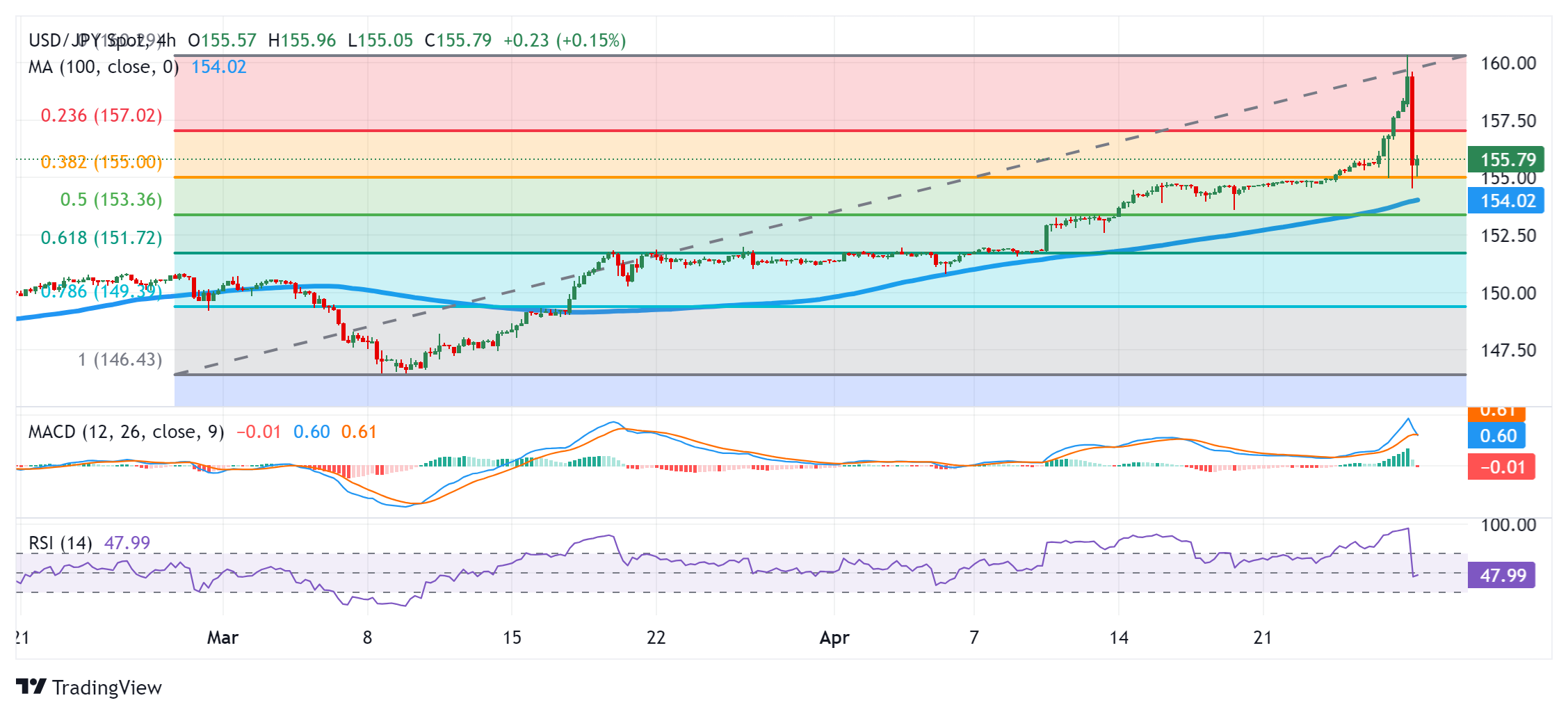
USD/JPY Analysis: Sharp intraday corrective slide shows resilience below 38.2% Fibo. level
- USD/JPY retreats sharply after an initial slump to its lowest level since October 1986.
- A possible intervention by Japanese authorities is cited as a reason behind the slump.
- The divergent BoJ-Fed policy expectations should help limit the downside for the pair.

The USD/JPY pair witnessed a dramatic intraday turnaround and tumbled over 570 pips from levels beyond the 160.00 mark, or the highest since October 1986 touched earlier this Monday. Although an official announcement has been made so far, the possibility of an intervention by Japanese authorities to support the domestic currency was cited as a key factor behind the sharp downfall. In fact, Japan’s top currency diplomat Masato Kanda refrained from making any comments on the market view that Japan intervened in the currency market this morning. Apart from this, the emergence of fresh US Dollar (USD) selling further contributes to the heavily offered tone surrounding the currency pair through the first half of the European session.
That said, growing acceptance that the wide interest rate differential between Japan and the United States (US) will remain for some time should cap gains for the Japanese Yen (JPY). The Bank of Japan (BoJ) decided to keep its key interest rate unchanged at the end of the April policy meeting on Friday and said that it will continue buying government bonds in line with the guidance made in March. In the accompanying quarterly outlook report, the BoJ lowered its economic growth forecast for the current fiscal year 2024. This, along with data showing that inflation in Tokyo slowed for a second month in April and fell below the central bank's 2% target, raised doubts about further policy tightening and should act as a headwind for the JPY.
In contrast, the Federal Reserve (Fed) is anticipated to keep interest rates higher for longer and the bets were reaffirmed by the release of the US Personal Consumption Expenditures (PCE) Price Index on Friday, which pointed to still sticky inflation. In fact, the headline PCE Price Index rose 0.3% in March and the yearly rate climbed to 2.7% from 2.5% in February, beating estimates for a reading of 2.6%. Adding to this, the core PCE Price Index, which excludes volatile food and energy prices, held steady at 2.8% as compared to 2.6% anticipated, reaffirming hawkish Fed expectations. This remains supportive of elevated US Treasury bond yields and favors the USD bulls, warranting caution before confirming that the USD/JPY pair has topped out.
Traders might also refrain from placing aggressive directional bets ahead of this week's crucial central bank event risk and the key US macro data scheduled at the beginning of a new month. The Fed is scheduled to announce its policy decision at the end of a two-day policy meeting on Wednesday, which will be looked upon for cues about the rate-cut path. Apart from this, the release of the closely-watched US monthly jobs data, popularly known as the Nonfarm Payrolls (NFP) report on Friday, will play a key role in influencing the USD price dynamics and provide some meaningful impetus to the USD/JPY pair.
Technical Outlook
From a technical perspective, the sharp intraday corrective decline could be attributed to some long unwinding amid an extremely overbought Relative Strength Index (RSI) on the daily chart. That said, the USD/JPY pair showed some resilience below the 38.2% Fibonacci retracement level of the March-April rally. The subsequent recovery of over 100 pips warrants some caution for bearish traders. Hence, it will be prudent to wait for some follow-through selling below the daily swing low, around the 154.55 region, before positioning for any further losses.
On the flip side, momentum beyond the 156.00 mark could extend further towards the 156.65-156.70 region, above which the USD/JPY pair could reclaim the 157.00 round figure. The latter coincides with the 23.6% Fibo. level support breakpoint, which if cleared decisively should pave the way for a move towards the 157.75-157.80 zone en route to the 158.00 mark and the the next relevant hurdle near the 158.30 area.
Author

Haresh Menghani
FXStreet
Haresh Menghani is a detail-oriented professional with 10+ years of extensive experience in analysing the global financial markets.

















