USD/CAD Price Forecast: Remains confined in a range; looks to US PPI for fresh impetus
- USD/CAD languishes near a two-month low amid the emergence of fresh USD selling.
- Reduced Fed rate cut bets act as a tailwind for the buck and limit losses for the pair.
- Sliding Oil prices undermine the Loonie and also lend support ahead of the US PPI.

The USD/CAD pair meets with some supply on Thursday and touches a nearly two-month low, around mid-1.4200s during the first half of the European session. The US Dollar (USD) attracts some sellers and drops to a fresh weekly low amid declining US Treasury bond yields, which turns out to be a key factor exerting pressure on the currency pair. That said, expectations that the Federal Reserve (Fed) will stick to its hawkish stance, bolstered by Wednesday's hotter US consumer inflation figures, act as a tailwind for the US bond yields and the Greenback. Furthermore, bearish Crude Oil prices undermine the commodity-linked Loonie and help limit further losses for the currency pair.
The US Bureau of Labor Statistics reported on Wednesday that the headline US Consumer Price Index rose more than estimated, by 0.5% in January – the most since August 2023. Meanwhile, the yearly rate climbed to 3% from 2.9% in December. Moreover, the core CPI, which excludes food and energy prices, nudged up by 0.4% on a monthly basis and jumped 3.3% from a year ago compared to 3.1% expected. The data pointed to still-sticky underlying inflationary pressures and suggested that the Fed doesn't have much room to cut interest rates further this year. Adding to this, fed Chair Jerome Powell said that the central bank wants to keep policy restrictive as inflation remains above the 2% target.
Separately, Atlanta President Raphael Bostic said the central bank must gain more insight into proposed policy changes on issues like trade and immigration before adjusting interest rates. Chicago Fed President Austan Goolsbee also spoke on Wednesday and called the latest inflation figures concerning. This comes on top of worries that US President Donald Trump's policies would boost inflation and temper hopes for further easing by the Fed. This assisted the yield on the benchmark 10-year US government bond to register its biggest one-day rise since December. This supports prospects for the emergence of some USD dip-buying and warrants caution for the USD/CAD bears.
Market participants now look forward to the US economic docket – featuring the release of the Producer Price Index (PPI) and the usual Weekly Initial Jobless Claims later during the early North American session. Apart from this, the US bond yields and trade-related headlines will drive the USD demand. This, along with Oil price dynamics, should contribute to producing short-term trading opportunities around the USD/CAD pair.
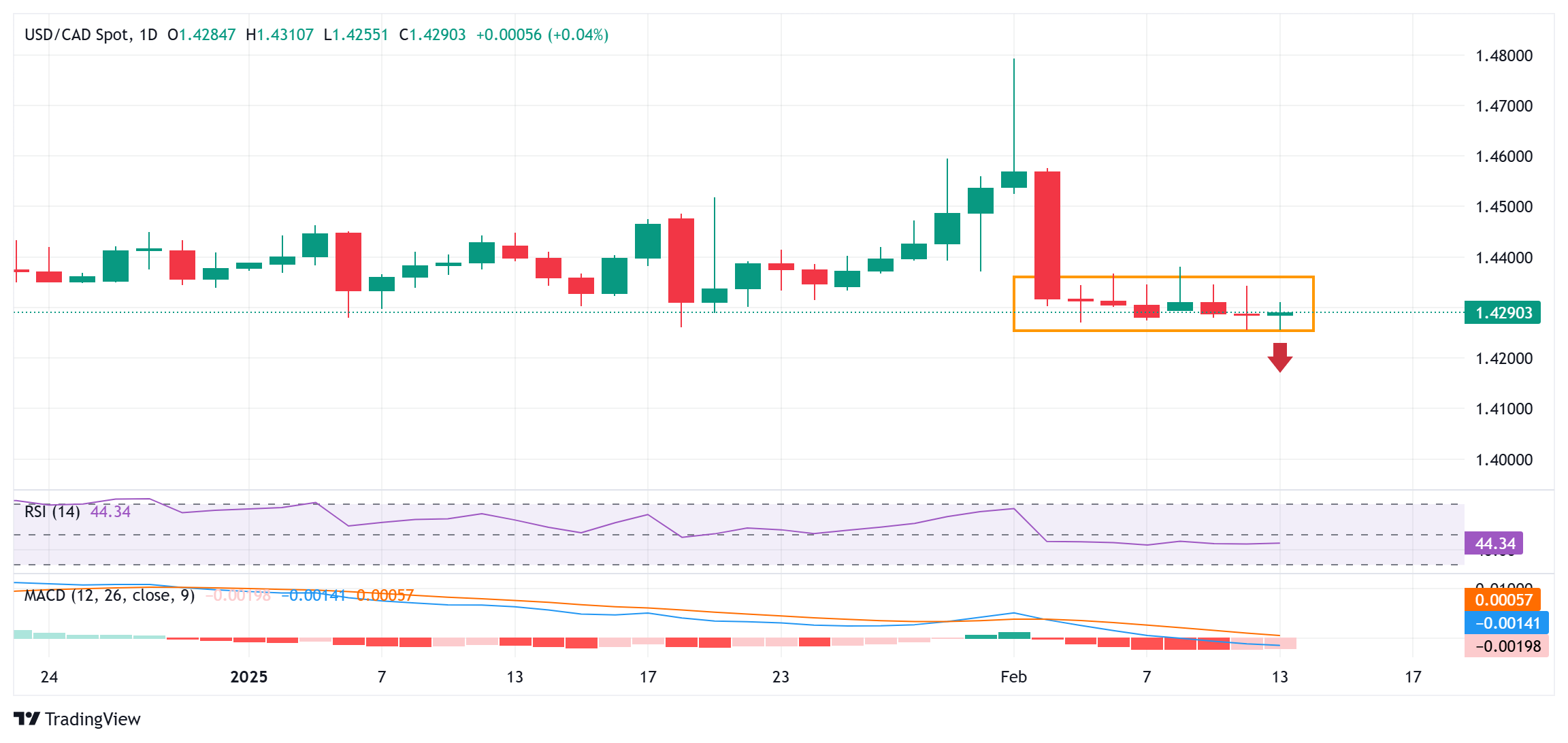
USD/CAD daily chart
Technical Outlook
From a technical perspective, the recent range-bound price action witnessed over the past week or so might be categorized as a bearish consolidation phase against the backdrop of a sharp pullback from a 22-year peak touched earlier this month. Moreover, oscillators on the daily chart have been gaining negative traction and suggest that the path of least resistance for the USD/CAD pair is to the downside.
That said, it will still be prudent to wait for a sustained breakdown below the trading range support, around mid-1.4200s before positioning for deeper losses. The USD/CAD pair might then accelerate the fall towards the 1.4200 round figure en route to the next relevant support near the 1.4170-1.4165 region and sub-1.4100 levels.
On the flip side, momentum beyond the 1.4300 mark is likely to confront a hurdle near the 1.4350 supply zone ahead of the weekly top, around the 1.4375 region. This is followed by the 1.4400 mark, above which a fresh bout of a short-covering momentum could lift the USD/CAD pair towards the 1.4455-1.4460 intermediate barrier en route to the 1.4500 psychological mark.
Author

Haresh Menghani
FXStreet
Haresh Menghani is a detail-oriented professional with 10+ years of extensive experience in analysing the global financial markets.