USD/CAD Forecast: Failure to find acceptance above 1.3700 warrants caution for bulls
- USD/CAD edges lower on Thursday, though it lacks any follow-through selling.
- Reduced Fed rate cut bets act as a tailwind for the USD and limit the downside.
- Trade jitters and subdued Oil prices undermine the Loonie, supporting the pair.

The USD/CAD pair attracts fresh sellers on Thursday and moves away from a one-and-a-half week high – levels beyond the 1.3700 round figure – touched the previous day. Minutes from the June 17-18 FOMC policy meeting showed that the majority of policymakers expect rate cuts to be appropriate sometime later this year and that any price shock from tariffs could be temporary or modest. This keeps the US Dollar (USD) depressed below a two-week high touched on Tuesday and turns out to be a key factor exerting downward pressure on the currency pair.
The FOMC minutes further revealed narrow support for a near-term reduction in borrowing costs. This comes on top of the upbeat US employment details released last Thursday, which showed that the economy added more jobs than expected in June, and dampens expectations of a rate cut by the Federal Reserve (Fed) this month. Adding to this, concerns about the potential economic fallout from US President Donald Trump's erratic trade policies act as a tailwind for the safe-haven Greenback, which, in turn, offers some support to the USD/CAD pair.
Trump issued a new round of trade letters, outlining individual tariff rates ranging from 20% to 50% for eight trading partners. A notable aspect of over 20 letters sent so far to different countries was Trump's direct threat that any retaliatory levies will be added to the existing US tariffs. Moreover, Trump announced 50% tariffs on copper starting from the new deadline of August 1. Given that the US is by far the largest destination for Canadian copper, the move undermines the Canadian Dollar (CAD) and contributes to limiting losses for the USD/CAD pair.
This adds a layer of uncertainty over the global economic growth, which, in turn, could dent fuel demand. The bearish outlook fails to assist Crude Oil prices to capitalize on its recent move up beyond the $68.00 mark, which might further hold back traders from placing aggressive bullish bets around the commodity-linked Loonie. Hence, it will be prudent to wait for strong follow-through selling before positioning for any further slides. Traders now look to the US Weekly Initial Jobless Claims and speeches by influential FOMC members for a fresh impetus.
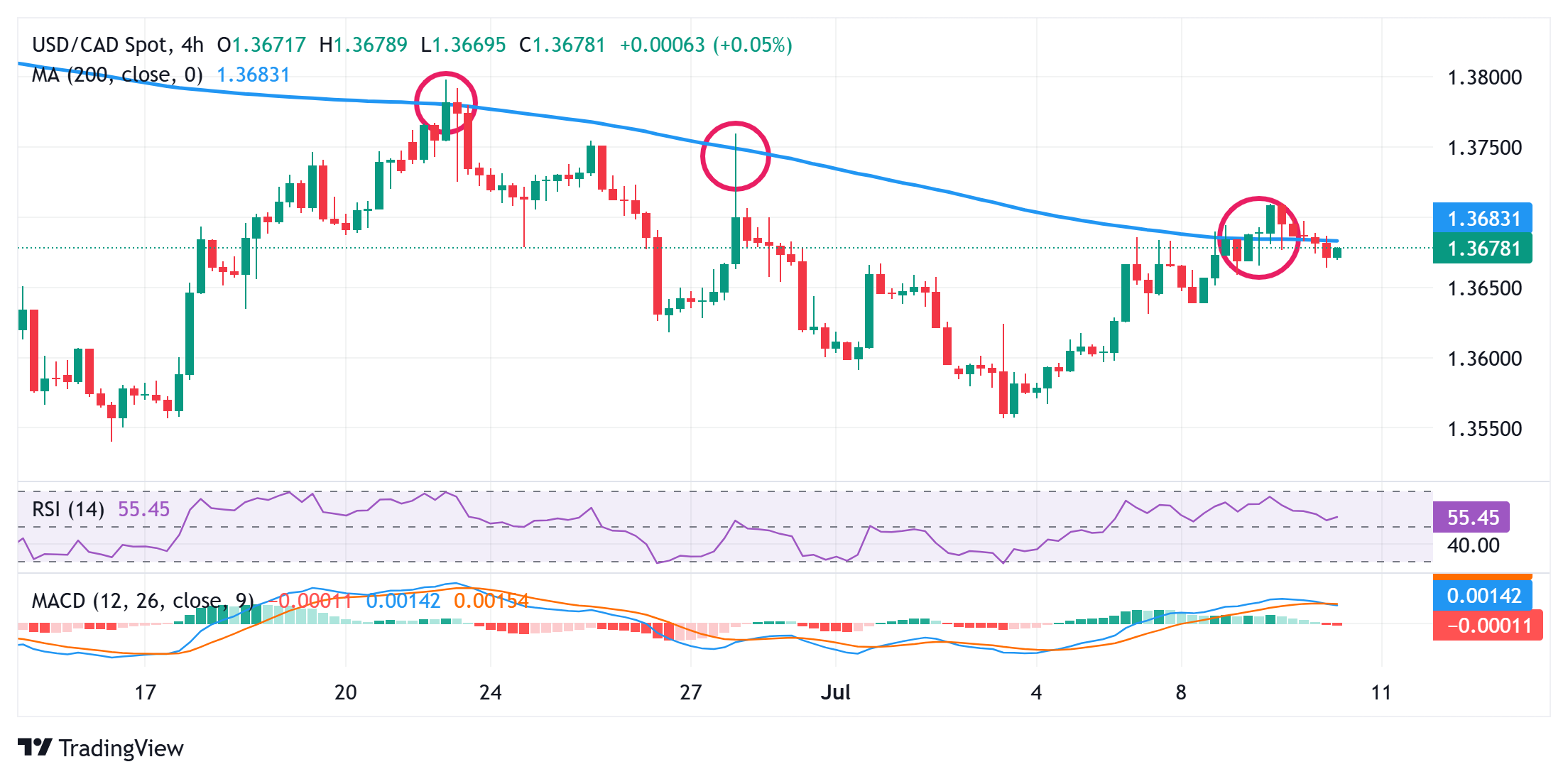
USD/CAD 4-hour chart
Technical Outlook
The overnight failure to find acceptance above the 1.3700 mark and the 200-period Simple Moving Average (SMA) on the 4-hour chart warrants caution for the USD/CAD bulls amid neutral oscillators on the daily chart. Hence, it will be prudent to wait for a sustained strength beyond the said handle before positioning for an extension of the recovery from the vicinity of mid-1.3500s, or the monthly low touched last week. Spot prices might then climb to the 1.3765-1.3770 intermediate hurdle before aiming to reclaim the 1.3800 mark for the first time late May.
On the flip side, weakness below the 1.3640-1.3635 area could drag the USD/CAD pair back towards the 1.3600 round figure. A convincing break below the latter would expose the monthly low, around the 1.3555 region. Some follow-through selling below the June monthly swing low, around the 1.3540 region, will be seen as a fresh trigger for bearish traders and make the pair vulnerable to accelerate the fall further towards the 1.3500 psychological mark.
Author

Haresh Menghani
FXStreet
Haresh Menghani is a detail-oriented professional with 10+ years of extensive experience in analysing the global financial markets.