USD/CAD Forecast: 38.2% Fibo. level holds the key for bulls ahead of Canadian CPI
- USD/CAD regains some positive traction and draws support from a combination of factors.
- Bearish Oil prices undermine the Loonie and act as a tailwind amid a modest USD uptick.
- Traders look to Canadian CPI for a fresh impetus ahead of the Fed decision on Wednesday.

The USD/CAD pair once again finds some support near the 1.3650 region and attracts fresh buying during the Asian session on Tuesday, reversing a part of the previous day's losses. Crude Oil prices struggle to capitalize on the overnight solid bounce from a fresh 15-month low and come under some renewed selling pressure amid worries that a deeper global economic downturn will dent fuel demand. This, in turn, undermines the commodity-linked Loonie, which, along with a modest US Dollar recovery from its lowest level since February 14, acts as a tailwind for the major.
A further recovery in the US Treasury bond yields - led by easing fears of a widespread contagion risk following the news that UBS will rescue Credit Suisse in a $3.24 billion deal - is seen as a key factor lending some support to the Greenback. That said, expectations for a less hawkish Federal Reserve might keep a lid on any meaningful upside for the US bond yields and the USD. Investors now seem convinced that the US central bank will soften its stance to prevent any further economic pressure from high borrowing costs and might even cut rates during the second half of the year.
The speculations were fueled by the collapse of two mid-size US banks - Silicon Valley Bank and Signature Bank - that had led to the recent steep decline in the US bond yields. It is worth mentioning that the rate-sensitive 2-year US government bond last week recorded its biggest three-day slump since Black Monday in October 1987. Hence, the market focus will remain glued to the outcome of the highly-anticipated two-day FOMC monetary policy meeting, due to be announced on Wednesday, which will drive the USD demand and determine the near-term trend for the USD/CAD pair.
Heading into the key central bank event risk, traders on Tuesday will take cues from the release of the latest Canadian consumer inflation figures later during the early North American session. Given that the Bank of Canada (BoC) became the first major central bank to pause its rate-hiking cycle earlier this month, a softer domestic CPI print could weigh on the Canadian Dollar and provide a fresh lift to the USD/CAD pair. Apart from this, the underlying bearish sentiment surrounding Oil prices suggests that the path of least resistance for spot prices remains to the upside.
Technical Outlook
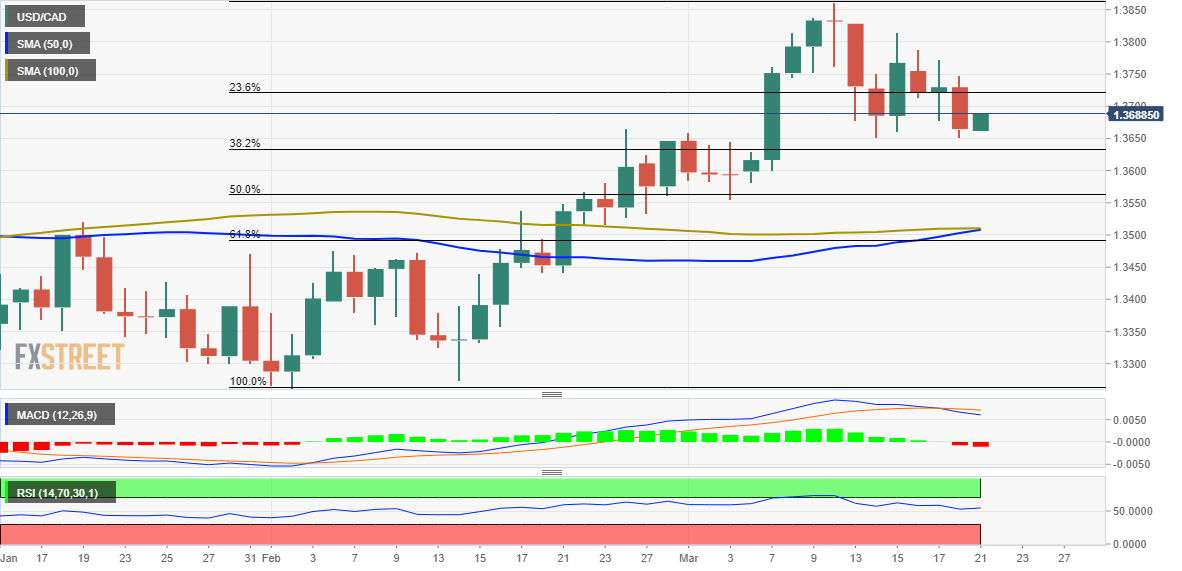
From a technical perspective, the USD/CAD pair, so far, has been finding support ahead of the 38.2% Fibonacci retracement level of the recent rally from the vicinity of the 200-day Simple Moving Average (SMA). The said support is pegged around the 1.3635 region, below which spot prices could slide further below the 1.3600 mark, towards testing the 50% Fibo. level near the 1.3565 zone. Some follow-through selling will expose the 1.3500 confluence, comprising the 100-day SMA, 61.8% FIbo. level and the 50-day SMA. A convincing break below the latter will negate any positive outlook and shift the near-term bias in favour of bearish traders.
On the flip side, the 1.3700 round-figure mark, followed by the 1.3720-1.3725 area (23.6% Fibo.) might now act as immediate hurdles ahead of the 1.3770-1.3775 region. A sustained strength beyond should allow the USD/CAD pair to surpass the 1.3800 mark and retest the multi-month peak, around the 1.3860 zone touched on March 10. The momentum could get extended further towards the 1.3900 mark en route to the 2022 swing high, around the 1.3975-1.3980 zone, above which spot prices could aim to reclaim the 1.4000 psychological mark.
Premium
You have reached your limit of 3 free articles for this month.
Start your subscription and get access to all our original articles.
Author
Haresh Menghani
FXStreet
Haresh Menghani is a detail-oriented professional with 10+ years of extensive experience in analysing the global financial markets.