US trade deficit narrows sharply in November


Summary
The U.S. international trade deficit narrowed sharply in November amid a collapse in imports. While this presents some upside risk to Q4 GDP growth, the details suggest economic weakness is also starting to show up in trade flows.
Trade flows essentially collapsed in November
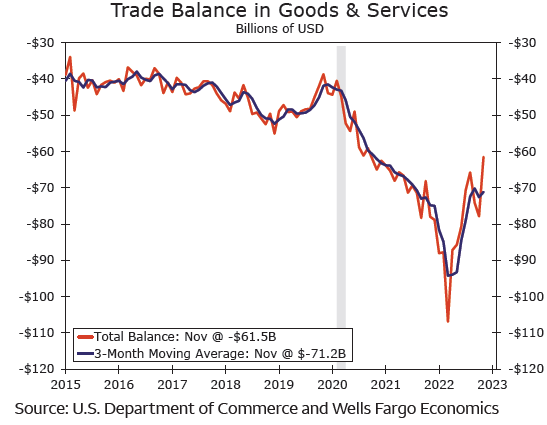
International trade flows continued their volatile path in November and caused the U.S. trade deficit to narrow to over a two-year low of $61.5 billion (chart). Specifically, U.S. imports from the rest of the world plunged by $21.5 billion during the month, which essentially puts the level of imports back to where they stood a year earlier (chart). While some volatile factors explain the sharp decline, broad weakness suggests the transition away from goods of domestic consumers may be starting to show up in import activity.
While all major categories declined (chart), the $8.8 million pullback in consumer goods led the drop. Weakness was broad based–consider that just five categories of end-use consumer goods imports rose during the month and that they are rather small representing less than 2% of year-to-date imports in consumer goods. That said, an unusually large $2.9 million decline in pharmaceutical preparations and another $2.7 million drop in cell phones & other household goods together were responsible for about 60% of the overall decline in consumer products. We thus conclude the transition away from goods and to services domestically is likely leading to some gradual weakness in consumer goods, but monthly volatility has made these figures appear a bit worse.
Volatility doesn't stop at consumer products either. A $1.7 million decline in crude oil imports, which is likely in part price driven, drove overall industrial supplies lower, and outsized declines in computers andtelecommunications equipment were what weighed on capital goods in November.
Author
Wells Fargo Research Team
Wells Fargo