US trade balance holds constant at record deficit in February


Summary
The U.S. trade balance held constant at a record deficit, but the steadiness of the U.S.trade balance is likely temporary. We expect the trade deficit to widen further over the coming quarters as U.S. businesses need to replenish inventories and exports look set to rise at only a moderate pace this year. The February data suggest net exports are still shaping up to be a considerable drag on first-quarter growth.
Some time away from stabilization in trade balance
The U.S. trade balance more or less held constant at a record deficit in February (chart). The balance narrowed only marginally by $44 million to a deficit of $89.19 billion in February from an upwardly revised $89.23 billion in January. This marks the smallest movement in the deficit since the start of 2020, after two years of extreme volatility in the month-to-month data (chart).
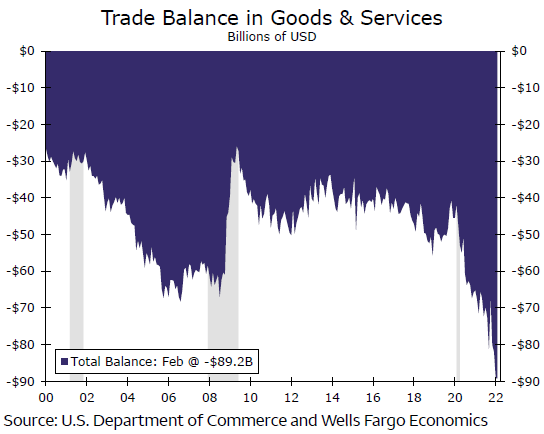
There has been a clear widening in the trade balance since the start of the pandemic as a result of robust domestic demand for goods (chart). Even as some of this demand subsides in the near term amid the return of services activities and soaring inflation, the need to replenish low levels of inventory should keep imports flowing into the U.S. At the same time, export growth should continue to moderately recover this year, but it's unlikely to be strong enough to offset the continued climb in imports. The slight narrowing in the February trade data thus likely does not demonstrate the start of stabilization in the trade balance.
The narrowing was a result of the U.S. exporting more to its foreign trading partners than it brought in. In nominal terms, exports grew 1.8% in February while import growth was weaker at 1.3%. Exportsreceived a solid boost from consumer goods (+6.7%), where pharmaceutical preparations accounted for most of the gain. The largest gain in imports came from a $1.9 billion gain in crude oil, accounting for nearly 60% of the overall gain in industrial supplies imports for February. Russia invaded Ukraine towards the end of the month and with the conflict unresolved this import component will likely remain elevated for some time. The services trade balance narrowed by $1 billion, in part reflecting temporary factors. There was a sizable gain in intellectual property imports, which may be tied broadcasting rights for the Winter Olympics.
Author
Wells Fargo Research Team
Wells Fargo