US S&P Global PMIs Preview: Win-win situation for the Dollar? Why investors may get spooked
- Economists expect the US S&P Global PMIs to point to modest growth in April.
- An upbeat figure may raise fears of aggressive rate hikes by the Federal Reserve.
- Weak data could trigger safe-haven flows, also supporting the US Dollar.
- The Fed's blackout period and the release before the weekend are additional factors impacting the Greenback.

There is no such thing as "second-tier" figures – that has been the notion in recent weeks, where every data point has had an outsized effect. That is especially relevant regarding a forward-looking release on Friday – and on the last day Federal Reserve (Fed) officials can speak before their "blackout period."
Here is a preview of the preliminary US S&P Global Purchasing Managers' Indexes for April, released on April 21, at 13:45 GMT.
Why S&P Global PMIs are important to markets
The month has another full trading week left, but S&P Global will already have preliminary data for April. The early publication causes investors to watch it closely – even if it lacks the depth of the parallel ISM PMIs.
The surveys' importance also stems from the Federal Reserve's focus on data in general, and forward-looking data. If businesses are optimistic, they spend and hire, and in case of worries, they hold back on expenses.
Sensitivity is especially high in this release, the first to fully reflect the banking crisis after the dust settled. Is credit sufficiently available for businesses, or are they feeling a chokehold from banks? That is one of the critical questions the PMIs can help answer.
Another source of angst comes from the timing – on Friday, as investors wish to take risks off the table. More importantly, it is the last day when Fed officials speak publicaly before they enter their self-imposed "blackout period." The central bank stays silent for ten days leading to their rate decisions.
The S&P Global PMIs are the last significant data points due out, and they may influence what officials say. Markets know that.
What investors expect from April's S&P Global PMIs
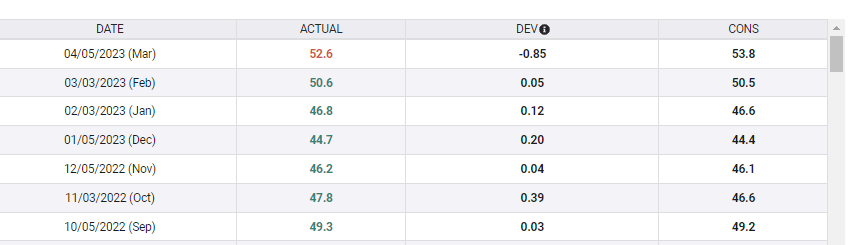
The economic calendar points to moderate declines in the various measures released. The focus will likely be on the Services figure, as the sector represents most of the US economy. Moreover, March's figure fell short of estimates for the first time since August 2022.
Source: FXStreet
For April, expectations are lower – 51.5 after 52.6 in March. Any score above 50 reflects expansion, while an outcome below that threshold represents contraction. Investors are wary of a further slide under 50, which would raise recession fears.
How the US Dollar may react to the S&P Global PMIs
Fear is in the air – while the banking crisis has stabilized, regional lenders are not out of the woods. Bigger banks are doing well, but with less competition, they may further tighten their lending conditions. The impact on the economy remains unclear, and markets hate uncertainty.
If the S&P Global PMIs, and especially the Services PMI, miss expectations, concerns about a downturn could take over. When the US economy sneezes, the rest of the world catches a cold – rushing to the safety of the US Dollar.
Conversely, if the figures beat estimates, investors may fear a tougher stance from Fed officials. While a 25 bps hike in May is priced in, another one in June is still uncertain. Any figure that would raise the chances of another increase in borrowing costs could push expectations higher, further boosting the Greenback.
In which scenario would the US Dollar decline? If data meet estimates. That would imply a moderate slowdown – the soft landing scenario that everybody desires. A gradual cooldown in the US economy would allow for continued growth elsewhere and diminish demand for the safe-haven US Dollar.
Final thoughts
Every data point matters – and even more so when it has its say before the final Fed speeches. Any significant surprise in the S&P Global PMIs would boost the Greenback.
Author

Yohay Elam
FXStreet
Yohay is in Forex since 2008 when he founded Forex Crunch, a blog crafted in his free time that turned into a fully-fledged currency website later sold to Finixio.