US Retail Sales won’t shift the dial for the Fed


The US retail sales report for May was closely watched for signs that the consumer is crumbling under the pressure of a soft labour market and fears about a slowing economy. Headline sales fell 0.9% last month, weaker than expected, and the lowest level since January. The biggest downward pressure on sales came from vehicle sales, restaurants and bars, gas stations and building materials, which all fell last month.
US consumers are cautious, but not struggling
Overall, there is not much good news about the consumer in this report, although control group sales rose by 0.4%, stronger than the 0.3% expected. Control sales exclude autos, building materials, gas stations and other categories like mobile homes and tobacco stores, which can give us a sense of how confident consumers feel about spending their income on more discretionary items. This is the one bright spot in this report, and it suggests that if you dig a bit deeper into the data, it is not as bad as thought. However, most Americans have cars and need gas, if they are not upgrading cars then it could suggest some caution from consumers as the labour market starts to soften and as the economy continues to roil from President Trump’s trade policy.
US Retail Sales
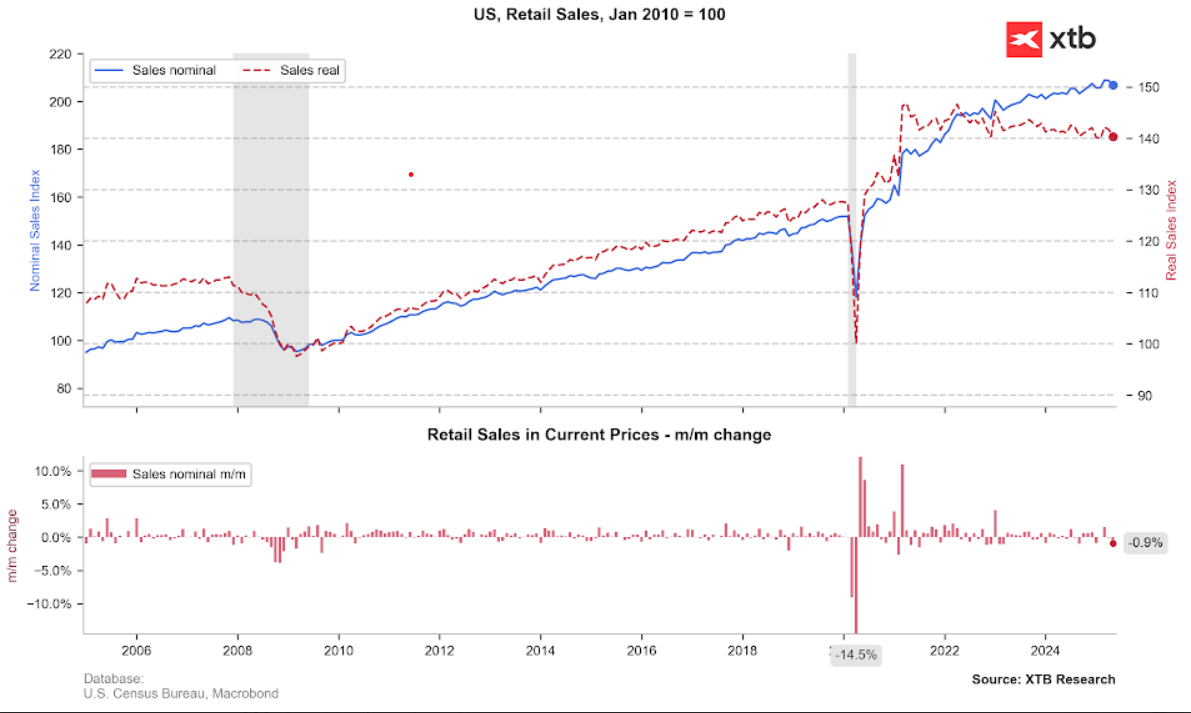
Source: XTB
No tariff pass through to prices, as yet
The other data points worth noting on Tuesday include import and export prices for May. Import prices were higher than expected, with the monthly rate staying flat, and the import price minus petroleum rising by 0.2%. Export prices were weak, suggesting that global trade has continued to be impacted by Trump’s tariffs.
Overall, this data supports the view that the US economy is slowing in an orderly way. The market reaction also reflects this view. The dollar index has reversed some earlier losses, and US bond yields are also rising on the back of this data. The 1.7% increase in the oil price on Tuesday is also putting pressure on bond yields globally.
The market is still pricing in the first rate cut from the Fed in September, and we do not think that this will be pushed forward anytime soon. The Fed is instead likely to extend their wait and see approach when they meet on Wednesday. From a market perspective, this could limit further downside for the US dollar.
Why inflation expectations matter more for the Fed than a softening labour market
According to the WSJ, the Fed will be watching inflation expectations closely in the coming months to see if the President’s trade policies have a de-anchoring impact. The latest inflation expectations data from the University of Michigan saw 1-year expectations moderate to 5.1% from 6.6%, the 10-year expectations were roughly stable at 4.1%, even though CPI is moderating. these levels are unacceptably high for the Fed, in our view, which is why the Fed is unlikely to deviate from its wait and see approach on Wednesday.
For now, high interest rate expectations could beat a stuttering labour market when it comes to the Fed’s next steps.
Author
Kathleen Brooks
XTB UK
Kathleen has nearly 15 years’ experience working with some of the leading retail trading and investment companies in the City of London.