US PCE Inflation Preview: Dollar rally has more legs to run
- Annual Core PCE inflation is forecast to rise to 4.8% in December from 4.7%.
- US Dollar Index surged to its highest level in more than a year on Fed's hawkish outlook.
- Dollar is likely to continue to outperform its rivals in the near term.

The dollar rally that was fueled by the US Federal Reserve’s hawkish policy outlook remains intact ahead of the weekend and the US Bureau of Economic Analysis’ (BEA) inflation report is unlikely to change that.
The Fed left its policy settings unchanged following the January policy meeting as expected. The QE program will come to an end in early March as planned and policymakers are set to vote in favour of a 25 basis points rate hike at the next meeting.
In a hawkish twist, however, FOMC Chairman Jerome Powell noted that they will shift their focus to balance sheet reduction after the first rate hike and added that they will need two meetings to come up with a plan. Earlier in the month, Powell told the US Senate Banking Committee that balance sheet reduction wouldn’t begin until toward the end of the year. Additionally, Powell downplayed the disappointing employment data and said that they have “quite a bit of room” to raise rates without hurting the labour market.
Commenting on the inflation outlook, Powell reiterated that they expect to see progress on inflation in the second half of the year while acknowledging that there is a risk price pressures could remain high for a prolonged period. “We are positioned to make changes in policy to address the risk of higher inflation,” the chairman added.
The BEA will release the Personal Consumption Expenditures (PCE) Price Index figures at 1330 GMT on Friday, January 28. The Fed uses the annual Core PCE Price Index reading as its preferred gauge of inflation and investors expect it to rise to 4.8% in December from 4.7% in November. Earlier in the month, the US Bureau of Labor Statistics reported that the Core Consumer Price Index jumped to 5.5% on a yearly basis in December from 5% in November.
The fact that the PCE inflation data will be released after the FOMC’s policy announcements undermines its significance. The December reading by itself is unlikely to derail the Fed from the tightening path. Hence, even if the PCE data comes in below the market expectation, the negative impact on the dollar should remain short-lived. On the flip side, a strong print should provide an additional boost to the dollar as it could fuel market speculation about a 50 bps rate increase in March. As it currently stands, the CME Group FedWatch Tool shows that markets price a more-than-60% chance of a 50 basis points rate hike by May.
US Dollar Index (DXY) Technical Outlook
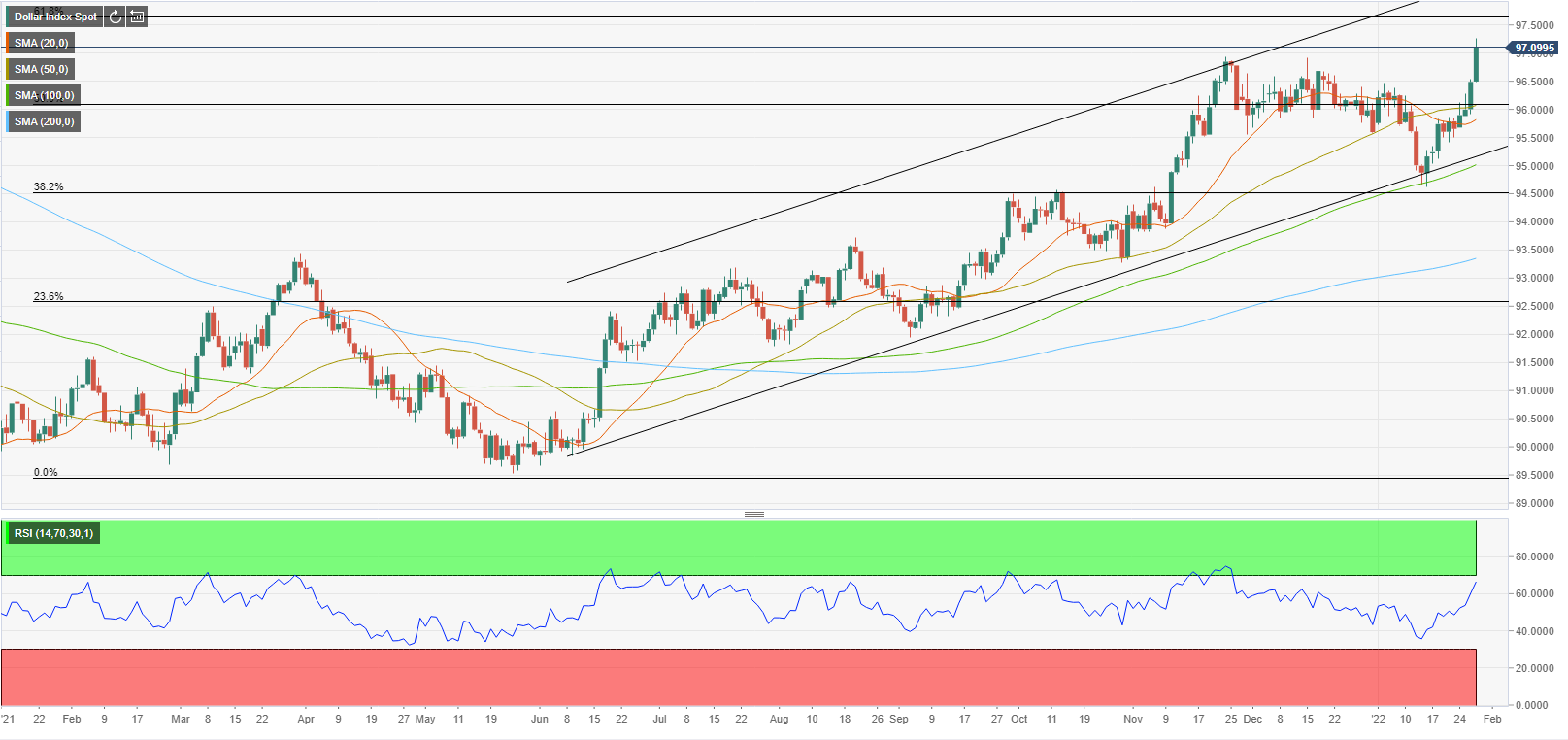
In case the DXY faces bearish pressure with the initial reaction to a weaker-than-expected Core PCE figure, 96.65 (former resistance, static level) aligns as first support ahead of 96.00 (50-day SMA, psychological level, Fibonacci 50% retracement of the March 2020 - January 2021 downtrend). As long as the latter holds, DXY’s bullish bias should stay intact.
On the upside, 97.70 (Fibonacci 61.8% retracement) could be seen as the first target before 98.00 (psychological level, the upper limit of the ascending trend channel coming from June 2021).
Meanwhile, the index has more room on the upside before turning technically overbought with the Relative Strength Index (RSI) indicator on the daily chart staying below 70.
Author

Eren Sengezer
FXStreet
As an economist at heart, Eren Sengezer specializes in the assessment of the short-term and long-term impacts of macroeconomic data, central bank policies and political developments on financial assets.