US Payrolls and Tesla help S&P 500 get back above 6,000
- US Payrolls help ease fears about a US recession.
- Labour market 8is softening, but not falling off a cliff.
- US rate cut expectations get scaled back.
- Will Trump and Musk kiss and make up?
- Tesla's recovery helps US stocks rally into the weekend.
- The Dollar hitches a ride on stronger bond yields.

The US payrolls report was stronger than expected for May. The economy created 139k jobs last month, the consensus was for a 126k reading. The April figure was revised lower to 147k. Leading up to this meeting there was concern that the labour market was buckling under the pressure of tariffs and weaker economic growth. However, the May report suggests that the labour market is softening, not falling off a cliff.
The unemployment rate remained steady at 4.2%, although this is likely to rise in the coming months, especially since the US has not created more than 200k jobs so far in 2025. Overall, jobs growth remains stable in the face of tariff risks, so the prospect of a rapid spike higher in the unemployment rate is retreating.
Falling immigration pushes up wages
The anomaly in this report was the average hourly earnings figure for last month. Earnings were 3.9%, defying expectations for a retreat to 3.7%. This suggests that employers are still willing to pay up for workers, possibly because of slowing immigration. Regardless of the specific drivers, strong wage growth suggests that we are not entering an era of high unemployment.
The better-than-expected jobs growth had an immediate impacts on financial markets. Stock investors are relieved, and US stocks markets are higher at the end of the week. However, that is also down to the latest development in the Elon Musk/ Donald Trump spat.
Bond yields jump as recession risks recede
The big move has happened in the bond market. 2-year yields are higher by 10bps, the 10-year yield is also higher by 7bps. This suggests that the market had gotten ahead of itself in pricing in recession risks for the US economy. The US economy is undoubtedly slowing, but at a reasonable pace.
Rate cuts get priced out, regardless of what Trump wants
The payrolls report has also triggered a recalibration of Fed interest rate cut expectations. Earlier this week, the market had fully priced in 2 rate cuts for 2025, this has now fallen to 1.7 cuts. The market now expects US interest rates to end the year at 3.87%, this was 3.75% on Wednesday.
The dollar is also higher on Friday, and the dollar index is back above 99.00, the dollar is also the top performing currency in the G10 FX space on Friday, as it gets lifted by the sharp rise in bond yields. Although the longer-term direction for the USD is weak, respite vs the EUR and the JPY is to be expected. USD/JPY is now back above its 50-day sma at 144.55. A weekly close above 145.00 would be a bullish development for this pair and for the dollar more broadly and could suggest a short-term recovery for the greenback.
Tesla drives US stocks back towards record highs
US stocks have had a strong open on Friday, and the S&P 500 is back above 6,000 for the first time since February. The question now is, can US stocks reach the record highs from February? This is now in reach, even with the multiple challenges facing the global economy including tariff risks and a global economic slowdown. The price action suggests that the market is not taking these risks too seriously, that they do not see a recession in the future and that investors still think that corporate earnings growth will be strong. It also suggests that investors are favouring tech stocks, and they may once again lead US stocks higher.
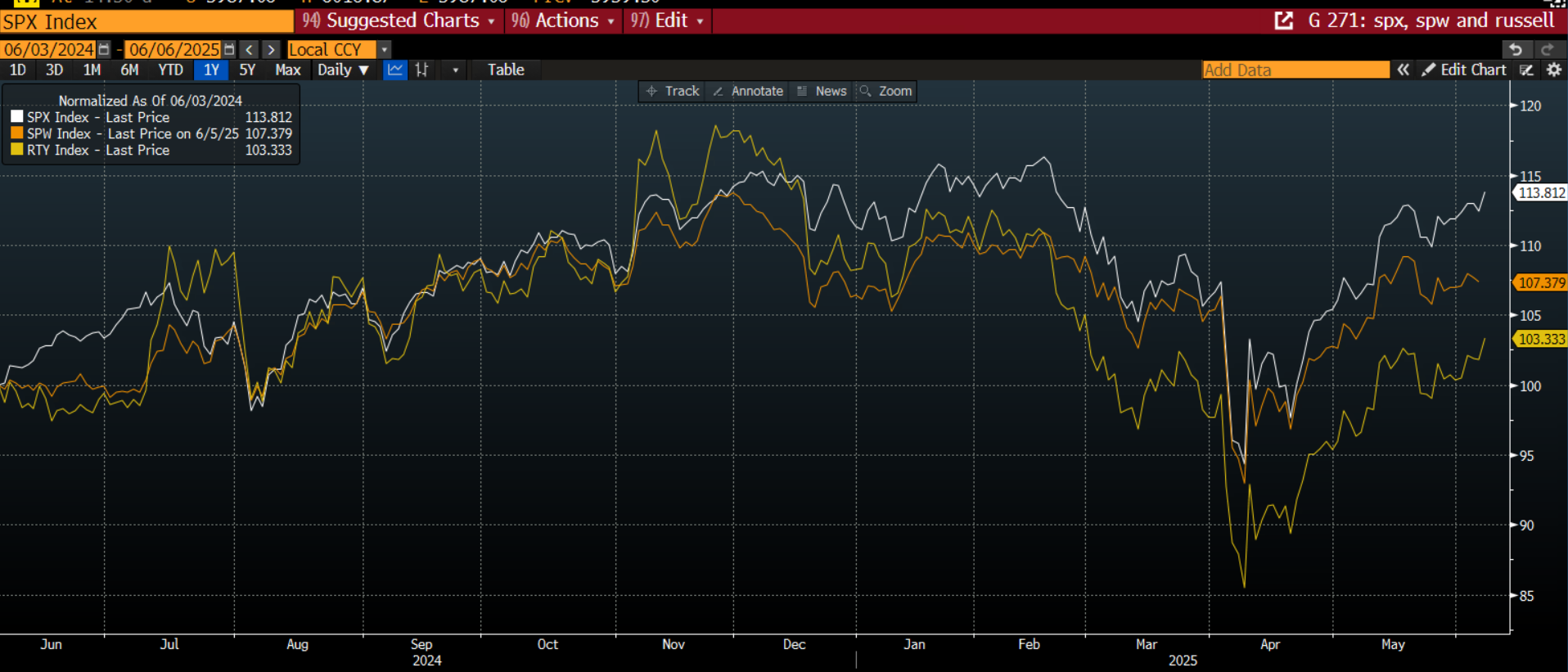
This is why the US market cap index has been outpacing gains in the equal weighted index, and the Russel 2000. It looks like we are back in an environment where tech stocks are leading US blue chip equity indices, which could lead to greater concentration risk, but may also see US stocks rise back to their record highs from February.
Chart 1: S&P 500, S&P 500 equal weighted index and Russel 2000, normalized to show how they move together
Source: XTB and Bloomberg
Will Musk and Trump kiss and make up?
The focus is back on tech, which is why the market was transfixed with the Elon Musk/ Donald Trump feud on Thursday. It has since cooled off, with Musk calling a truce with the President. Analysts now expect them to kiss and make up and put the recent spat behind them. However, although Tesla shares are higher by 5% on Friday, they have not recouped all of Thursday’s losses. Thursday’s 14% decline was the largest single day decline in Tesla’s share price for at least 5 years. The second biggest decline came after Trump’s reciprocal tariffs, when Tesla’s share price fell 10%. This suggests that politics are toxic for Tesla’s share price, and a political risk premium may get baked into the stock.
Due to the political risk premium, it may be hard for Tesla’s stock to get back to the $350 highs from May, and it may also limit its ability to get back into the trillion-dollar club, after Tesla’s market cap plunged by $200bn on Thursday.
Nvidia and Meta overtake Tesla as the leaders of the Magnificent 7
Overall, today’s payrolls report is considered benign and is putting to bed fears about a US recession. The stock market surge is largely down to Tesla’s recovery on Friday. However, we think that Tesla’s increased political risk premium will lead to a shakeup of the leadership within the Magnificent 7. Tesla had been leading Mag 7 since April, however, that has now changed with Nvidia and Meta now leading the group of mega cap tech stocks. Both of these stocks have posted strong earnings reports for Q1, their leadership teams have also escaped the wrath of President Trump, for now.
Author

Kathleen Brooks
XTB UK
Kathleen has nearly 15 years’ experience working with some of the leading retail trading and investment companies in the City of London.