US indices stall as government shutdown looms ahead of NFP [Video]
- Government shutdown fears weigh on equities, eroding investor confidence and risking disruption of economic data flow.
- Labor market already fragile, with Friday’s Nonfarm Payrolls and unemployment rate release set to dictate the Fed’s path.
- Indices consolidating at support, leaving room for sharp directional moves if NFP or shutdown headlines disappoint.
![US indices stall as government shutdown looms ahead of NFP [Video]](https://editorial.fxsstatic.com/images/i/HIGH Traffic - 1330 GMT - US PCE inflation.png)
Shutdown risk intensifies
The U.S. stock market enters October facing a dual challenge: a looming government shutdown and a fragile macro backdrop. Congress remains gridlocked on spending bills, threatening to halt nonessential federal operations.
While shutdowns historically cause short-lived pullbacks, the current context is different. Beyond fiscal drag, a prolonged shutdown could delay vital data releases - including inflation, GDP, and labor reports - at precisely the moment the Federal Reserve is trying to calibrate its policy easing cycle. This adds a dangerous layer of uncertainty.
Labor market in the spotlight
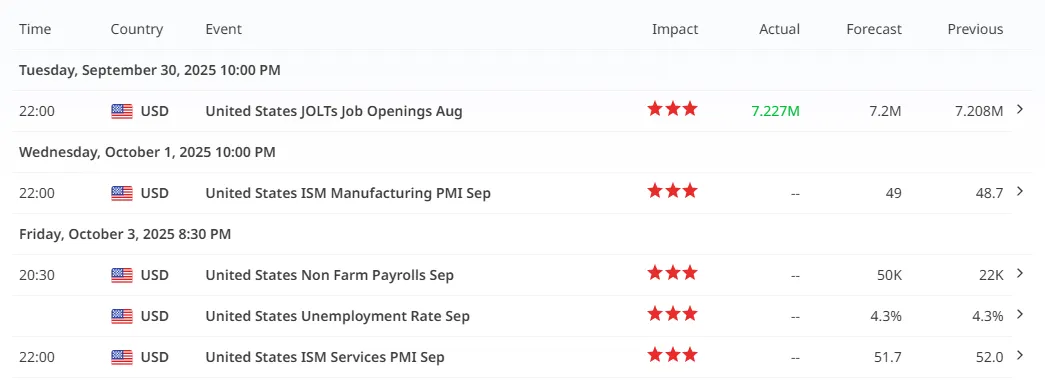
The labor market has already shown signs of strain:
- August payrolls: just +22K jobs.
- Unemployment: ticked up to 4.3%.
- JOLTS Job Openings (Aug): 7.227M, marginally above forecast but still near multi-year lows.
This Friday’s Nonfarm Payrolls (Sep) is now the most important test. The forecast is +50K, but given recent softness, risks tilt lower. Alongside it, the unemployment rate (expected 4.3%) and ISM Services PMI will further shape Fed expectations.
If the data undershoots, it confirms a weakening labor market just as political dysfunction erodes confidence. On the other hand, a strong surprise could ease some fears - but risks reigniting Fed caution on inflation.
Fed’s delicate balancing act
Fed officials remain cautious: Vice Chair Jefferson acknowledged labor “stress,” but the central bank is reluctant to signal aggressive easing while inflation remains above target.
The dilemma is clear:
- Weaker jobs data + shutdown → stronger case for cuts, but also greater growth anxiety.
- Stronger jobs data → less urgency to cut, but markets may see this as hawkish.
Either outcome reinforces volatility risks into Friday.
Price action narratives
Nasdaq-100 (NAS100)
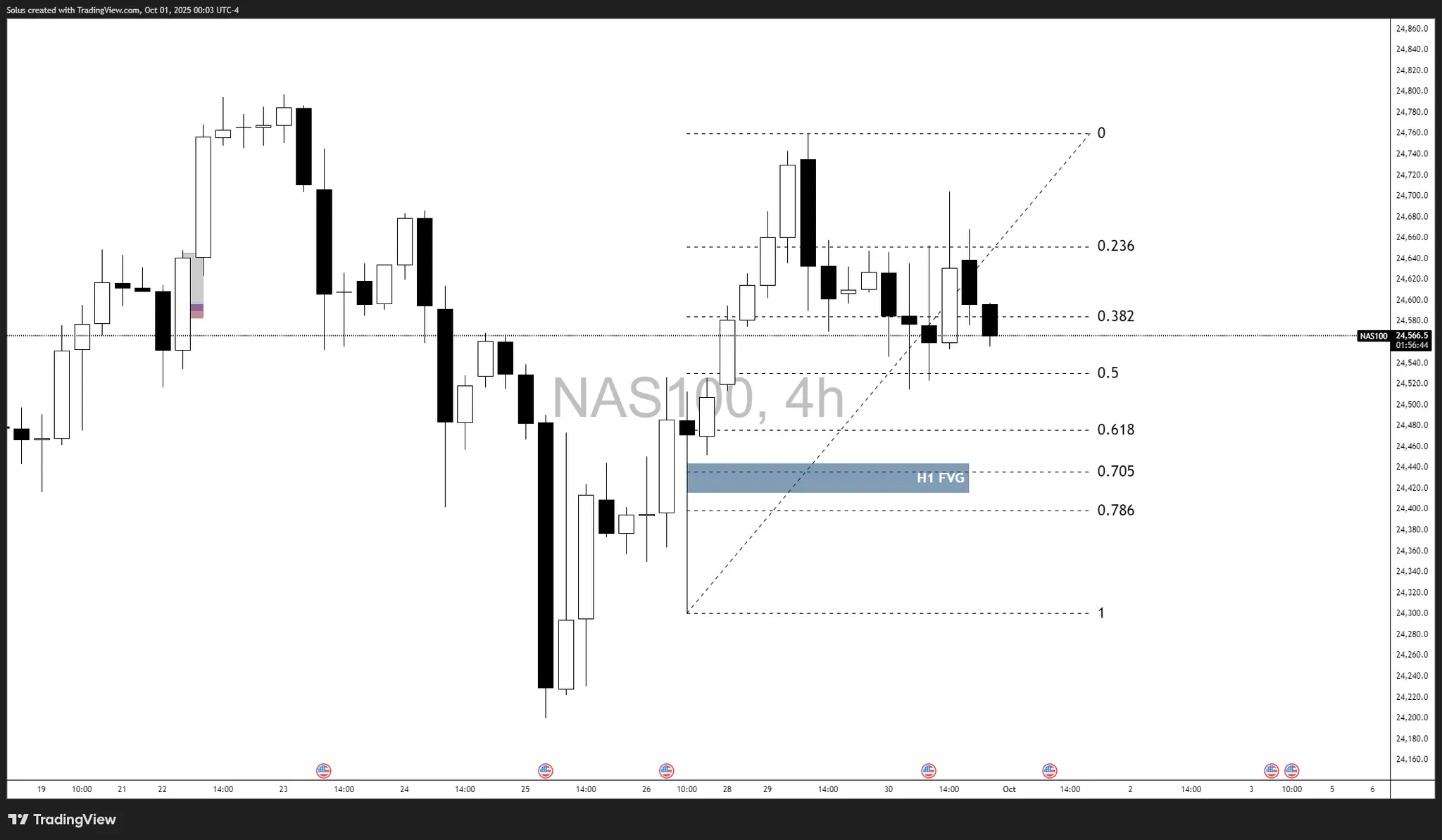
Currently trading near 24,580, the Nasdaq is holding the 0.382 Fibonacci retracement. A visible H1 FVG sits lower at 24,420–24,460. Momentum is capped below 24,700.
- Bullish: Break above 24,700 reopens the path to 24,860.
- Bearish: Slip below 24,500 could target the FVG and 0.618 retracement near 24,480.
S&P 500 (US500)
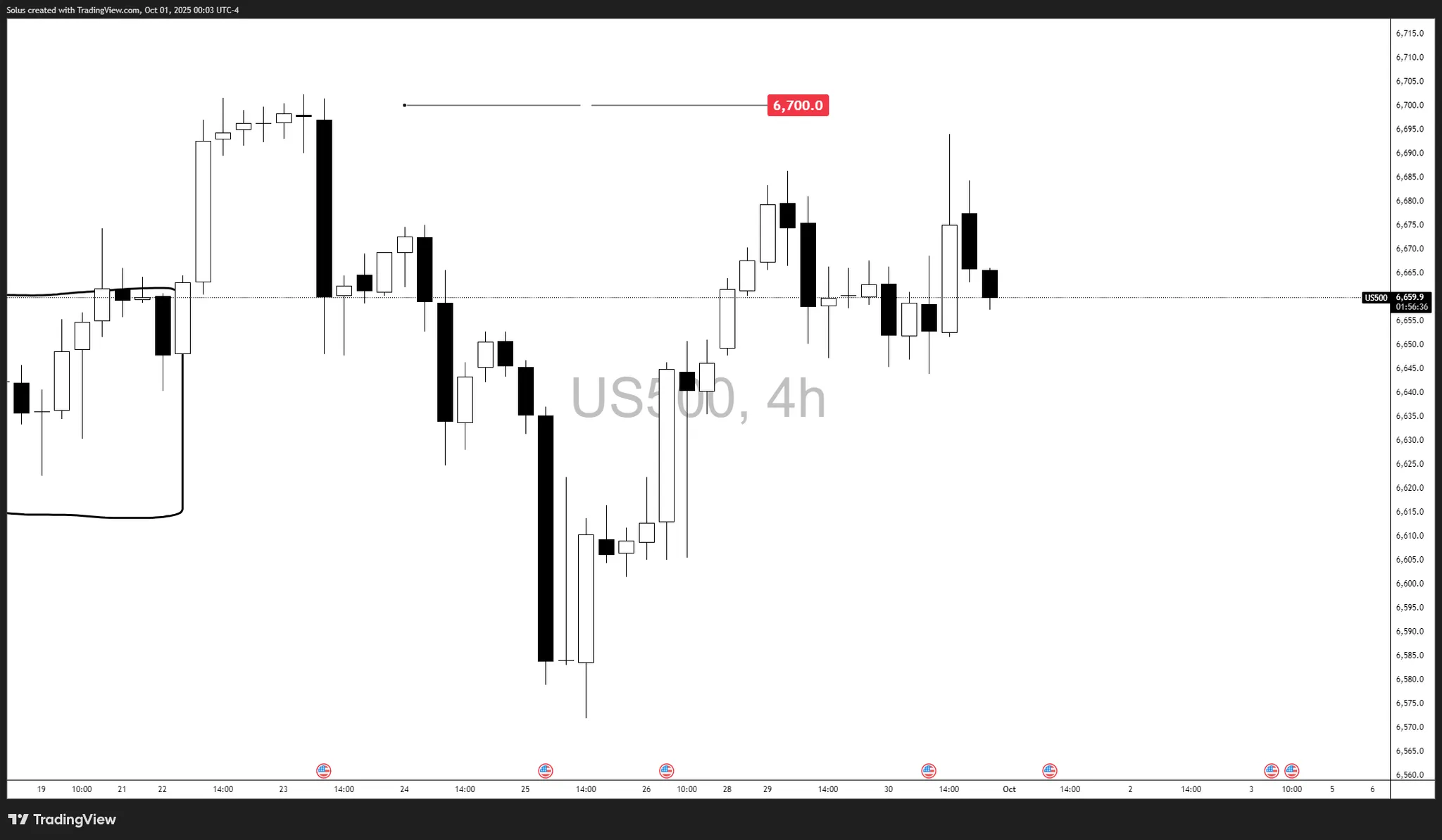
Trading around 6,660, the index has been rejected multiple times near 6,690–6,700. Short-term support rests at 6,640.
- Bullish: Breakout above 6,700 could spark a move to 6,715.
- Bearish: Break below 6,640 exposes 6,600 as the next downside pivot.
Dow Jones (US30)
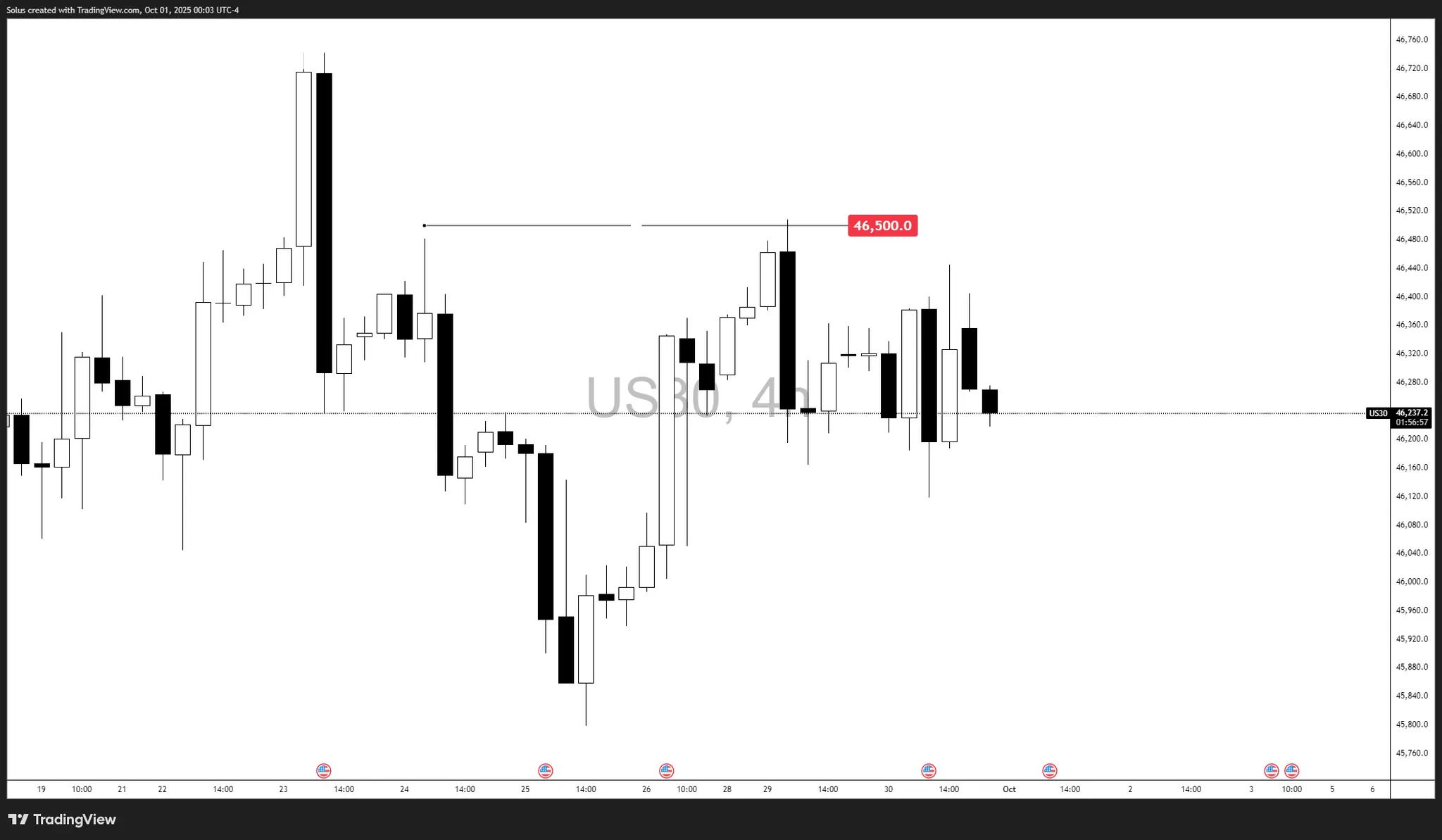
The Dow trades at 46,280, trapped between resistance at 46,500 and support at 46,200. Price structure shows indecision.
- Bullish: A breakout above 46,500 could lift toward 46,700.
- Bearish: A drop below 46,200 risks a slide to 45,960.
Final thoughts
U.S. indices are caught in the crossfire of shutdown risk and critical jobs data. With Friday’s NFP and unemployment rate set to dictate the Fed’s next moves, any disruption from a prolonged shutdown could worsen volatility. Until clarity emerges, markets are likely to remain rangebound - but support cracks or upside breakouts could accelerate sharply once the labor numbers hit.
Author

Jasper Osita
Independent Analyst
Jasper has been in the markets since 2019 trading currencies, indices and commodities like Gold. His approach in the market is heavily accompanied by technical analysis, trading Smart Money Concepts (SMC) with fundamentals in mind.