US economy is losing momentum. A recession around the corner?
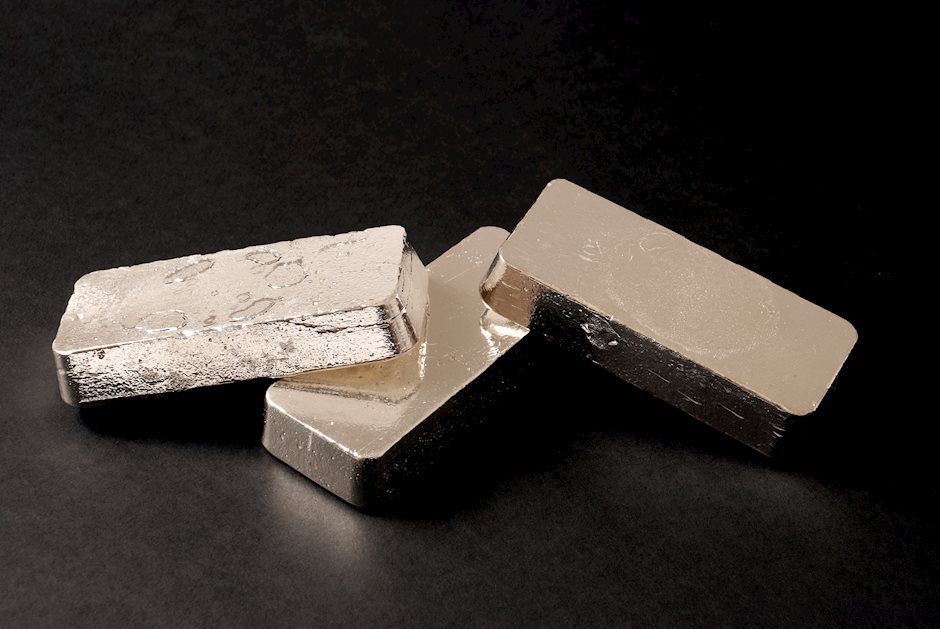

Retail sales and industrial production fell more than expected. With a recession on the horizon, silver may fly if the Fed stops the hikes!
It is closer and closer… wrapping itself slowly but decisively around the economy like an anaconda around its prey. I mean a recession, of course. The recent bunch of economic data leaves no doubt that the U.S. economy is losing momentum.
Retail sales fell 1.1% in December, following a downwardly revised drop of 1% in November. The decline was larger than expected, and it was the biggest decrease in 12 months. The fall is really disturbing as we are talking about the holiday shopping period. However, the sales were reduced in part because of the decline in prices.
Industrial production also surprised negatively, falling 0.7% in December. It followed a 0.6% decrease in November and was larger than expected. The decline was driven mainly by manufacturing output which fell 1.3% in December and moved down 2.5% at an annual rate in the fourth quarter. Higher interest rates and reduced purchasing power by inflation hurt demand for goods.
The latest edition of the Beige Book also doesn’t inspire optimism. According to the report, five of the Fed’s districts reported slight or modest increases in overall economic activity over the last several weeks, while six noted no change or slight declines from the previous reporting period, and one cited a significant decline.
Will Softer Data Prompt a More Dovish Fed?
The disinflationary pressure and widespread signs of weakening demand could encourage the Fed to further decelerate the pace of its interest rate hikes. This is what Patrick Harker, Philadelphia Fed President, suggested this week, saying that “he‘s ready for the U.S. central bank to move to a slower pace of interest rate rises amid some signs that hot inflation is cooling off”. Dallas Fed President Lorie Logan expressed a similar view in her first major policy speech at the new post:
If you’re on a road trip and you encounter foggy weather or a dangerous highway, it’s a good idea to slow down. Likewise if you’re a policymaker in today’s complex economic and financial environment That’s why I supported the (Fed’s) decision last month to reduce the pace of rate increases. And the same considerations suggest slowing the pace further at the upcoming meeting
Futures traders also bet on such a scenario, as they see a more than 95% chance of a 25 basis point hike in two weeks, according to the CME FedWatch Tool. The slowdown in hikes would be fundamentally positive for silver prices.
Implications for Silver
What does it all mean for the silver (and gold) outlook for 2023? Well, the falling inflation rate and weakening economic momentum imply that the Fed may become less aggressive in raising interest rates. Any signs of a more dovish monetary policy should be positive for silver and support the upward trend that started in November 2022 (see the chart below, courtesy of silverpriceforecast.com). What’s more, as the U.S. economy is losing momentum, recession worries should intensify, which could also strengthen the safe-haven demand for the precious metals.
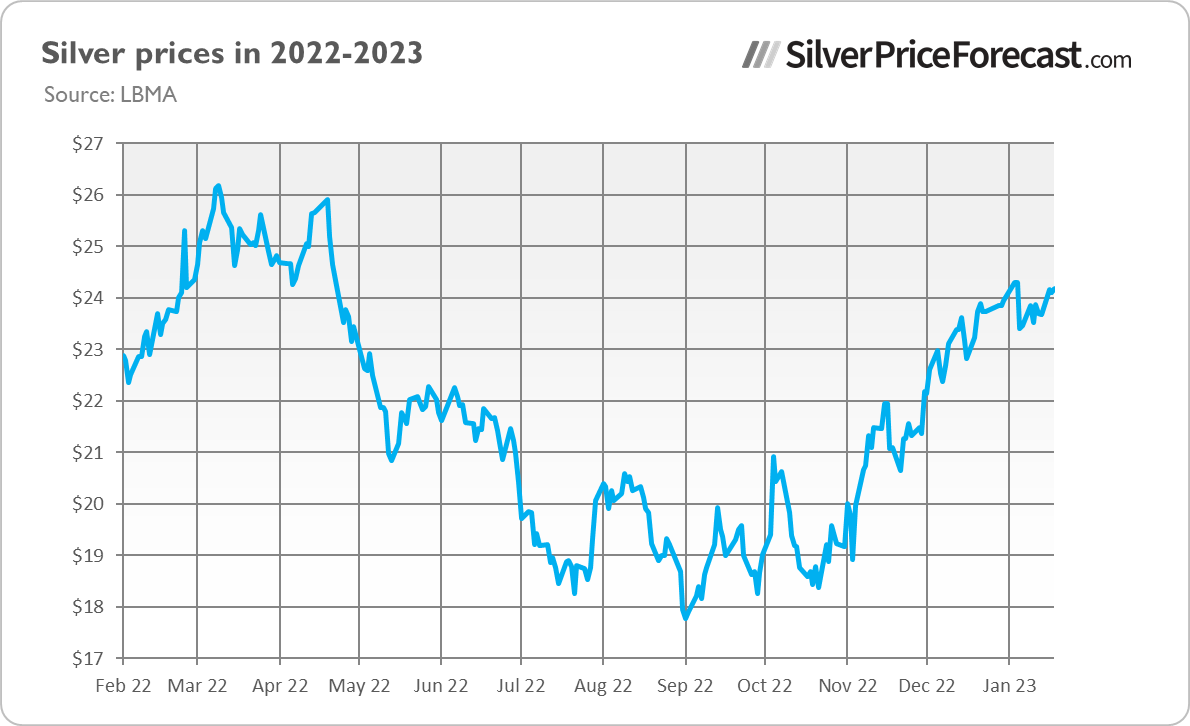
Counterintuitively, the price of silver declined yesterday. But it could have been a normal correction (please remember that silver is partially an industrial metal) or a reaction to some hawkish comments of the Fed’s Bullard and Mester about the need to move the federal funds rate above 5%. But these two hawks are not the voting members this year. Thus, don’t pay attention to the market noise, but focus on the fundamental trends. And they are clear: the economy is slowing down, which will prompt the Fed to decelerate and later to even stop the rate hikes.
Want free follow-ups to the above article and details not available to 99%+ investors? Sign up to our free newsletter today!
Author
Arkadiusz Sieroń
Sunshine Profits
Arkadiusz Sieroń received his Ph.D. in economics in 2016 (his doctoral thesis was about Cantillon effects), and has been an assistant professor at the Institute of Economic Sciences at the University of Wrocław since 2017.