US Dollar Weekly Forecast: A complex backdrop keeps the US Dollar on edge
- The US Dollar plummets to six-week lows amid US-Iran tensions.
- The Fed delivered another hawkish hold on Wednesday.
- Markets should shift their attention to the US docket next week.

The week that was
The US Dollar (USD) has traded mostly lower throughout the week, briefly testing six-week lows despite prevailing risk aversion, which has been driven by unabated geopolitical tensions in the Middle East.
That said, the US Dollar Index (DXY) dipped to the 99.90 zone for the first time since mid-June, just to recover some ground afterward toward the end of the North American session.
This week’s price action has mainly reflected renewed tensions between the US and Iran and their impact on the Strait of Hormuz. In addition, news that the Japanese Ministry of Finance (MoF) has intervened in the FX markets to support the Yen has also contributed to the sharp retracement in the buck. The latter makes sense following the hawkish message from the Federal Reserve (Fed) at its event on Wednesday.
Looking at the US money market, US Treasury yields bounced sharply on Friday, with the 30-year yield hitting tops not seen since June 2007 and the 10-year tenor advancing to 18-month peaks.
Hawkish dissent opens the door to tightening
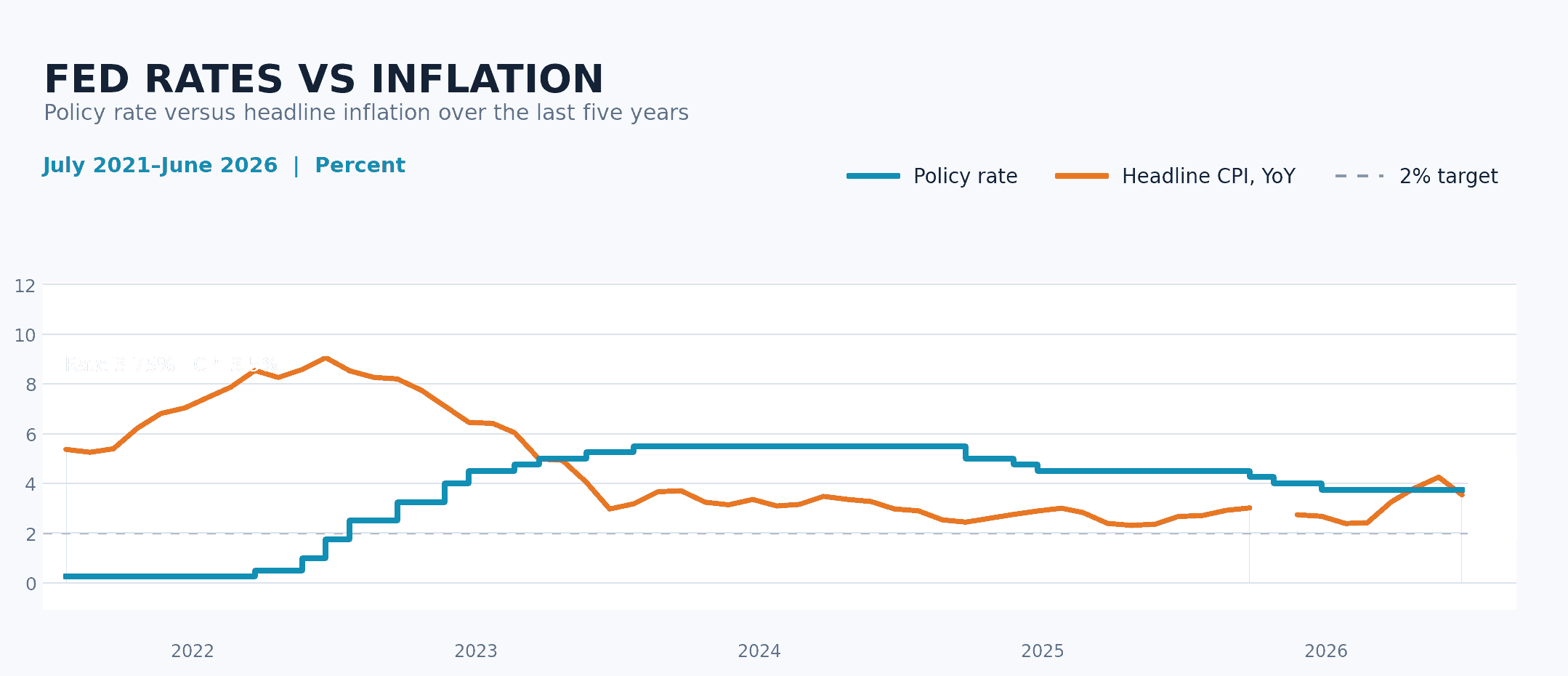
The Fed held interest rates at 3.50%–3.75%, but the decision carried a hawkish tone as three officials voted for an immediate 25-basis-point increase. Policymakers said economic activity remained solid, supported by a stable labour market, strong productivity and capital investment, while inflation continued to run above target.
The 9–3 vote revealed a growing appetite for tighter policy, although Chair Kevin Warsh played down the divisions and described the debate as robust. He stressed that the Committee remained broadly united on the challenge posed by persistent inflation.
Warsh was unequivocal about the Fed’s commitment to price stability, rejecting any suggestion that policymakers might tolerate inflation above 2%. However, he avoided setting out a predetermined policy path, saying future decisions would depend on inflation trends, the spread of supply shocks and signals from financial markets.
Overall, the meeting was hawkish. Rates were left unchanged, but the dissents, persistent inflation concerns and Warsh’s readiness to act left the door open to further tightening.
Bullish momentum returns, investors rebuild long exposure
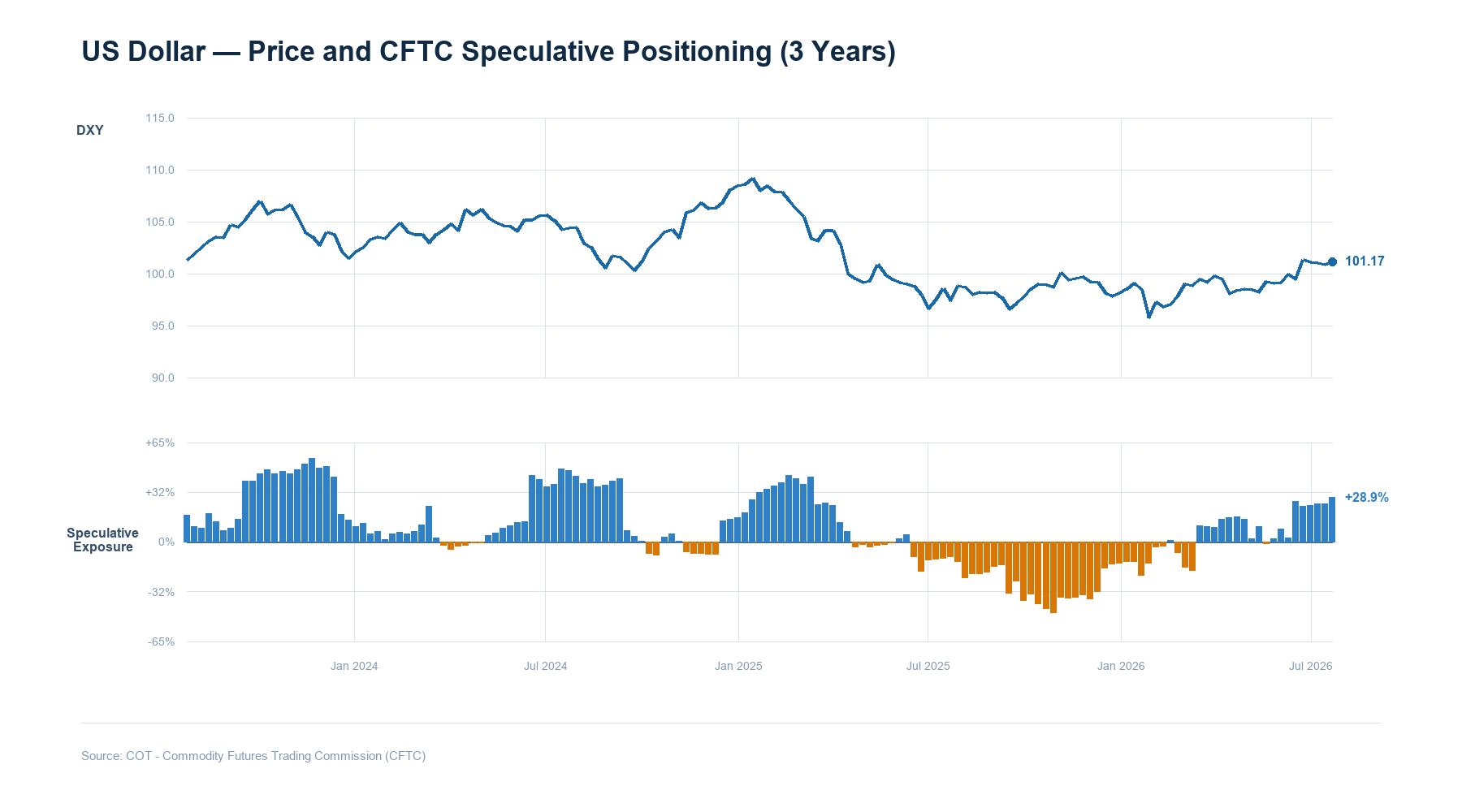
Speculative positioning on the US Dollar gathered further strength in the week to July 21, with data from the Commodity Futures Trading Commission (CFTC) showing net long positions rising to 15.6K contracts from 13.2K in the prior week. The weekly rise of 2.4K contracts was a stark reversal of the largely unchanged positioning seen in the week before and points to investors having resumed adding to bullish Dollar exposure.
Open interest increased modestly to 54.0K contracts and speculative exposure rose to close to 29%, but the improvement was also accompanied by a slight increase in market participation. The mix of higher open interest and larger net longs suggests fresh buying interest, not just short covering, was behind the latest shift in positioning.
The broader trend has also turned constructive again. Indeed, the 4-week change moved back into positive territory at +2.7K contracts, reversing the marginally negative reading recorded a week earlier. Despite the renewed buying, positioning remains far from stretched as the Net Position Percentile edged up to 59, while the Speculative Exposure Percentile stands at 47.1, both remaining close to the middle of their respective five-year ranges and indicating that speculators still have ample room to increase their exposure on the Greenback.
Overall, the latest CFTC report suggests that the consolidation phase that has characterised recent weeks may be giving way to a renewed rebuilding of bullish Dollar positions. While current positioning is constructive rather than crowded, the return of positive weekly flows and improving 4-week momentum provides a supportive backdrop for the buck. As long as US economic data remain resilient and expectations for Fed policy continue to favour a higher-for-longer stance, speculative positioning appears to have scope to strengthen further.
Sticky inflation, softer jobs: A mixed picture for the Dollar
The US Dollar has been caught in a tug-of-war between a host of economic signals.
On the one hand, inflation remains stubborn. Headline CPI cooled a tad to 3.5% in the year to June from 4.2%, while core inflation edged down to 2.6% from 2.9%. The latest Personal Consumption Expenditures (PCE) report reinforced that picture, showing some loss of momentum although keeping alive persistent underlying price pressures, giving the Fed another reason to keep policy restrictive for longer.
On the other hand, the Greenback has struggled following a disappointing June Nonfarm Payrolls (NFP) report. The US economy added just 57K jobs in June, while May’s print was revised down to 129K from 172K. The Unemployment Rate eased to 4.2% from 4.3%, although the decline appears to have been partly driven by fewer people participating in the labour force.
Even with signs that the labour market is losing momentum, Fed Chair Kevin Warsh has shown little desire to shift the focus away from inflation. That has left investors wondering whether the recent weakness in employment will be enough to change the central bank’s policy stance.
The wider market mood also remains cautious. Investors are trying to make sense of the uncertain outlook for the Middle East and the White House’s still-unsettled approach to resolving the conflict with Iran. Meanwhile, attention is shifting toward next Tuesday’s US CPI report, which could provide the next major catalyst for the US Dollar and shape expectations for the Fed’s next steps.
What’s next?
Next week, the US docket will be exclusively dominated by labour market releases, with the salient event on Friday being the publication of the July NFP. In addition, the ISM gauges will gather attention alongside comments from Fed officials following this week’s hawkish hold.
Sticky inflation keeps the Dollar supported
Recent months have highlighted a familiar challenge: bringing inflation down from its peak is one thing, but getting it all the way back to target is far more difficult.
That final stretch of the disinflation process could become an important source of support for the US Dollar in the months ahead. Markets may have been too optimistic about how quickly the remaining price pressures would fade.
As long as underlying inflation stays persistent, expectations that interest rates will remain higher for longer should continue to provide a firm footing for the Greenback.
Author

Pablo Piovano
FXStreet
Born and bred in Argentina, Pablo has been carrying on with his passion for FX markets and trading since his first college years.