US Dollar Weak Ahead of US Jobs Report

Inflation data in Europe and US to guide Market
The USD fell on Thursday despite a strong private jobs report released in the morning. The ADP showed that 250,000 jobs were added in December beating a forecast of 190,000 positions. Bears continue to pressure the greenback as the U.S. Federal Reserve is losing its status as the lone central bank tightening monetary policy. The EUR is near three year highs as economic growth has put the European Central Bank (ECB) in a position to start removing stimulus on its way to higher rates. Rising political risk in the US has led the growth and monetary policy stories from having less impact ahead of this year’s primaries.
- NFP expected to have gained 190,000 jobs in December
- Canadian Jobs to show slight gain after massive November gain
- European flash inflation could cool euro pace
The U.S. non farm payrolls (NFP) will be released by the Bureau of Labor Statistics on Friday, January 5 at 8:30 am EST. The forecast calls for more than 190,000 jobs to have been added in December but more importantly the average hourly wages to have gained 0.3 percent. The Fed is torn between members who want to wait for more signs of inflation before committing to higher rate hikes and those who want to hike sooner rather than later.
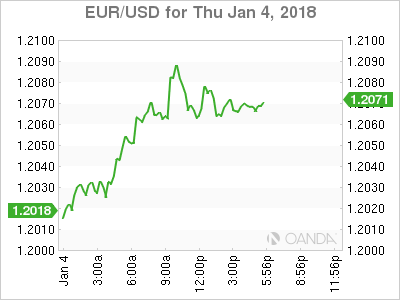
The EUR/USD rose 0.46 percent on Thursday. The single pair is trading at 1.2070 after the release of various Service PMI reports published in the morning. The sense that European indicators continue to improve was enough to keep the USD from gaining after a strong ADP report. This is something that could play out again tomorrow when the inflation estimates for Europe are leased on Friday, January 5 at 5:00 am EST. Inflation has not recovered evenly in the EU, with Germany at a five year high, but countries such as Italy still stuck in negative price pressures. The European Central Bank (ECB) has signalled that is ready to start tapering its QE program, but it awaits more clarity on inflation. A strong preliminary inflation report could end up hurting the dollar, even if the NFP report beats expectations.
The U.S. Federal Reserve raised rates three times in 2017, but the path of monetary policy is unclear in 2018 as Fed Chair Janet Yellen is soon to step back with Jerome Powell taking her place at the head of the central bank. A US interest rate hike in January is unlikely with the CME FedWatch tool showing market participants expect the Fed to stand pat at 99.5 percent probability. The rhetoric from other central banks has moved closer to ending lower rates which has put pressure on the US dollar as investors seek better yields.
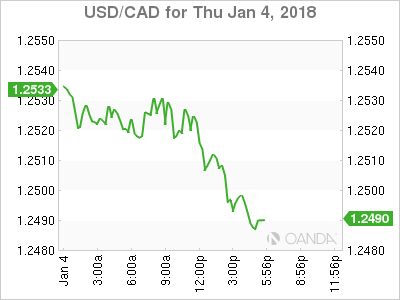
The USD/CAD has lost 0.73 percent during the week. The currency pair is trading at 1.2488 as once again the loonie has managed to trade under 1.25. The surge in the price of oil has supported the Canadian currency as the correlation has gotten stronger. The geopolitical risk driving the commodity and the NAFTA risk as the treaty is under review could turn negative for the CAD. Canadian employment data will be published on Friday. Canada is expected to have added 1,800 jobs in December a far cry form the close to 80,000 positions created in November. The unemployment rate is forecasted to rise to 6.0 percent.
Economic indicators improved in the first half of 2017, prompting the Bank of Canada (BoC) to raise rates twice to put the benchmark rate at 1.00 percent. This is the same rate from 2015 before the BoC cut pro actively to avoid the drop in oil prices. While the gap between Canadian and American interest rates is expected to grow in 2018 the BoC Governor Stephen Poloz will not make a proactive move like the two rate cuts in 2015. that monetary policy decision was the result of an anticipated drop in oil prices. With the price of West Texas Intermediate above $60 the BoC can afford to wait. Mr. Poloz has said that that current interest rates were still too low and would hike although he was in no rush to do so.
Next in the Canadian economic calendar will be the release of employment data on Friday, January 5 at 8:30 am EST. Statistics Canada reported a gain of 79,500 positions in November, and the forecast calls for a loss of 2,500 in December with an unemployment rate of 6 percent. US jobs data will also be released at the same time with the U.S. non farm payrolls (NFP) expected to show a gain of 190,000 positions. The wage component will be closely scrutinized for signs of inflation with an expected 0.3 percent in hourly earnings. The USD could start a rally if the NFP report shows a definite improvement in wage growth but if it misses it will continue to be a disappointing start for the greenback in 2018.
Market events to watch this week:
Friday, January 5
5:00am EUR CPI Flash Estimate y/y
8:30am CAD Employment Change
8:30amCAD Trade Balance
8:30am USD Average Hourly Earnings m/m
8:30am USD Non-Farm Employment Change
10:00am USD ISM Non-Manufacturing PMI
*All times EDT
Author

Alfonso Esparza
MarketPulse
Alfonso Esparza specializes in macro forex strategies for North American and major currency pairs.